Delta State Astro Summer Camp offers June science fun for kids
Delta State's Astro Summer Camp gives K5-6th graders hands-on space science, daily planetarium shows, and a nearby June option for families.
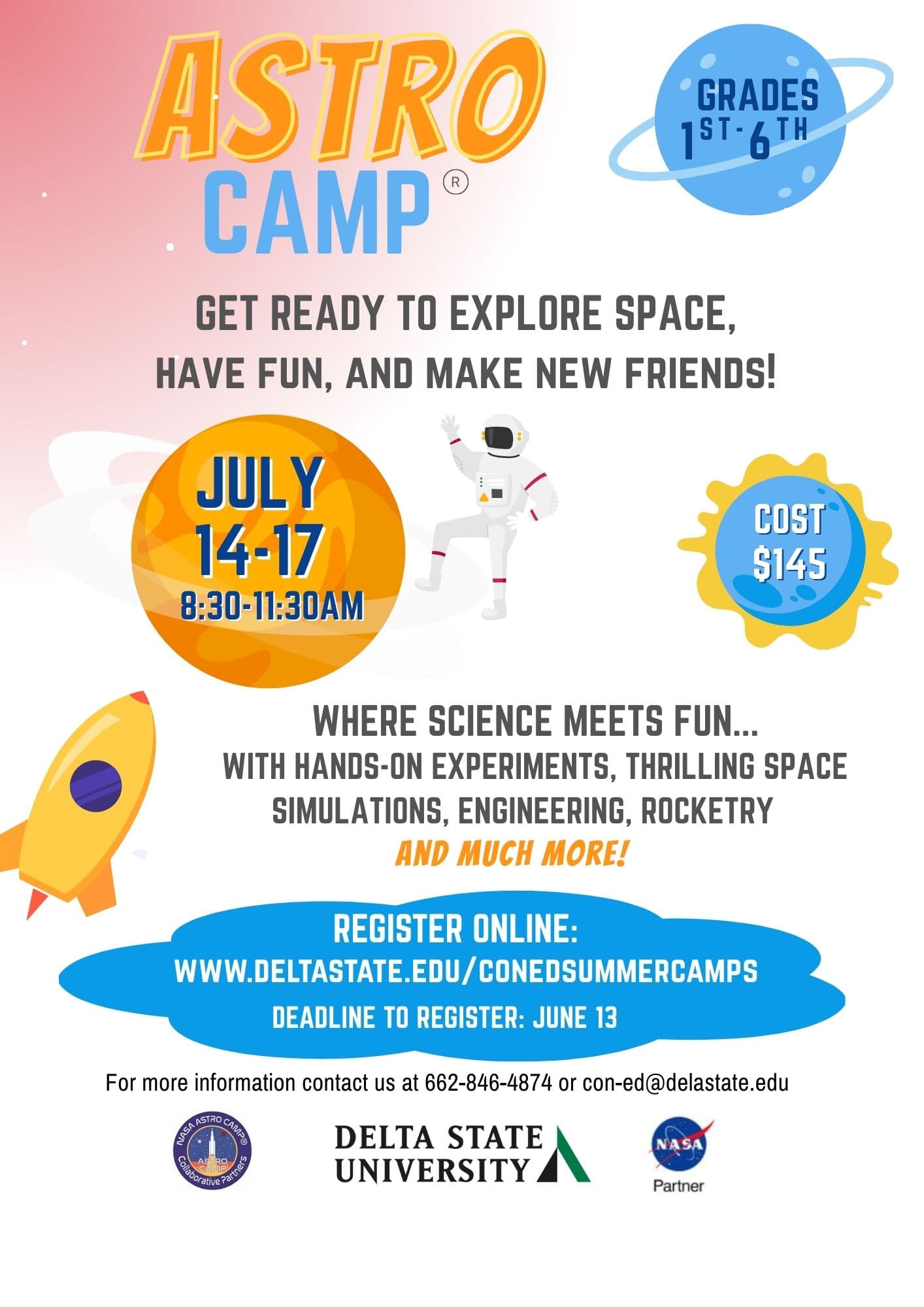
Delta State University is lining up a four-morning science experience that feels built for busy families as much as future astronauts. Astro Summer Camp runs June 22-25, 2026, from 8:30 a.m. to 11:30 a.m. for children in grades K5 through 6th, with a $150 fee that includes a T-shirt, all supplies, and a daily snack.
What campers will actually do
The camp is not just a place for children to sit and listen. Delta State says campers will take part in experimentation, simulations, engineering, and rocketry, giving them a chance to touch the kinds of activities that make science feel real instead of abstract. That matters for younger students, especially those who learn best by building, testing, and seeing an idea work in front of them.
Each day also includes a planetarium show led by Dr. Maria Weber inside Wiley Planetarium. The 2026 camp description says the curriculum covers heliophysics, Earth science, astrophysics, planetary science, and space telescopes, a lineup that gives children an early look at the language and ideas behind modern space science. For families trying to gauge educational value, that is the real draw: children are not only entertained, they are being introduced to a broad set of STEM fields in a setting designed for their age group.
Delta State says campers are divided by age or grade on the day of camp, depending on enrollment numbers once registration closes. That detail suggests the university is trying to keep group sizes manageable and the activities age-appropriate, which is especially important for elementary students who may be coming to campus for the first time.
Why a university camp matters locally
For parents, the practical appeal is easy to see. A June camp with a clear morning schedule can help fill the gap when school is out but work is not, and it offers children a structured place to spend time without leaving the area. In a community where summer childcare, enrichment, and safe activities can be hard to coordinate, a university-hosted camp gives families a nearby option with a built-in educational payoff.
The camp also serves a broader public mission. Delta State’s continuing education office uses programs like Astro Camp as a way to extend campus life beyond degree programs and into community service. That makes the camp more than a seasonal class; it becomes part of the university’s relationship with Cleveland and surrounding communities in Bolivar County.
There is also a social equity angle here that deserves attention. STEM exposure often depends on access, transportation, and family resources, and summer programs can widen the gap between children who keep learning through the break and those who do not. Delta State says the goal of Astro Camp is to give all students the chance to get involved in and experience science, technology, engineering and math, which is exactly the kind of early access that can help children imagine themselves in fields they may not otherwise encounter.
A planetarium with deep roots
Astro Camp is tied closely to Wiley Planetarium, one of Delta State’s signature science spaces. The planetarium opened in 1976 and marked 50 years in 2026, making it a long-running part of campus life. It also holds a special place in Mississippi as the only planetarium associated with a college or university campus in the state.
The planetarium reopened to the public in October 2016 after renovation with a Digistar 7 digital projector system. That upgrade matters because it gives local children access to a modern visualization tool that can make astronomy feel immediate and vivid. For a summer camp built around space science, the setting is as important as the curriculum.
Part of a much wider NASA network
Delta State’s Astro Camp is also part of NASA’s ASTRO CAMP Community Partners Program, which provides training and resources to universities, schools, museums, libraries, and youth organizations so they can bring NASA STEM activities to local communities. In fiscal year 2024, NASA said the program worked with 323 sites in 29 states and the District of Columbia, plus 50 sites in six countries.
That wider reach shows that Delta State’s camp is not an isolated activity. It sits inside a national and international outreach effort aimed at making space science more accessible where children already live and learn. For Cleveland families, that means the camp connects local kids to a much larger STEM ecosystem without asking them to travel far.
What families need to know about enrollment
The camp page says registration is not complete until payment is received, and families who want to pay by cash or check are given a phone number to arrange that process: 662-846-4874. That is a practical detail for parents who prefer not to rely on online-only payment systems, and it underscores that a spot is not truly secured until the fee is handled.
The 2026 fee is listed at $150, while a separate Delta State AstroCamp page listed a $145 fee for a four-day camp experience. Taken together, those listings suggest the price can shift from year to year, so families comparing options should look closely at the current camp information before planning around a set budget.
For Cleveland-area parents looking for a short, structured, educational summer option, Delta State’s Astro Summer Camp offers a rare combination: hands-on science, a trusted campus setting, and an introduction to the universe through one of Mississippi’s most distinctive planetarium programs.
This article was produced by Prism’s automated news system from verified source data, official records, and press releases, then run through automated quality and moderation checks before publishing. The system is built and supervised by the people who set the standards it runs under. Read our full AI policy.
Know something we missed? Have a correction or additional information?
Submit a Tip