Mound Bayou’s founding marked a milestone in Black self-determination
Mound Bayou began as a Black-led experiment in freedom, and its schools, hospital, and civic life still shape how the Delta tells its own story.
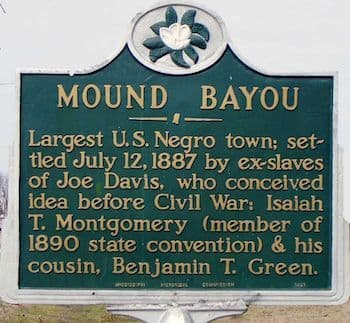
Mound Bayou was built as an answer to exclusion. Founded in 1887 by Isaiah T. Montgomery and Benjamin T. Green, the town grew in Bolivar County along the Louisville, New Orleans, and Texas Railroad route, where Black residents were determined to create a community of their own in the harsh world of the Mississippi Delta. Its story reaches far beyond symbolism: Mound Bayou became one of the most successful all-Black communities in American history, a place where people built institutions because they had to.
A town rooted in self-determination
The town’s name points back to the land itself, referring to nearby ancient Indigenous earthworks and the Chickasaw burial mounds that marked the area long before the railroad arrived. That detail matters because Mound Bayou did not appear in a vacuum. It rose in a post-Civil War South defined by segregation, racial violence, and exclusion, and it did so in a region where even basic opportunity was shaped by who had power and who did not.
The railroad helped make the town possible, but Black settlers gave it meaning. Early residents came in part because the railroad needed towns to create a customer base, yet the people who arrived were building more than a stop on a line. They were building a civic identity, a public life, and a proof of concept for Black self-reliance in the Delta.
Building institutions when systems shut Black people out
Mound Bayou quickly became a center of Black business, education, health care, and agriculture. Residents established schools, churches, newspapers, banks, and medical facilities, and they also created a post office, cotton gins, sawmills, and general stores that were Black-owned and operated. In a region where many public systems excluded Black residents, the town’s institutions filled the gap and gave people access to work, learning, and care.
That history is why Mound Bayou cannot be reduced to a symbol. It functioned as a working community with real infrastructure, real governance, and real economic life. Historical scholarship has described it as at one time the nation’s largest and most self-sufficient African American town, and the Mississippi Delta setting only underscores the achievement. This was not an easy place to build, yet the town’s founders and residents made it work.
Education and health care became pillars of the town
Education was central from the beginning. The Mound Bayou Normal and Industrial Institute was founded in 1892, and the first students met at Green Grove Baptist Church before the school developed further and became known as T. R. M. Howard High School. That early arrangement tells a larger story about the town: people used the institutions they already had to create the ones they needed.
Health care became just as important. Taborian Hospital opened on February 1, 1942, with 42 beds and expanded to 76 beds within four years. By 1946, it was conducting more than 1,200 operations a year. Staffed by Black physicians and nurses, the hospital served as a major health resource for Black patients across the Delta at a time when access to care was deeply unequal. In public health terms, the hospital was not only a local landmark. It was a community response to structural neglect.
National figures saw Mound Bayou as a model
Mound Bayou drew the attention of major figures in Black education and national politics. Booker T. Washington saw it as both a “school” and an inspiration, while President Theodore Roosevelt called it an “object lesson full of hope for the colored people.” Those responses reveal how the town was understood beyond its borders: as evidence that Black communities could govern, organize, and sustain themselves when given the chance.
Isaiah T. Montgomery’s own political role was complicated by the era he lived in. Born enslaved on May 21, 1847, at Hurricane Plantation on Davis Bend near Vicksburg, he later became known as a conservative accommodationist in the Jim Crow South, delivered a conciliatory speech to the 1890 Mississippi Constitutional Convention, and served as mayor of Mound Bayou. The town itself remained a reliable Republican stronghold in a Democratic South, another sign that local politics here often followed a different script from the state around it.
The civil rights era deepened the town’s legacy
Mound Bayou’s importance did not end with its founding generation. In 1951, Dr. T.R.M. Howard founded the Regional Council of Negro Leadership in Mound Bayou, helping turn the town into a base for Black entrepreneurship and voter registration. Howard also became a key figure in organizing protection for Mamie Till-Mobley and NAACP members connected to the Emmett Till case, tying the town to one of the most painful and consequential chapters in American civil rights history.
That connection shows why Mound Bayou still matters to readers across the Delta. The town was not only a place where Black life endured under pressure. It was also a place where Black civic power was organized, sharpened, and carried into broader struggles for justice. Its local institutions fed a regional movement.
Why the history still matters now
For Cleveland County readers, Mound Bayou’s story is not remote history. It speaks directly to present-day questions about preservation, investment, and who gets to define a community’s future. In a region where many Black towns and neighborhoods have been underfunded or overlooked, Mound Bayou stands as evidence that civic identity is built, not inherited. It is a reminder that institutions matter, and that communities survive when they can shape their own schools, health care, business life, and public memory.
That legacy is visible in preservation efforts too. The Mound Bayou Historic District is listed in the National Register of Historic Places, and the Isaiah Thornton Montgomery House is recognized as a National Historic Landmark. The town is still known locally as “The Jewel of the Delta,” a name that reflects both pride and responsibility: pride in what was built, and responsibility to protect it.
Mound Bayou’s place in Mississippi memory also includes figures like Fannie Lou Hamer, who died there on March 14, 1977. Taken together, these histories make the town more than a landmark. They make it a living record of Black self-determination, one whose lessons still shape how the Delta understands leadership, survival, and the struggle to leave something lasting behind.
This article was produced by Prism’s automated news system from verified source data, official records, and press releases, then run through automated quality and moderation checks before publishing. The system is built and supervised by the people who set the standards it runs under. Read our full AI policy.
Know something we missed? Have a correction or additional information?
Submit a Tip