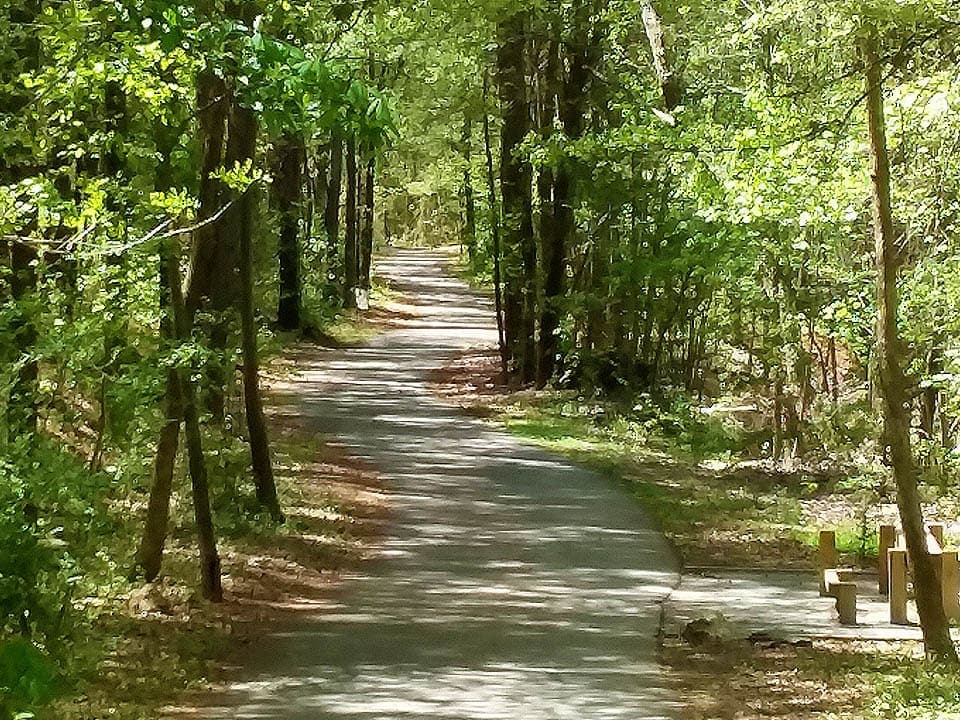
Shelby walk ties Cleveland County history, music and downtown charm
One walk through Shelby links the old courthouse square, Earl Scruggs, Don Gibson and City Park, showing how Cleveland County tells its story downtown.
Shelby gives Cleveland County its clearest story in a single, walkable loop. In one afternoon, the courthouse square, the music landmarks and the preserved downtown blocks show how the county seat became the county’s public identity, not just its administrative center. The route also works because the city’s core still holds together as a civic landscape, with history, performance and everyday public space only a few blocks apart.
Courthouse square at the center
Start in Uptown Shelby, where the Central Business District is a nationally registered historic district and the courthouse square still anchors the community. Cleveland County was formed in 1841 and named for Revolutionary War hero Benjamin Cleveland, while Shelby was incorporated in 1843 and named for Colonel Isaac Shelby, the hero linked to nearby Kings Mountain. Those two names still shape the way the place reads today: the county and the city were built around Revolutionary War memory, then given physical form through county government and the streets that grew around it.
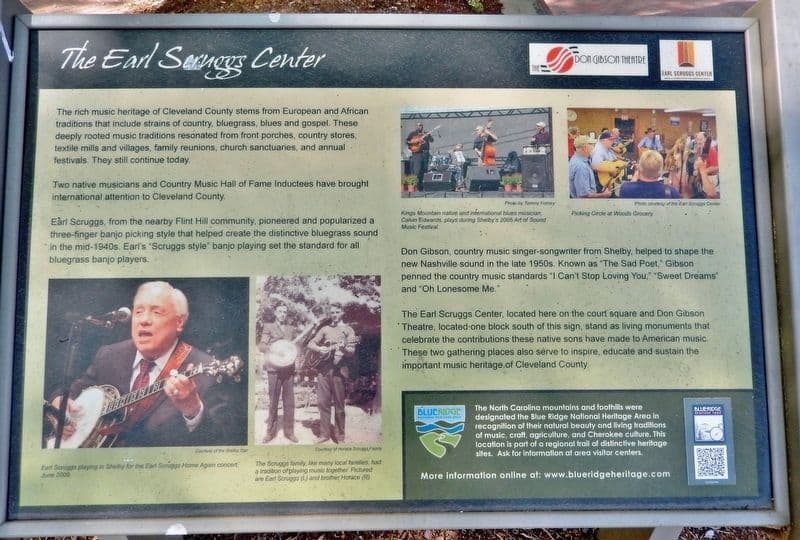
Shelby’s first permanent courthouse went up in 1845, serving the county until the 1907 courthouse took over. That later building is now The Earl Scruggs Center, and the transformation keeps the old civic core in use rather than frozen behind a fence. The center sits at 103 S. Lafayette St., with the guest services building and main entrance on the Washington Street side of the square, so the walk itself moves through the same space that once organized county business and now interprets a major piece of North Carolina music history. The courthouse renovation was large enough to merit a grand opening on January 10-11, a reminder that preservation here has been treated as a civic investment, not a decorative extra.
What the square reveals about Shelby
The square shows how Shelby grew as a county town serving the surrounding farm economy. County history connects its early development to government functions and to the needs of residents coming in from the broader foothills region. That matters in a county that now spans 469 square miles in the Blue Ridge foothills, because the downtown core remains the most concentrated place to understand how a rural county organized itself around law, trade and public life.
Several named landmarks around Shelby reinforce that pattern. Cleveland County’s historic places list includes the old courthouse, now The Earl Scruggs Center, along with the Bankers House, Double Shoals Cotton Mill, Joshua Beam House, Central School Historic District, East Marion Belvedere Park Historic District, King Street Overhead Bridge, Margrace Mill Village Historic District, Masonic Temple Building, Shelby High School, Shiloh Presbyterian Church Cemetery, Joseph Suttle House, Webbley and the West Warren Street Historic District. The list shows that the city’s identity is not built from one monument but from a preserved cluster of homes, schools, churches, bridges and mill sites that still mark different layers of local life.
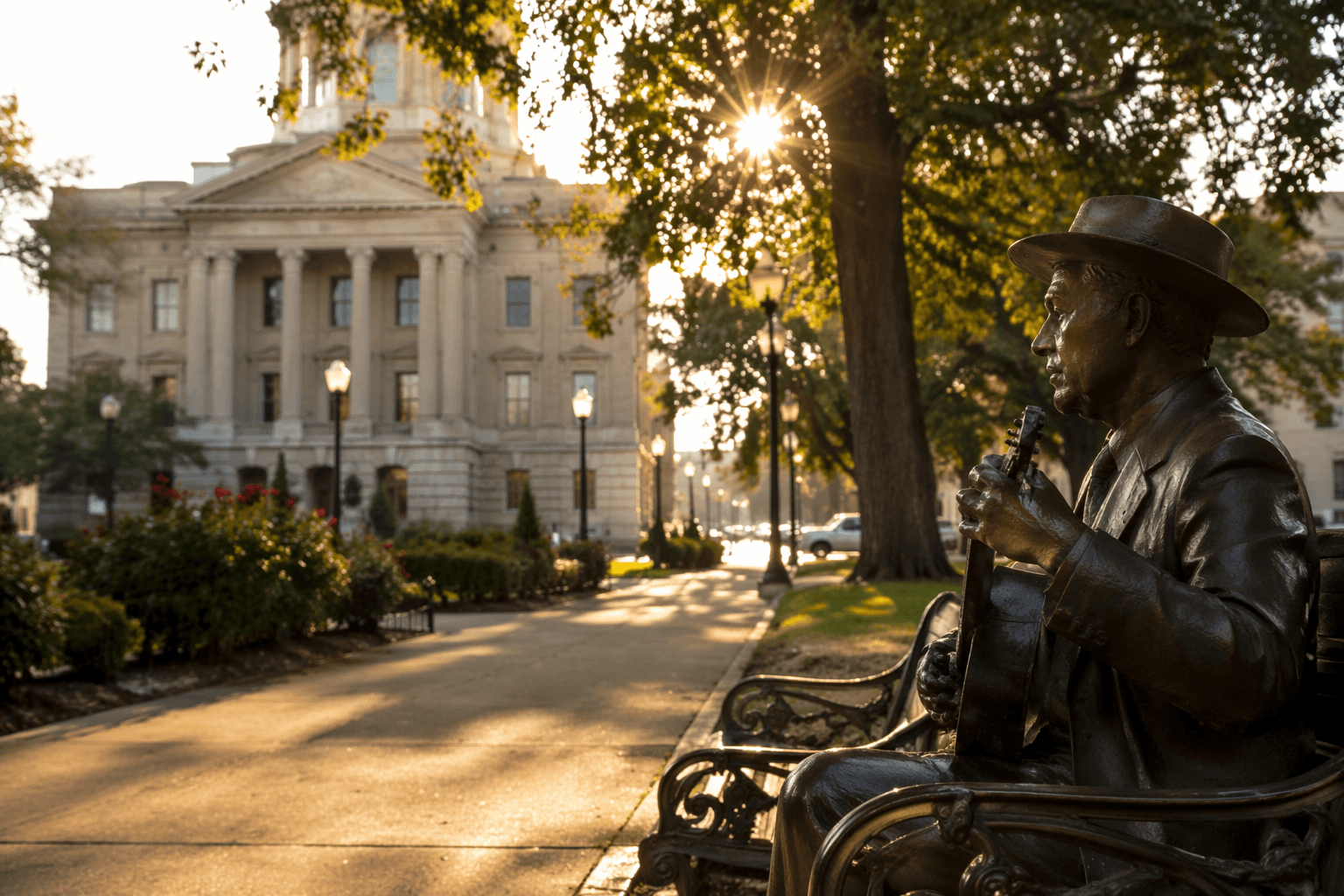
The Bankers House is a key stop if you want one building that carries both private and civic memory. It was built in 1874, when Shelby’s first bank was organized at Lafayette and Warren streets, and it later received protective covenants through Preservation North Carolina. Its National Register of Historic Places listing places it firmly in the protected downtown story, not apart from it. That kind of preservation work matters because it keeps the downtown walk readable for residents and visitors alike, while protecting the historic blocks that give the square its scale and character.
Music roots run through the middle of town
From the courthouse, the walk turns naturally toward music. The Earl Scruggs Center ties the restored courthouse to the life of Earl Scruggs, who was born in Flint Hill, North Carolina, on January 6, 1924. NCpedia notes that he was already playing local dances by his early teens before joining Bill Monroe’s Blue Grass Boys in 1945. The center uses that biography to show how a musician from a nearby Cleveland County community helped shape American bluegrass from the foothills outward.
Don Gibson adds another layer to the same downtown story. The North Carolina Music Office says Donald Eugene Gibson was born in Shelby on April 3, 1928, and made his first recordings in 1948 with Sons of the Soil. The Country Music Hall of Fame and Museum says he was inducted in 2001 and released more than eighty charted records between 1956 and 1980. The North Carolina Music Hall of Fame adds that *I Can’t Stop Loving You* became a standard recorded by more than 700 artists. Together, those facts make Shelby feel less like a place with scattered music claims and more like a true corridor of nationally significant country and bluegrass talent.
The Don Gibson Theatre helps carry that legacy forward as a 400-seat live-music venue a few blocks from the square. In practical terms, that means the music stop is not just archival. It is part of the present tense of downtown, where a visitor can move from museum interpretation to performance space without leaving the walkable core.
End the route in Shelby City Park
The final stop belongs at Shelby City Park, where the 1919 Herschell-Spillman Carrousel and the miniature train turn the itinerary toward families and everyday public enjoyment. The park’s carousel materials say the 40-foot, all-horse, three-row Spillman carousel was new to Shelby in 1952, then deteriorated before restoration began in 1985 with state and local matching funds. After restoration, the National Carousel Association returned in 1998, and the Anne Dover Bailey Pavilion was built to house the attraction.
That history matters because the park is not separate from the downtown story. Thompson Gardens, the carousel and the miniature train make the park another kind of public square, one where generations have gathered around a preserved amusement landscape instead of a courthouse. It rounds out the walk with green space and a reminder that Shelby’s public identity has always depended on shared places, not just buildings.
Why the walk works
Cleveland County’s own population figures help explain why this downtown core still matters. The U.S. Census Bureau counted 99,519 residents in Cleveland County and 21,918 in Shelby in the 2020 census. By the July 1, 2025 estimate, the county had grown to 103,325 and Shelby to 23,309. Growth has not erased the need for preservation; it has made the preserved center more useful, because new residents and weekend visitors can still find the county’s core story in a compact, walkable route.
The county also sits in a broader regional crossroads, with Shelby positioned between Charlotte, Greenville and Spartanburg, and Asheville. That location has long made it a gateway rather than an isolated courthouse town. In one afternoon, the square, the music sites, the historic blocks and the park show how Cleveland County’s public identity was built, and why Shelby remains the place where that identity is easiest to see on foot.
This article was produced by Prism’s automated news system from verified source data, official records, and press releases, then run through automated quality and moderation checks before publishing. The system is built and supervised by the people who set the standards it runs under. Read our full AI policy.
Know something we missed? Have a correction or additional information?
Submit a Tip