Coryell City traces Coryell County’s growth from creek settlement to decline
Coryell City began as Rainey’s Creek, grew on cotton and church life, and still survives in road signs, cemetery ground and county memory.
Coryell City sits on Farm Road 929 about 10 miles northeast of Gatesville, but the place matters for reasons that go far beyond its size. It began as Rainey’s Creek when Coryell County was organized in 1854, grew into a post office community, and then faded as county commerce shifted elsewhere. What remains today is a map name, a church history, a cemetery, family land and the kind of local memory that keeps a small place present long after its commercial center thins out.
From Rainey’s Creek to Coryell City
The first version of the community was tied directly to the county’s earliest settlement pattern. When Coryell County was created on February 4, 1854 and organized on March 4, 1854, the settlement was known as Rainey’s Creek, a creek-side neighborhood in the northeastern part of the county. A post office opened under that name in 1857, putting the place on the county’s official mail map and giving residents a local anchor in an era when post offices often defined the boundaries of rural life.
By 1860, nearly 70 families lived in the Rainey’s Creek vicinity, a sign that the settlement had moved beyond a scattering of cabins. In the early 1870s, the community adopted the name Coryell, tying it more closely to the county itself and to the larger identity built around James Coryell, the Texas Ranger for whom the county was named. That shift from creek name to county name is part of the story: the place did not appear suddenly, and it did not disappear overnight. It evolved as Coryell County evolved around it.
A small agricultural center in the 1880s
By the 1880s, Coryell had the basic institutions that marked a working rural community in Central Texas. It had a church, a district school, two steam cotton gins and about 200 residents shipping cotton, wool and grain. Those details matter because they show a settlement with a real local economy, not just a name on a map. Cotton gins meant nearby growers had a processing point; shipments of wool and grain show that the community was tied to more than one farm product.
That agricultural role also helps explain the place in county history. Coryell County’s early communities were built around creek access, farm land and the nearest point where people could gather, mail goods and send crops to market. Coryell City fit that pattern exactly. Its growth was gradual, not explosive, which is why it remained a durable named place even after its heyday passed.
Why decline followed growth
Coryell City reached its highest documented population in 1939, when 406 residents lived there. Only four years later, that number had fallen to 150. The sharp drop shows how vulnerable small farm communities were once the older mail-and-gin economy lost its central role and transportation patterns changed.
The post office closed in 1958, and mail was then routed through Gatesville and Valley Mills. That change was more than administrative. Once a town no longer handles its own mail, the daily routines that once revolved around it begin to fray. Residents still live there, land still belongs to local families, and the place still exists on the map, but its formal services have shifted outward to larger towns.
What still marks the place today
The strongest surviving markers are not commercial. They are the kinds of landmarks that carry memory across generations: road alignment, church ground, cemetery space and family land. Coryell City’s location on Farm Road 929 keeps it legible to anyone tracing the county from Gatesville to the northeast. The name itself still preserves the older settlement pattern, even though the post office and business center are gone.
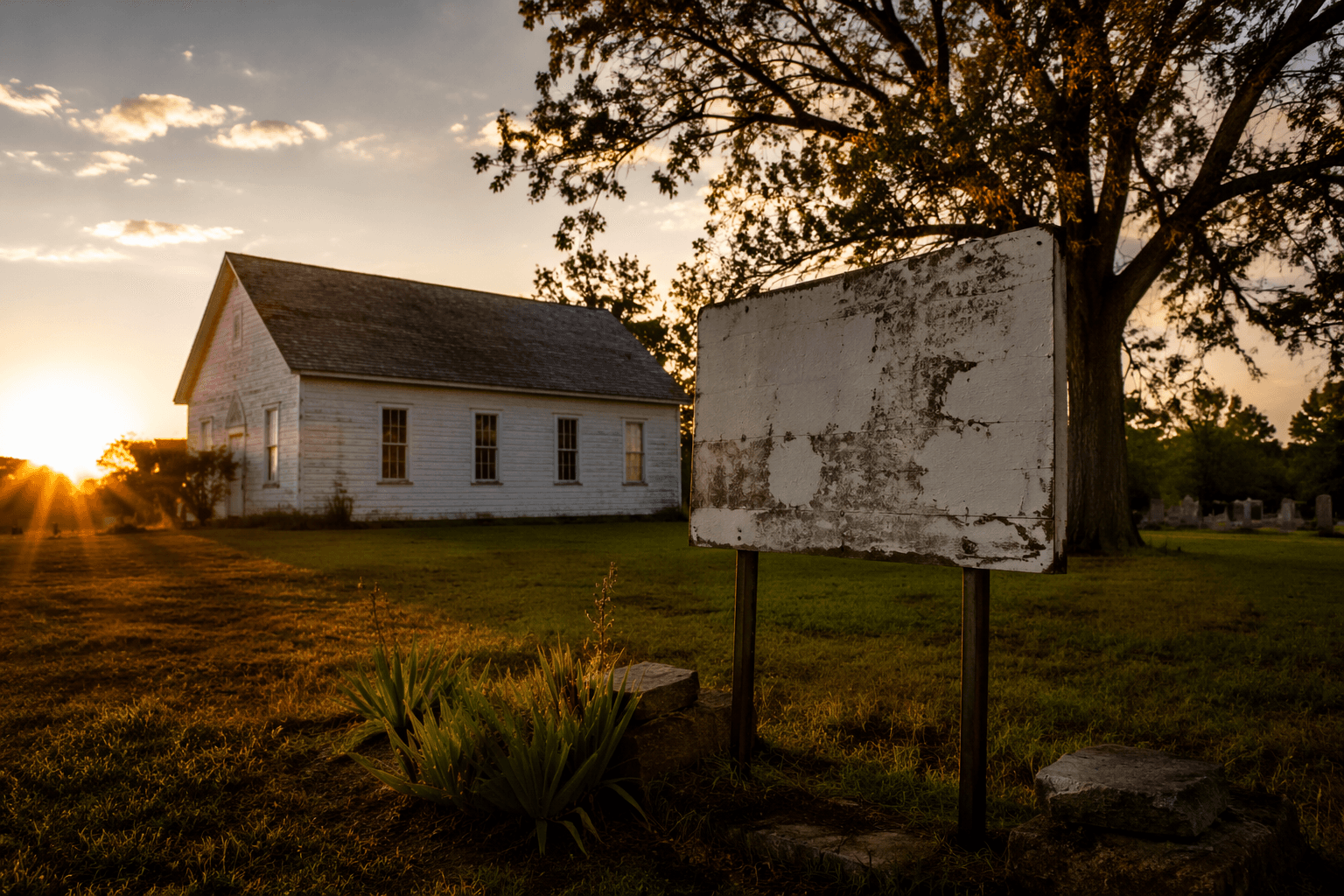
Coryell Church is part of that continuity. The church was founded in 1854, the same year the county was organized, and its 1888 building was completed on land donated by Green Franks and Henry Hall. That detail links the settlement to named families and to the land they set aside for worship, which is often how rural communities outlast their markets. The church school also gives a rare snapshot of daily life: in 1904, it had 61 students and one teacher.
The Coryell Baptist Church Cemetery adds another layer of permanence. A cemetery does not generate commerce, but it fixes a place in local geography and family history. Once a burial ground and church site are established, they keep drawing descendants, churchgoers and local historians back to the same ground, even after the surrounding settlement has thinned.
Coryell City in the broader county pattern
Coryell City makes more sense when read alongside the rest of Coryell County’s early growth. The county was named for James Coryell, a Texas Ranger killed near Fort Milam on May 27, 1837. Gatesville was established shortly after the county was organized in 1854, and the Waco-to-Gatesville section of the Texas and St. Louis Railway was completed in 1882, turning Gatesville into the county’s major shipping and supply center. As that center strengthened, smaller communities like Coryell City lost some of the commercial weight that had once sustained them.
Other rural settlements followed a similar path. Station Creek had a post office established in 1855, another sign that Coryell County’s earliest geography was built from a network of small post office and church communities rather than one dominant town. Coryell City endures because it captures that entire pattern in one place: creek settlement, post office, church, school, farm economy, population peak and decline.
The county’s history is still visible there, not in storefronts but in the land itself. Coryell City remains alive in the way old communities often do in rural Texas: through a road number, a cemetery, a church memory and a name that never left the map.
This article was produced by Prism’s automated news system from verified source data, official records, and press releases, then run through automated quality and moderation checks before publishing. The system is built and supervised by the people who set the standards it runs under. Read our full AI policy.
Did this article answer your question?