Fort Gates marks Coryell County’s first settlement and county seat beginnings
Fort Gates was Coryell County’s first settlement, brief county seat, and the root of Gatesville. Its marker off U.S. 84 still ties frontier defense to today’s county layout.
Fort Gates is where Coryell County’s story begins in plain view. The post anchored the Leon River frontier, gave Gatesville its name, and served briefly as the county seat before the government moved on and the town around it took shape.
A frontier post on the Leon River
Fort Gates opened on October 26, 1849, as a stockaded United States cantonment on the north bank of the Leon River above Coryell Creek, about five miles east of the site of present Gatesville. W. R. Montgomery established it on the military post road between Austin and Fort Graham with one purpose in mind: protecting the frontier against raids.
The fort took its name from Bvt. Maj. Collinson Reed Gates, a New York-born officer who earned distinction in the Mexican War. That naming choice still matters locally, because the fort name moved into the town name and then into the county’s civic memory. Coryell County’s beginnings are tied to the same place where soldiers, settlers, and supplies all crossed paths.
The garrison that made the post more than a marker
Fort Gates was not a small outpost in its busiest months. The 1850 census counted six officers and 94 enlisted men there, and in April 1851 the post reached its largest reported strength, with 256 enlisted men and 45 officers. The Eighth United States Infantry supplied companies D, I, F, and H, making the fort part of a broader military line meant to hold the frontier.

The roster at Fort Gates also connects Coryell County to a larger military history. Lt. George Bibb Pickett served there in 1850 and 1851, years before he became known for Pickett’s Charge at Gettysburg. Capt. Carlos Adolphus Waite commanded the post from March 10, 1851, through January 7, 1852, a command span that sits inside the fort’s short life but helps fix the post in the record rather than the legend.
Why Fort Gates became Coryell County’s first county seat
The post’s civilian role came quickly after county organization. Fort Gates served as Coryell County seat from February 4 to May 27, 1854, before the seat moved to Gatesville. That short span is one reason the site matters so much: it is the county’s first seat of government, not just its first military post.
Coryell County itself was created by the Texas Legislature in 1854 and was named for James Coryell, a Texas Ranger and early explorer. In practical terms, that means the county’s political identity formed around a frontier settlement pattern already underway along the Leon River. Fort, county, and town all grew out of the same settlement logic.
How Gatesville grew from the fort
Gatesville was established on land donated by Richard G. Grant shortly after the county was organized in 1854. The town took its name from nearby Fort Gates, which makes the old post the naming source for the county’s largest city. James C. Newton became the first postmaster when the post office opened in July 1854.
Life in the early town was difficult and remote. Supplies had to be hauled by wagon from Houston, about 200 miles away, and Gatesville remained fairly isolated in its early years. Even so, by 1880 the town had 434 residents and had become an important frontier supply station, a sign that the old military route had given way to a civilian trade route without losing its strategic value.
The transportation map still tells the same story
Fort Gates sat where river, road, and defense overlapped, and that pattern still shapes Coryell County. The original post stood on the Leon River near Coryell Creek, while modern Gatesville sits at the junction of U.S. Highway 84 and State Highway 36. Those roads are the present-day frame for a county that once depended on wagon freight and military protection.
In the early 1880s, Gatesville residents gave $30,000 and land to the Texas and St. Louis Railway to secure rail service. That investment shows how the town tried to convert its frontier position into a transportation advantage. The county’s history is not just about where people settled, but how they kept trying to connect that settlement to larger routes of trade, travel, and government.
What residents can still see now
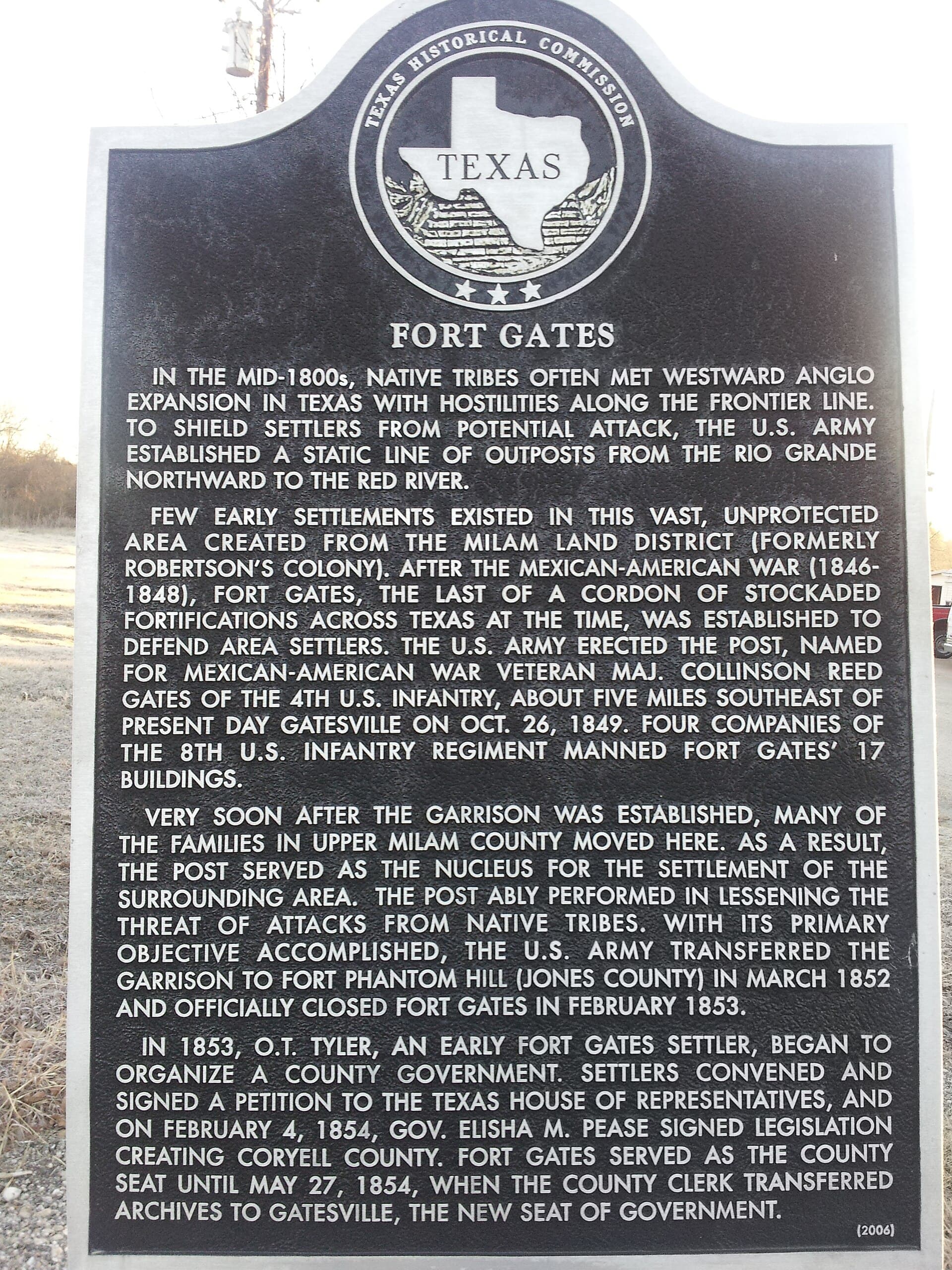
The clearest physical reminder is the Texas Historical Commission marker for the Fort Gates site. It places the historical marker in Gatesville, and the marker location directs visitors from Gatesville by way of U.S. 84. That makes the fort more than an archive entry: it is a place reachable from roads people use every day.
The fort’s afterlife matters too. The post was officially abandoned in March 1852, as the frontier line moved west, though settlers still used the site as a place of defense during Indian raids. The site’s history later resurfaced in the 1940s, when the Fort Gates community was revived after Fort Hood was established in southern Coryell County. The community was incorporated in February 1966 with a population of 250, then grew to 755 in the 1980s, 818 in 1990, and 847 in 2000.
That arc gives Coryell County a rare kind of origin story: a military post became a county seat, the county seat helped birth Gatesville, and the old fort’s name survived long after the frontier line moved on. On the ground, the traces are still there in the river corridor, the highway marker, and the town name that came from Fort Gates itself.
This article was produced by Prism’s automated news system from verified source data, official records, and press releases, then run through automated quality and moderation checks before publishing. The system is built and supervised by the people who set the standards it runs under. Read our full AI policy.
Did this article answer your question?