Fort Hood upgrades barracks and facilities in long-term overhaul
Fort Hood's overhaul is already reshaping daily life on post, from a 224-soldier barracks rebuild to new dining, housing and fare-free transit that ripple into Coryell County.
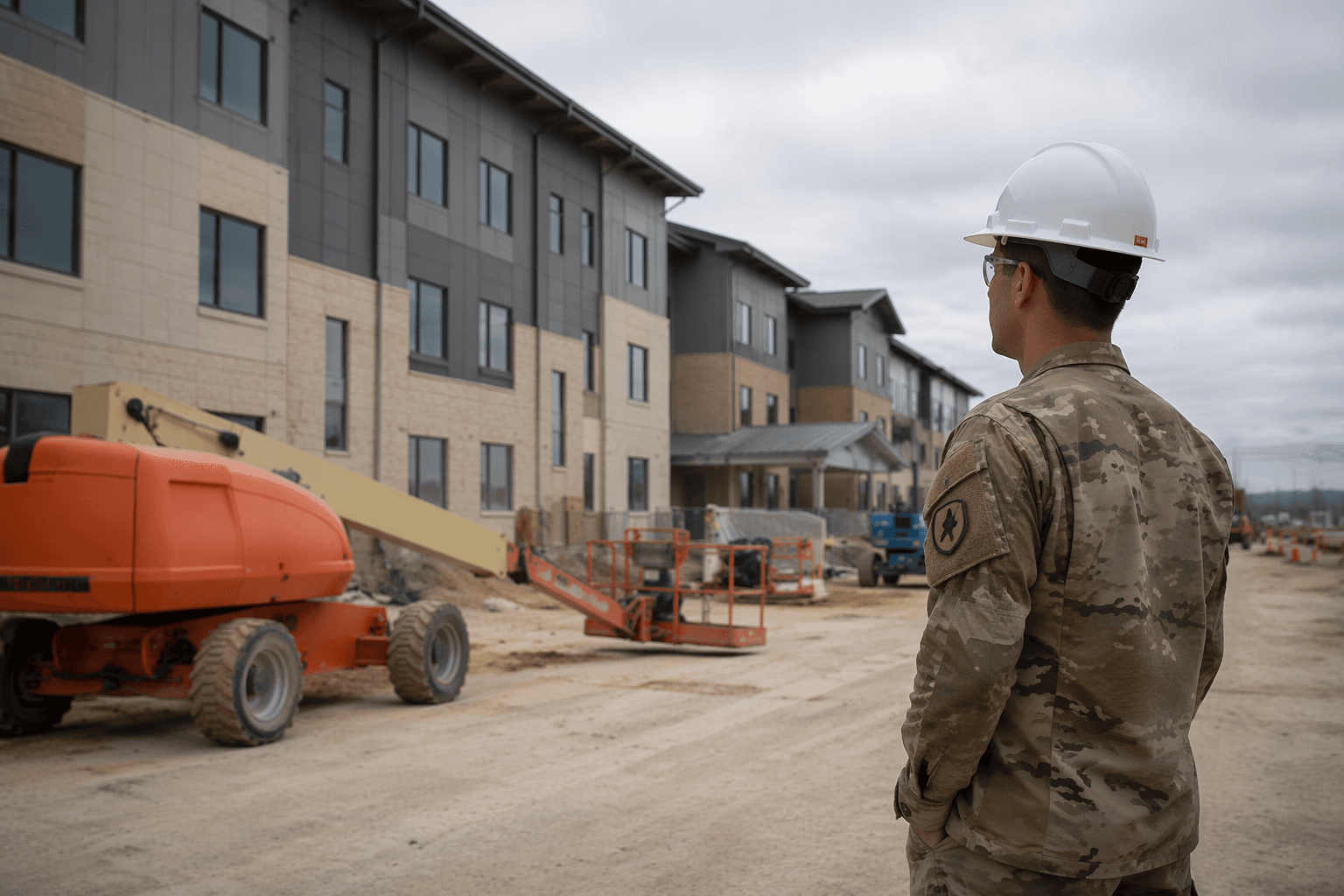
Fort Hood is tearing down one of its oldest barracks to make room for a modern replacement that will house 224 soldiers, but the bigger story is a broader reset of how people live, eat and move across the installation. The work reaches beyond a single building and into the routines that matter most to soldiers and families, from housing and meals to transportation and the condition of the post’s older infrastructure.
What is changing on post
Command Sgt. Maj. John McDwyer says the Army is trying to improve aging infrastructure while transforming the force, and the list of projects already under way shows how wide that effort has become. Better motor pools, brand-new or refurbished barracks, family housing such as Heritage Heights, the 42 Bistro dining venue and the Cavazos Connector ride system are all part of the same long-running overhaul.
Brent Cabaniss, the DPW chief of engineering, has made clear that the post cannot fix everything at once. The changes are happening in stages, through a series of smaller victories over time, which is why some improvements are already visible while others are still under construction. For soldiers living on post, that means the impact is arriving unevenly, with some daily frustrations easing now and others waiting on future phases.
The new barracks under construction are designed around a modern layout that replaces the older, more rigid model many service members have lived with for years. Officials describe the building as having four rooms per pod, shared amenity spaces and two bathrooms, a configuration intended to improve privacy, common space and day-to-day livability. The project will ultimately benefit 224 soldiers, making it one of the clearest near-term markers of whether the upgrade effort is delivering more than cosmetic change.
Housing and services are where families feel it first
For military families, the most tangible part of the overhaul is the housing pipeline. Heritage Heights grew out of the demolition of McNair Village and was described as a public-private partnership that will eventually exceed 500 homes, a scale that gives the neighborhood more weight than a simple replacement project. A 2024 update said 248 homes had already been completed, with 25 more planned by the end of March, making it one of the installation’s clearest measures of progress.
Food service is changing too, and the difference is immediate for anyone who eats on post. The Army’s first campus-style dining venue, 42 Bistro, officially opened on February 18, 2026, with expanded hours, multiple food stations and healthier options. III Armored Corps and Fort Hood marked the opening as a milestone in food service modernization, giving the installation a more flexible place to eat than the standard dining-hall model many soldiers are used to.
Transportation is the other daily pressure point. The Cavazos Connector, an app-based fare-free transit system, launched in March 2024 and is meant to help service members, family members, civilians, retirees and veterans move around the installation without relying on a car. On a post as large as Fort Hood, that matters because a ride system can shape whether someone gets to work, to appointments or to the dining hall on time, especially when parking and travel between facilities become part of the daily grind.
Why Coryell County should pay attention
Fort Hood is not just a federal installation sitting apart from the county around it. It occupies 218,823 acres, with most of that land in Coryell County, and its size alone explains why changes on post spill into local housing, traffic and labor markets. Fort Hood also reaches into Bell County, including the Killeen side of the region, which means the installation’s decisions ripple far beyond the fence line.
The economic stakes are just as large. The Texas Comptroller of Public Accounts estimates that the population directly affiliated with Fort Cavazos contributed at least $39 billion to the Texas economy in 2023, and direct employment linked to the post was listed at 59,695 in the Comptroller’s impact analysis. Those numbers make each barracks project, housing expansion or service upgrade more than an internal construction update, because they help shape where people live, spend and stay in Central Texas.
That is why a demolition on post matters locally even when it does not look dramatic from the outside. Better barracks can make it easier to keep soldiers here longer, while more livable family housing can influence whether spouses and children stay in the region instead of moving away. Transit and dining upgrades may sound routine, but at Fort Hood’s scale they affect everything from commute patterns to whether families see the installation as a place where daily life is manageable.
A long reinvestment cycle, not a one-off project
The current overhaul also fits a much longer history of reinvention. Fort Hood was originally announced on January 14, 1942, as a tank destroyer tactical and firing center, then redesignated Fort Cavazos in 2023 in tribute to Gen. Richard E. Cavazos. The Army’s own language for the post has shifted, but the underlying pattern is familiar: the installation keeps being rebuilt for a different generation of soldiers and families.
That history matters because the latest upgrades are not a stand-alone beautification effort. They are part of a cycle of reinvestment that has to prove itself in ordinary life, whether that means a barracks that works better for 224 soldiers, a housing neighborhood that keeps filling out, a dining venue that stays open when people need it, or a fare-free shuttle that actually gets people where they need to go.
The clearest test now is whether the improvements show up in the daily routines of soldiers and families, not just in ribbon-cutting photos. If the new barracks, Heritage Heights, 42 Bistro and the Cavazos Connector hold up under real use, the overhaul will be felt in the places where Fort Hood families spend their time every day.
This article was produced by Prism’s automated news system from verified source data, official records, and press releases, then run through automated quality and moderation checks before publishing. The system is built and supervised by the people who set the standards it runs under. Read our full AI policy.
Did this article answer your question?