Museum feature recalls river baptisms in rural Coryell County
A 1913 Leon River baptism in Hay Valley opens a window on how Coryell County churches doubled as worship sites, gathering places and community networks.
A baptism photo that tells a bigger Coryell County story
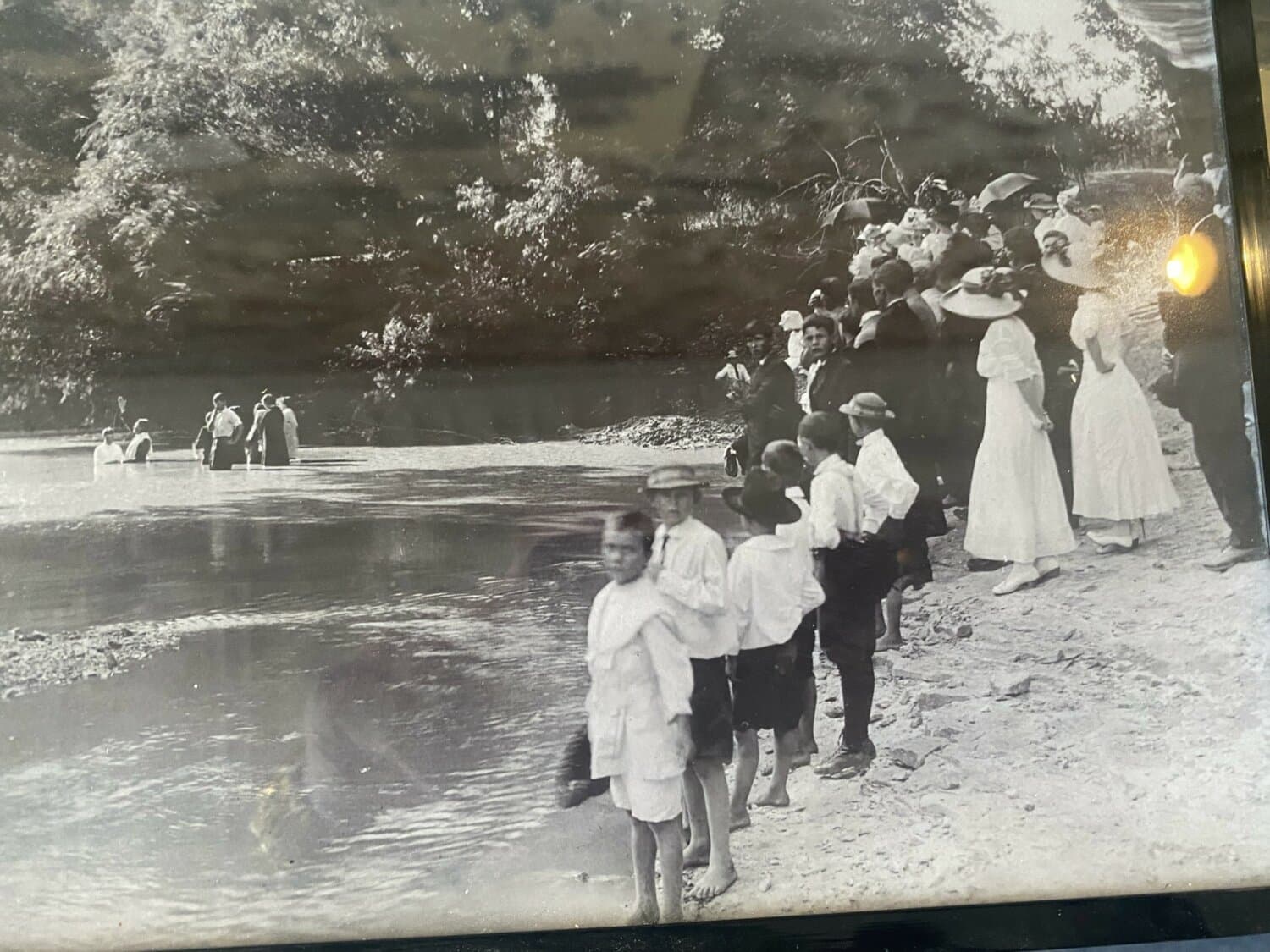
A single photograph from July 1913 does more than record a church rite. It shows how rural Coryell County communities used the Leon River for worship, public gathering and mutual support, with Hay Valley Baptist Church gathering on the water to baptize in a place the whole community could recognize.
That image, featured in the Coryell Museum and Historical Center’s church display, reaches beyond one denomination or one family. It helps explain why a riverbank mattered as much as a sanctuary in early rural Texas, and why baptisms were often as social as they were spiritual. In places like Hay Valley, the church was not separate from daily life. It was where people prayed, watched neighbors make faith commitments, and reinforced the ties that held a small community together.
Why the Leon River mattered
Hay Valley sits four miles northwest of Gatesville in north central Coryell County, and the Leon River runs to its south. That geography shaped church life in a very practical way. When congregations needed a place for immersion baptisms, the river was close, visible and already part of the community’s routines.
The museum feature notes that baptisms in rural Texas were commonly held in natural water sources such as creeks, rivers, lakes, stock tanks and ponds. In Coryell County, that meant the Leon River and Coryell Creek served not just as landscape features but as sacred gathering places. A baptism there was public by nature, with families, neighbors and church members lining the banks to witness it. The event marked a personal decision, but it also affirmed the entire community’s shared identity.
How rural churches functioned beyond the pulpit
The Hay Valley photograph captures a pattern that was common across frontier and rural Texas Christianity. Baptists, Methodists and Churches of Christ were among the earliest Protestant traditions to take hold in Texas, and their early congregations often met in settings where indoor baptisteries did not exist. That meant rivers and creeks filled a practical need, but they also gave religious life a communal setting that a closed building could not match.
For many rural families, a baptism was also a social occasion. It brought people together in a way that blended worship, family memory and local news. The same riverbank where someone was baptized could also be a place where neighbors exchanged updates, supported one another through hardship, and remembered who belonged to which church family. In that sense, the water’s edge functioned as one of the county’s most important civic spaces.
The move from river baptisms to indoor baptisteries
The church display also points to a clear change in religious practice during the 1920s and 1930s, when churches increasingly moved baptisms indoors. A 2011 scholarly article on Southern Baptists describes indoor baptisteries as a modern technology, and that shift fits the broader pattern seen in the museum’s interpretation. As churches modernized and gained temperature-controlled facilities, indoor baptisteries became a sign of changing architecture and changing expectations.
That transition did not erase the older tradition, but it did change how baptisms looked and where they happened. What once took place in open water gradually moved behind church walls. The museum’s photograph preserves the earlier practice at the exact moment when rural Texas was beginning to leave it behind.
A museum built to keep Coryell County memory visible
The Coryell Museum and Historical Center at 718 E. Main Street in Gatesville preserves that kind of local history on purpose. The museum says its mission is to collect, preserve, document, exhibit and interpret cultural materials related to Coryell County and Central Texas. That makes the church display more than a nostalgic corner. It is part of a larger effort to keep the county’s social history visible in the present.
The museum also helps tell another story that many Gatesville residents already know well: the town’s connection to spurs. The Lloyd and Madge Mitchell Spur Collection includes more than 10,000 spurs and is described by the museum as the largest in the world. 25 News has reported that about 6,000 pairs are on display, and that the 77th Texas Legislature designated Gatesville the Spur Capital of Texas. The Texas Bucket List also noted that local coach and collector Lloyd Mitchell amassed about 10,000 spurs during his lifetime. Together, those details show how the museum links religious history, ranching culture and local identity under one roof.
What visitors can take away from the display
The church exhibit is useful because it shows how Coryell County actually worked. Worship, baptisms, social life and mutual aid were intertwined, not separate. The Leon River was part of that system, just as Hay Valley Baptist Church was part of the landscape around Gatesville. The photo of a July 1913 baptism gives that world a face, a date and a setting readers can still place on a map.
For anyone who knows Coryell County by its roads, churches, river crossings and family histories, the display offers a sharp reminder that local history is often carried in ordinary places. The river was not just scenery. It was a meeting ground, a witness stand and a memory bank for communities that built faith in public view. The museum preserves that truth in a photograph that still speaks clearly today.
This article was produced by Prism’s automated news system from verified source data, official records, and press releases, then run through automated quality and moderation checks before publishing. The system is built and supervised by the people who set the standards it runs under. Read our full AI policy.
Did this article answer your question?