Cumberland County farmland preservation keeps farms working for the long term
Cumberland County buys development rights, not farm fields, keeping more than 22,000 acres in agriculture and limiting future nonfarm development.
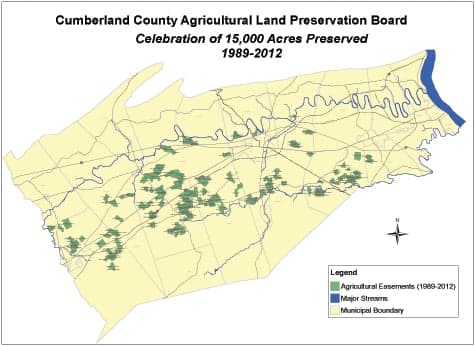
Since 1992, Cumberland County says it has preserved more than 22,000 acres by buying the right to develop a farm, not the farm itself. That keeps active acreage in production, with deed restrictions and annual inspections to enforce the limits. A preservation closing can take up to three years and requires appraisals, title work, a full survey and legal work.
How the program works
The Cumberland County Agriculture Development Board, known as the CADB, runs the county program under the Agriculture Retention and Development Act, the state framework for farmland preservation. A landowner who participates sells a development easement, which extinguishes the right to use the tract for non-agricultural development while the farmer keeps ownership and continues farming it. Landowners submit an application to sell an easement, make a non-binding offer per acre, and the final price is based on survey work and fair market appraisals; questions go through the county planning office, including Assistant Planning Director Matthew E. Pisarski.
There are two main ways a farm gets preserved. Most tracts go through easement purchase, in which the county buys the development rights at a price tied to the appraised value of those rights. Some landowners donate easements instead, which can carry significant income and estate tax benefits while still producing the same permanent preservation outcome. Funding comes from a mix of federal, state, county and municipal government dollars, with nonprofit money sometimes added to the stack.
What residents get back
For residents, the biggest return is that farmland stays farmland. The restrictions are recorded in a deed of easement and run with the land forever, so future owners are bound by the same limits. The public has no right to enter or use a deed-restricted farm without the owner’s consent, but participating landowners do get limited protection from eminent domain, nuisance actions, and some emergency water and energy restrictions. They are also eligible for cost-sharing grants for soil and water conservation projects.
Cumberland County says it contains nearly 70,000 acres of farmland, ranks No. 1 in New Jersey for vegetables, melons and potatoes, and has about 13,000 acres preserved under the state Farmland Preservation Program. The county also says it accounts for nearly 20% of the state’s agricultural market value, with leading fresh-market crops including summer squash, scallions, cucumbers, radishes, spinach, sweet corn and tomatoes, alongside a strong nursery, floriculture and sod sector.

Taxes, value and long-term farm economics
The tax side is just as important as the land-use side. Under New Jersey’s farmland assessment rules, properties that qualify are taxed on agricultural productivity rather than speculative development value, which usually means a lower assessment than a comparable parcel held for subdivision. Cumberland County’s preservation eligibility rules also require land to qualify for farmland tax assessment and sit in an agricultural development area, tying preservation to an existing farm-use tax structure rather than a blank-slate open-space model.
Keeping land in farming preserves the base for the jobs that support planting, harvesting, packing, greenhouse production and distribution, and it helps explain how Cumberland County can supply consumers in New Jersey, the eastern United States and Canada. The county planning department’s broader mission is to promote new jobs and industry while protecting the area’s environment and cultural heritage.
Where the next pressure points are
Cumberland County’s 2009 Farmland Preservation Plan, adopted with input from participating municipalities, remains the framework for deciding where preservation dollars go first. The plan’s maps point to countywide project areas in Shiloh, Hopewell North, Hopewell Central, Hopewell South, Stow Creek, Greenwich, Deerfield, Fairfield, Lawrence, Millville, Vineland and Downe, along with agricultural development areas that the county and the state have already identified as preferred farm country. The county also uses GIS to identify farmland and open-space priority areas, which is how officials steer preservation money toward land that is still in play.
The local picture is especially clear in places like Greenwich and Hopewell. Greenwich Township says it has preserved more than 2,300 acres of farmland on its own, while Hopewell Township is located in several county project areas and has a municipal farmland preservation program that matches county cost-sharing on farms in the Hopewell South Project Area. Commercial Township and Stow Creek are also inside county project areas targeted for preservation.
This article was produced by Prism’s automated news system from verified source data, official records, and press releases, then run through automated quality and moderation checks before publishing. The system is built and supervised by the people who set the standards it runs under. Read our full AI policy.
Did this article answer your question?