Millville glassmaking legacy helped shape Cumberland County's arts identity
Millville’s glass legacy still drives Cumberland County’s arts identity. WheatonArts turns that history into tourism, preservation and working access to glass art.
Millville's glass story still pays civic dividends in Cumberland County. At WheatonArts, the Wheaton family legacy has become a 45-acre cultural anchor that shapes tourism traffic, preservation priorities and access to working glass art. That matters because glassmaking once ranked among the county's principal industries and remained important into the 1970s, leaving Millville with an identity built as much on industry as on art.
How southern New Jersey became a glass region
Southern New Jersey had the basic ingredients that glassmakers needed: wood for fuel, sand, soda ash and silica. WheatonArts traces the American glass industry in the region back to 1739, when Caspar Wistar founded what it describes as the nation's earliest successful glass factory in nearby Salem County. Millville was already part of that industrial world by the time the Wheaton family arrived, and its own first glass factory was established in 1806 by James Lee.
The town's advantages were practical as well as geological. Millville drew on local silica deposits, and its access to the Maurice River and later rail transport helped move raw materials and finished goods. By the 19th century, glass was not an incidental trade in Cumberland County, it was one of the region's defining industries, and that long run of production explains why the county still treats glass heritage as part of its public identity.
The Wheaton family turned industry into institution
The Wheaton name enters the story in the 1880s, when Dr. Theodore Corson Wheaton began making pharmaceutical bottles in Millville in 1888. Cumberland County's biography of Frank H. Wheaton Sr. says his father settled in Millville in 1883, invested in a small factory in 1888 and helped lay the groundwork for an enterprise that eventually grew far beyond one plant. That sequence matters because it ties the family directly to the town's industrial rise rather than to a later effort to memorialize it.
The next generation turned that industrial inheritance into a cultural project. WheatonArts says Frank H. Wheaton Jr. visited the Corning Museum of Glass in Corning, New York, in the early 1960s and realized how much of the glass on display had been made in southern New Jersey. He made WheatonArts, then Wheaton Village, his goal, and in 1968 he searched for and found a collection of American glass from the Bucks County Glass Museum in Pennsylvania. That collection became the foundation for what is now WheatonArts' American glass holdings.
The first buildings on the Millville campus opened in 1970. Three years later, the T. C. Wheaton Glass Factory opened, followed shortly by the Museum of American Glass. The sequence shows how the site moved from a family collection and historic tribute into a full cultural complex with exhibitions, demonstrations and artist space.
What visitors find at WheatonArts now
WheatonArts today spans more than 45 wooded acres and includes 18 buildings. The Museum of American Glass offers more than 18,000 square feet of exhibition space, and WheatonArts says its collection holds more than 22,000 objects, both historic and contemporary. The museum is also one of only nine New Jersey museums accredited by the American Alliance of Museums, a distinction that gives the site weight beyond Millville's borders.
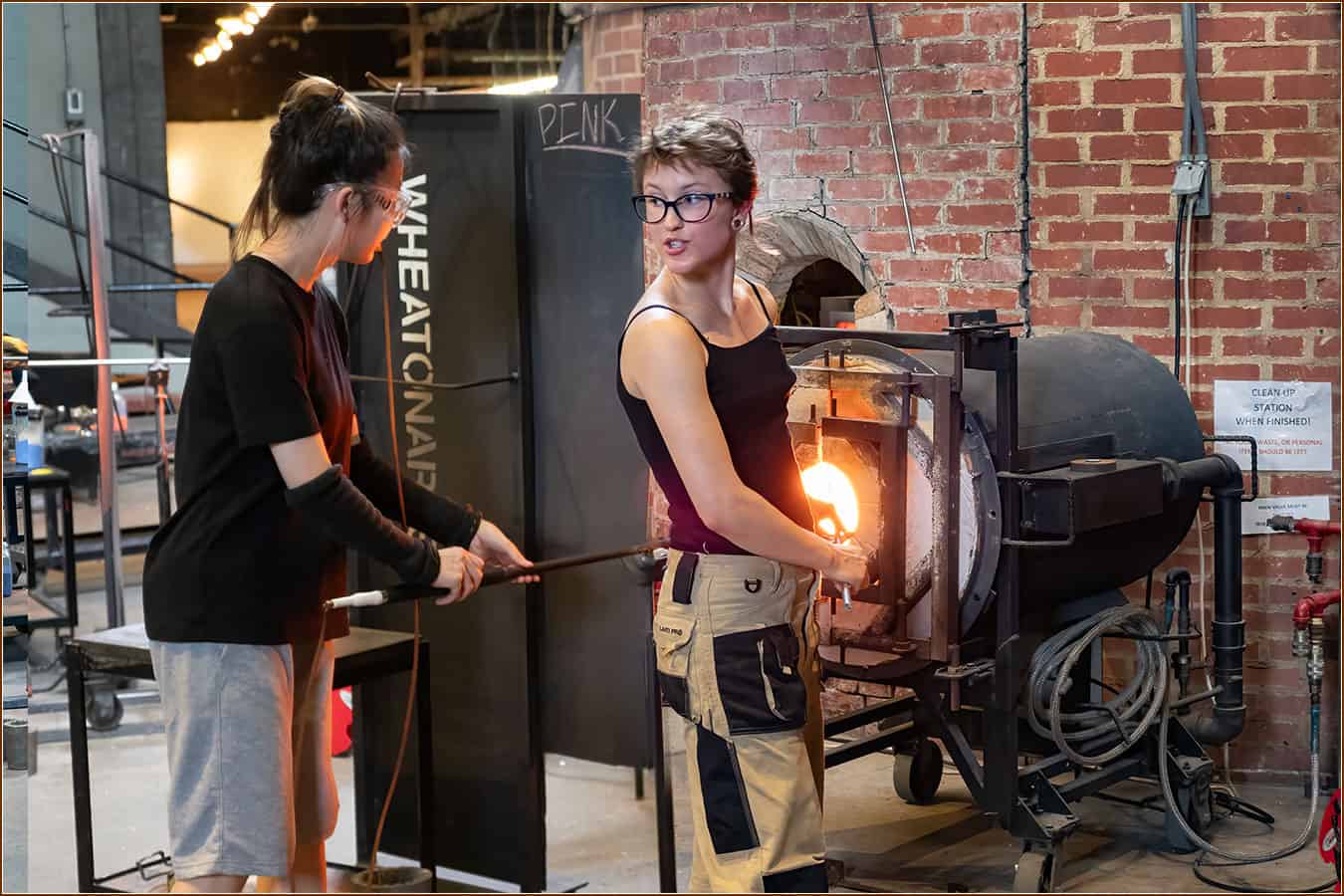
The campus is designed to connect memory with making. The Glass Studio is a replica of the 1880s T. C. Wheaton Glass Factory, which gives visitors a direct visual link to the industrial plant that helped shape the family story. Millville's tourism office promotes WheatonArts as a place where people can watch glass art being created in the Glass Studio and tour the Museum of American Glass, and the campus also shows work associated with artists such as Dale Chihuly and Paul Stankard.
That mix matters for local arts access. Residents do not have to travel to Philadelphia or farther north to encounter a major glass collection or see glassblowing in action. The site also gives Cumberland County a cultural attraction that is rooted in place rather than imported as a generic museum concept.
Why this legacy still affects county decisions
The real value of WheatonArts is not only that it preserves the past. It still influences how Cumberland County tells its story to visitors, where preservation attention goes and how local arts programming reaches schools and neighborhoods. A single institution now carries several jobs at once: museum, working studio, folklore center and tourism draw.
That broader role became even clearer as WheatonArts expanded its living-arts work. The Creative Glass Fellowship Program began in 1983 and has awarded more than 365 residencies to artists from the United States and 26 foreign countries. The Down Jersey Folklife Center was launched in 1995, tied to a state folklife infrastructure initiative, and WheatonArts says its programming has reached schools and other sites, including a 2016 Caribbean cultural heritage project done with Cumberland County organizations. Those efforts turned the campus into a production site for culture, not just a repository for artifacts.
For Cumberland County, the Wheaton legacy is no longer only a family name or a chapter in industrial history. It is a working part of the local economy, a reason visitors come to Millville, and a preservation priority that shapes how the county understands its own past.
This article was produced by Prism’s automated news system from verified source data, official records, and press releases, then run through automated quality and moderation checks before publishing. The system is built and supervised by the people who set the standards it runs under. Read our full AI policy.
Did this article answer your question?