Crowder High preserved Decatur County's Black school history
Crowder High filled Decatur County’s Black school gap, then became a last-link archive of alumni memory, family history, and local pride in Decaturville.
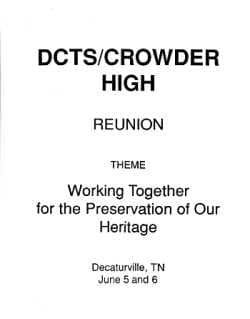
Crowder High School was never just a school building in Decaturville. It was the first Black high school in Decatur County, the place that filled a gap that had left Black students without a local secondary education before 1925, and the institution that gave many families a path into teaching, farming, church leadership, and civic life. In a county seat of 807 people and a county of 11,435, the school’s legacy still sits in plain view at 516 S West St., where alumni and friends marked the site as a place worth preserving.
A county gap that Crowder filled
Before 1925, Decatur County had no high school for Black students. That absence mattered in a rural county where access to secondary education could determine whether a young person stayed at home with limited options or moved into work, school, and public life with real prospects. Decatur County Training School, later remembered as Crowder High School, became the county’s first Black high school and the institution that answered that need.
The school’s history makes sense in the wider Tennessee pattern. Before integration, the state had about 90 African-American high schools, stretching from Memphis to Kingsport. Crowder High belonged to that network of segregated schools that did more than teach reading, math, and science. In rural west Tennessee, schools of this kind often doubled as anchors for the Black community, as Montgomery High School in Henderson County did for its area, and Crowder High appears to have played that same role in Decaturville.
Professor David Carroll Crowder’s arrival
The school’s founding story centers on Professor David Carroll Crowder, who came to Decaturville around 1924 after graduating from Roger Williams College in Nashville. Roger Williams University, which reopened in North Nashville in 1909 and closed in 1929, gave Crowder a credential that carried unusual weight in a segregated state. Reunion materials described him as the only licensed Negro veterinarian in Tennessee, a detail that shows both his professional standing and the narrow doors available to Black educators and professionals at the time.
Those same materials identify David C. Crowder as the school’s first principal, first agricultural instructor, and veterinarian. That combination mattered in a farming county like Decatur. He was not just administering classes; he was linking classroom work to the economy families actually lived in, from agriculture to practical science. The school’s first homemaker instructor was Miss Mabel McKay of Nashville, whose role added another layer of instruction tied to household management and family life.
What the school taught, and who it served
Crowder High School’s value reached beyond a diploma. It gave Black families in Decatur County a local institution that reflected their lives and expanded their children’s choices. The reunion materials preserve names, photographs, and class memories because the school shaped more than individual careers. It helped define family histories, church membership, and local standing in a county where Black education had been held back by segregation.
The school also built an alumni culture that lasted long after formal classes ended. The Decatur County Training School/Crowder High School Alumni Association kept reunion booklets, directories, and photographs circulating into the 2000s, creating a paper trail for descendants and local historians. Names preserved in those materials, including Novella Yarbro Tole, Currie Porter Boyd, James Ashworth, F.L. Buck, J.S. Crumm, F.G. Craig, S.F. Dobbins, Peggy Scruggs, Margaret Mallard Beach, Myrtle Moody, Georgia Brasher, Professor G.W. Beal, Prof. J.H. Edwards, Odessa Hurt Wadley, and Daisy Edwards, show how many households remain tied to the school’s story.
When the high school curriculum moved elsewhere
Crowder High’s high-school offerings ended in the 1940s, and Black students from Decatur County then went to Montgomery High School in Lexington for high school curriculum. That shift marks an important turning point. The local school remained a community institution, but the county no longer had a Black high school curriculum of its own, forcing students to look outside Decaturville for secondary work.
That change also underscores how fragile Black schooling could be under segregation. A single institution could anchor an entire county for a generation, then lose part of its function when local arrangements changed. The memory of Crowder High survives partly because the community kept naming what was lost and what had been built before it disappeared from daily use.
A final sports marker, and a living memory site
The school’s closing years still produced moments that alumni remember clearly. In late February and early March 1965, Crowder High School’s boys and girls won the District IV basketball tournament in Lexington. That result stands as one of the clearest late milestones for the school, showing that athletics, like classrooms, were part of the institution’s public life.
Today, the most visible sign of that history is the historical marker at 516 S West St. in Decaturville. The marker places the school years at 1925 to 1965 and says members and friends of the DCTS-CHS Alumni Association dedicated the monument to the memory of the faculty and students who attended the institution. That wording matters because it shows who has carried the memory forward: alumni, descendants, and local people who refused to let the school fade into a footnote.
For Decatur County, Crowder High remains more than a line in a history file. It is a concrete reminder that Black families built institutions here under segregation, that those institutions shaped life chances in a small county seat, and that the people connected to them still have names, places, and records worth preserving.
This article was produced by Prism’s automated news system from verified source data, official records, and press releases, then run through automated quality and moderation checks before publishing. The system is built and supervised by the people who set the standards it runs under. Read our full AI policy.
Did this article answer your question?