Decatur County formed from river settlement and citizen push for self-rule
Decatur County began as a river frontier pressed into self-government, and that origin still defines its courthouse towns and river-facing identity.
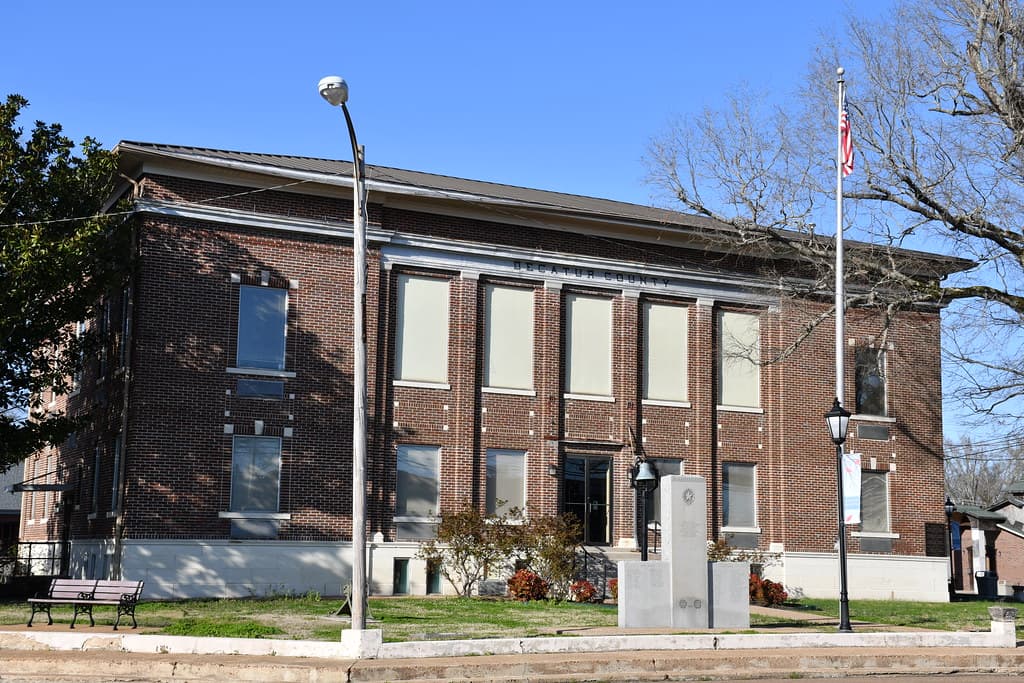
Decatur County was born from movement on the Tennessee River and a local demand for control over local affairs. About 200 citizens on the west side of the river petitioned for a new county in 1845, and the Tennessee General Assembly carved it from Perry County and named it for Commodore Stephen Decatur, the War of 1812 naval hero. That political split did more than redraw a map. It fixed a county boundary around settlement patterns, river access, and the practical need for a seat of government close to where people actually lived.
River settlement and the first push for a county
The land that became Decatur County was part of the Jackson Purchase of 1818, after the Chickasaw cession negotiated by Andrew Jackson and Isaac Shelby opened the area to settlement. The Decatur County Historical Society places the county’s earliest recorded settler, Jimmy Harris, known as Uncle Jimmy, at the center of that opening chapter. In the society’s telling, Harris paddled down the Tennessee River and landed at the mouth of Cub Creek, a detail that captures how the river served as both highway and destination.
That geography shaped the county’s identity from the start. Decatur County borders the Tennessee River in West Tennessee, and the river corridor linked the county to frontier travel, trade, and the westward push of settlement. The county’s creation in 1845 was not an abstract act of legislation. It was the formal response to people already living, moving, and building along the river who wanted a county of their own.
Decaturville and the courthouse pattern
The county seat, Decaturville, grew directly out of that settlement pattern. Local history says it was laid out from 25 acres purchased from John McMillan and 10 acres from Burrell Rushing, a land assembly that turned scattered holdings into a civic center. Decaturville was established in 1847, and the first court met there in 1848 in a cabin west of the square. The detail matters because it shows how early county government began in modest conditions, long before permanent civic buildings defined the town center.
That early courthouse story also explains why the modern courthouse carries so much local weight. The first courthouse burned in 1869. After that fire, a two-story brick courthouse was built at a cost of $9,000, only to burn in 1926. County fact sheets also list a courthouse fire in 1927, which underscores how often the county’s governing house had to be rebuilt. Each loss reset the physical center of county administration, but it never broke the county’s habit of organizing civic life around Decaturville.
Decaturville remains the county seat and, by county government figures, had a population of 867 at the 2010 census. Its size reflects the county’s broader pattern: a small seat town anchored by a larger network of other communities rather than one dominant urban center.
Three incorporated towns, many local identities
Decatur County has three incorporated towns: Decaturville, Parsons, and Scotts Hill. UT County Technical Assistance Service lists their 2020-era populations as 867 for Decaturville, 2,373 for Parsons, and 984 for Scotts Hill. That spread shows how the county’s population is distributed across multiple town centers rather than concentrated in one place.
Parsons carries its own history of growth tied to land and rail. Local historical material says Henry Myracle donated land in 1889, and Parsons was later chartered in 1913. Scotts Hill adds another incorporated center to the county’s map. Together, these towns show how Decatur County moved beyond its original river landing and courthouse cabin into a county of layered settlements, each with its own civic role.
The historical society’s towns-and-communities material also makes clear that the county extends well beyond the incorporated towns. Its unincorporated communities preserve the older frontier pattern, where settlement spread along landings, creeks, roads, and later rail lines. That mix of town and countryside is still part of how Decatur County functions today.
County size, population, and what the numbers show now
The county had a population of 11,435 in the 2020 census, according to the U.S. Census Bureau, and it covers 333.9 square miles of land area. Those figures place Decatur County among Tennessee’s smaller counties by population, but not by geographic presence. The county’s size on the map, paired with its river border, helps explain why local identity has stayed tied to place and transportation rather than to a single dense city.
Recent county profile figures add a practical picture of life there. The 2024 American Community Survey profile lists a median household income of $45,375, 14.0 percent of residents with a bachelor’s degree or higher, 74.3 percent owner-occupied housing, and 228 employer establishments. Those numbers suggest a county with a strong homeownership base, a modest business footprint, and an economy shaped by small employers rather than a large industrial center.
The county government also describes Decatur County as a Tennessee Three-Star Community. That label fits the broader pattern: a county that still presents itself through stewardship, local institutions, and a community identity rooted in place rather than scale.
Politics, river identity, and the county’s continuing shape
Decatur County’s river location has mattered politically as well as geographically. One compiled history of Tennessee’s 1861 secession referendum records a vote of 550 to 310 for remaining in the Union. In a region where many counties split differently, that result marks Decatur County as one of the West and Middle Tennessee counties that chose a Union stance. The vote reinforces the same pattern seen in the county’s founding: geography and local conditions shaped political identity, and residents used their vote to assert a position distinct from neighboring counties.
That same instinct for self-definition still appears in how the county presents itself. Decatur County’s history is not only about what happened in 1845. It is about how a river settlement, a petition for local control, a rebuilt courthouse, and a set of small towns formed a county that still organizes itself around the Tennessee River. The boundaries drew the first map; the institutions that followed gave that map its lasting shape.
This article was produced by Prism’s automated news system from verified source data, official records, and press releases, then run through automated quality and moderation checks before publishing. The system is built and supervised by the people who set the standards it runs under. Read our full AI policy.
Know something we missed? Have a correction or additional information?
Submit a Tip