Dove Creek Press helped build a town voice in Dolores County
The Dove Creek Press gave a remote farm town a public voice, and its archive still shows how Dolores County built civic memory when institutions were sparse.
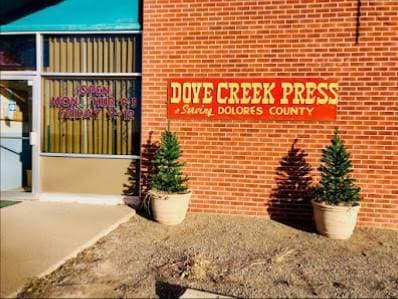
The Dove Creek Press was more than a weekly newspaper. In a town where homesteaders were carving farms out of sagebrush, it became one of the few durable records of who lived here, what was being built, and how a remote agricultural community explained itself to itself.
A newspaper for a town that had to build everything
The Library of Congress records The Dove Creek Press as a weekly paper created in Dove Creek by Dan Hunter and R.T. Williams, with its first run stretching from May 10, 1940 through November 7, 1952. That alone places the paper inside a period when small-town news outlets did far more than publish notices. They helped organize civic life, connect scattered residents, and preserve the facts of daily government and local change in a place far from larger editorial centers.
The newspaper’s title trail shows a community and a paper adjusting together. The Dove Creek Press and San Juan Record ran from November 14, 1952 through April 23, 1953. Then The Dove Creek Press resumed from April 30, 1953 through April 29, 1977, before later title changes carried it forward. For readers trying to understand Dolores County’s record, those dates matter because they show continuity as well as change, with the paper surviving long enough to chronicle several distinct eras in the town’s life.
The homesteader years behind the headlines
The Dove Creek historical marker gives the town’s early setting a hard edge. It says World War I veterans homesteaded near Dove Creek in the late 1910s and spent decades clearing sagebrush. That detail captures the reality behind the county’s early farm economy: this was not a settled town absorbing growth, but a landscape being forced into production one field at a time.
The marker identifies Daniel Brown Hunter as one of those early settlers. It says he moved to Dove Creek in 1918 and began publishing the Dove Creek Press in 1919. That timeline places him at the center of two building projects at once, the physical work of turning land into farms and the civic work of giving the town a newspaper that could stitch those farms into a shared public life.
Hunter’s role went beyond the pressroom. The marker says he sold his interest in the paper in 1945 and continued serving the town until his death in 1958. It also credits him with running a successful pinto-bean farm, helping found the town’s high school, organizing municipal water and power utilities, and writing newspaper articles. In a small community, those are not separate accomplishments so much as parts of one job: helping a town function when it was still defining its own institutions.
How the paper tracked a changing county
The value of the Dove Creek Press is not limited to its earliest years. The historical marker notes that Dove Creek later saw Dust Bowl migration, the uranium-boom years and tourism growth. That means the paper sits across multiple transformations in Dolores County, from homestead settlement to outside migration, from an agricultural base to a county shaped by broader western economic cycles.
That is why the publication’s archive matters now. A local paper in a town like Dove Creek does not merely file stories about change; it records the order in which changes arrive, who is affected first, and which institutions carry the load. When a school is founded, a utility is organized, or a community grows beyond its original settlers, the newspaper provides the paper trail that helps later residents understand how those systems began.
The Dove Creek Press also shows how local journalism can function as a form of public accountability in a place where distance once made outside oversight weak. If a town notice was printed, it could be found. If a local dispute became public, it had a record. If a community wanted to remember who built what, the paper could preserve names that otherwise would fade into family memory or oral history.
What readers lose when small-town papers weaken
The question raised by the Dove Creek Press is not only what the paper once did, but what happens when a town loses that kind of voice. In a small county, fewer local news pages can mean fewer durable records of school decisions, utility changes, town business and the everyday acts that shape civic life. It can also mean that community memory becomes harder to verify, because the details no longer sit in one place where anyone can check them.
That problem reaches beyond nostalgia. Local news outlets are often where residents learn what is being decided, where notices appear before deadlines pass, and where a town’s own history stays legible from one generation to the next. The Dove Creek Press shows what a weekly paper can do when outside institutions are far away: it can turn scattered farms into a public community with names, dates and responsibilities attached.
For Dolores County, that is the enduring lesson of the paper’s record. The archive is not just a relic of early settlement. It is evidence that civic voice in a remote place had to be built, maintained and repeatedly renewed, and that when local journalism weakens, the loss is felt not only in news coverage but in the county’s memory of itself.
A record worth keeping usable
The strongest practical value of the Dove Creek Press today is the clarity of its trail. The publication dates, title changes and associated figures give researchers, families and local readers a framework they can trust: May 10, 1940 to November 7, 1952 for the first run, November 14, 1952 to April 23, 1953 for The Dove Creek Press and San Juan Record, April 30, 1953 to April 29, 1977 for the next Dove Creek Press run, and the later title changes that carried the paper forward.
That kind of continuity is rare in a small town’s public record. In Dove Creek, it marks the difference between a place that merely grew and a place that documented how it grew.
This article was produced by Prism’s automated news system from verified source data, official records, and press releases, then run through automated quality and moderation checks before publishing. The system is built and supervised by the people who set the standards it runs under. Read our full AI policy.
Did this article answer your question?