Rico Microgrid Project Aims to End Small Town's Power Vulnerability
One wire over Lizard Head Pass supplies all of Rico's electricity. A $1.4 million grant and a 1,500 kWh battery system could end that single-point vulnerability by 2026.
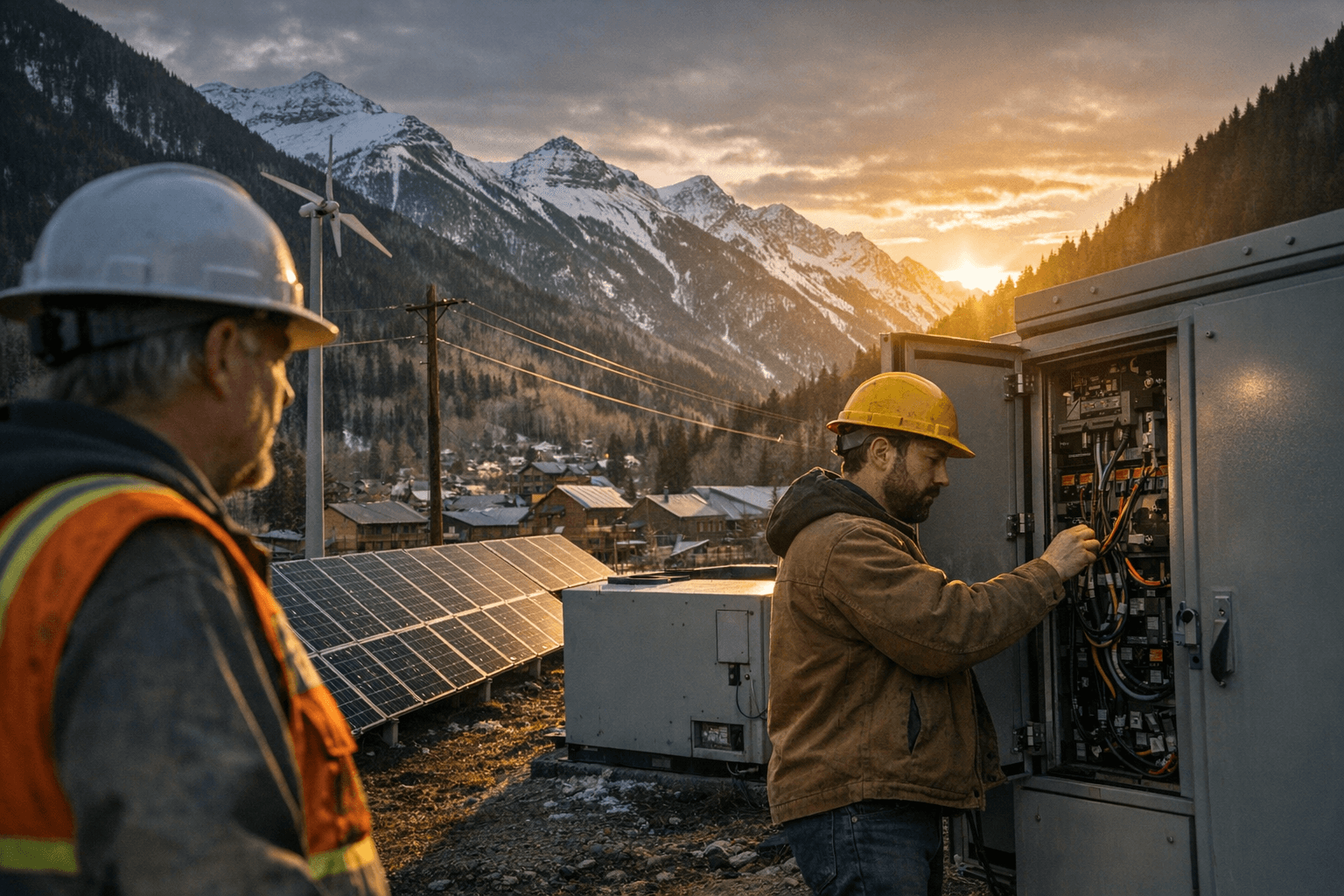
One overhead line descends from Lizard Head Pass, crosses the Dolores River multiple times along Colorado Highway 145, and delivers every watt of electricity that Rico's 347 residents use. There is no backup loop, no secondary feed, no underground alternative in the steep alpine terrain. When that line fails, Rico goes dark until crews can reach it.
That physical reality has driven a multi-year push by San Miguel Power Association (SMPA) and its partners to build a community-scale microgrid in the upper Dolores watershed, a project that has cleared federal environmental review, secured $1.4 million in state construction funding, and now faces its most consequential local decision: where to put the hardware.
What the System Would Keep Running
The microgrid is not designed to power every home through an extended outage. It is designed to protect the services that become dangerous to lose in a winter emergency. During an outage event, the system would sustain municipal water pumps, wastewater infrastructure, heating loads at critical facilities, emergency communications, and the medical and fire protection functions that the Rico Fire Protection District depends on. At a town this remote, those are precisely the systems whose failure turns a power outage into a public safety emergency.
SMPA's design calls for a battery energy storage system now sized at 1,500 kilowatt-hours, upgraded from the originally approved 1,320 kWh capacity to accommodate future growth in Rico's electricity consumption. Paired with microgrid control hardware, the system is rated to provide four to six hours of backup power for the entire town. For extended events lasting a full day or more, a planned community solar array would recharge the batteries and stretch coverage further.
What It's Designed For
Rico's exposure is not hypothetical. The distribution line traverses rugged mountain terrain, must remain overhead because of the topography, and is vulnerable to avalanches, rockfall, heavy snow loads, and high winds that can bring trees and debris onto conductors. Wildfire risk to transmission infrastructure farther up the path adds another threat vector that has become more relevant across the region in recent years.
The "Snowpocalypse" storm that paralyzed Silverton in February 2023 was a turning point for how SMPA and mountain communities in the San Juans think about single-feeder vulnerability. Rico has experienced similar significant winter outages. At Silverton, when the power went out at 8:30 a.m. that February, gas pumps failed, cash registers went dark, and emergency responders struggled to open motorized garage doors. Rico's geography makes it equally susceptible to the same cascade.
Funding and Total Cost
The Colorado Department of Local Affairs awarded SMPA $1,414,500 for Rico battery construction through its Microgrids for Community Resilience program, which was created by state House Bill 22-1013 and has since been expanded with federal grid resilience formula funding from the U.S. Department of Energy. The total estimated project cost is $1,885,400, meaning SMPA will need to cover the gap between the grant award and the full construction budget, a portion of which may include the additional expense of the capacity upgrade from 1,320 to 1,500 kWh.
The DOE has also issued a categorical exclusion under its National Environmental Policy Act process (CX-032380), a federal environmental clearance that formally acknowledged the project scope and determined it does not require a more intensive environmental review.
Where the Project Stands
As of September 2025, the project reached a critical local decision point. SMPA consultant Terry Schuyler sent correspondence to Rico Town Manager Chauncey McCarthy requesting that the Town consider two specific battery placement sites, both on Town-owned land, identified through drone surveillance mapping. Schuyler's letter framed the request plainly: SMPA is asking the Town's trustees to view the partnership as in the best interest of all residents, offering multiple value streams in exchange for a host land agreement.
The Rico Board of Trustees first heard about the microgrid concept in February 2023. The project has since moved through a DOLA planning grant, a construction grant application filed in June 2024, an award announcement, and DOE environmental clearance. The battery siting question, now before the trustees, is the lever that unlocks construction.
One complication remains unsettled: the solar array that would recharge the batteries during extended outages. SMPA has examined and rejected multiple potential sites across the Dolores County valley due to terrain constraints, proximity to three-phase power lines, environmental considerations, and visual impact. "We are running out of sites," Schuyler told the Rico Board of Trustees during a 2023 planning session. A "batteries first, solar later" approach, referred to informally as Plan B, has been discussed as a path forward if a solar site cannot be secured before construction begins.
Timeline and the June 2026 Deadline
SMPA faces a concrete financial pressure point: the DOLA grant requires that half the awarded funds be spent by June 2026. Construction is targeted for 2026, which means the sequence of remaining steps is compressed. Before crews can break ground, SMPA and the Town of Rico must finalize a site agreement for the battery hardware, initiate permitting and any required reviews by the Colorado Parks and Wildlife, U.S. Forest Service, or other regulators with jurisdiction over the chosen site, and issue a public Request for Proposals to contract with an engineering-procurement-construction firm.
Community Process and Rate Implications
Public outreach has run alongside the technical and regulatory work throughout. "Community Power Hour" style meetings in Rico have given residents a forum to ask what a microgrid is, which sites are under consideration, how the system would operate during an outage, and what the project might mean for monthly electric bills. EcoAction Partners, the regional sustainability nonprofit, and partners from the Telluride and San Miguel region have supported these sessions, weaving in workforce development information for residents who might pursue careers installing the heat pumps, solar panels, and EV charging equipment that will define the next decade of rural electrification.
On rates: SMPA proposed a 7.6 percent retail rate increase for 2026, identifying the Rico microgrid battery storage project among the reliability investments driving additional financing expenses. SMPA's own historical rate data shows its average annual increases since 2017 have been less than half the Consumer Price Index and less than the national average for electric utilities, providing some context for the cost discussion ahead.
The Larger Lesson
For Dolores County and neighboring communities that share the same topographic vulnerabilities and single-feeder exposure, the Rico project is a live template. Every decision made here, on site selection, environmental permitting, land use agreements, grant matching, and battery sizing, generates institutional knowledge that could accelerate future resilience investments in similarly situated towns. The first battery in the upper Dolores watershed will not end extreme weather. It will, for the first time, give Rico the ability to wait it out.
This article was produced by Prism’s automated news system from verified source data, official records, and press releases, then run through automated quality and moderation checks before publishing. The system is built and supervised by the people who set the standards it runs under. Read our full AI policy.
Did this article answer your question?