Bert Nash workers vote June 25 on Teamsters representation
Bert Nash workers will vote June 25 on Teamsters representation, a fight tied to staffing, pay and whether Lawrence’s mental health safety net can hold.
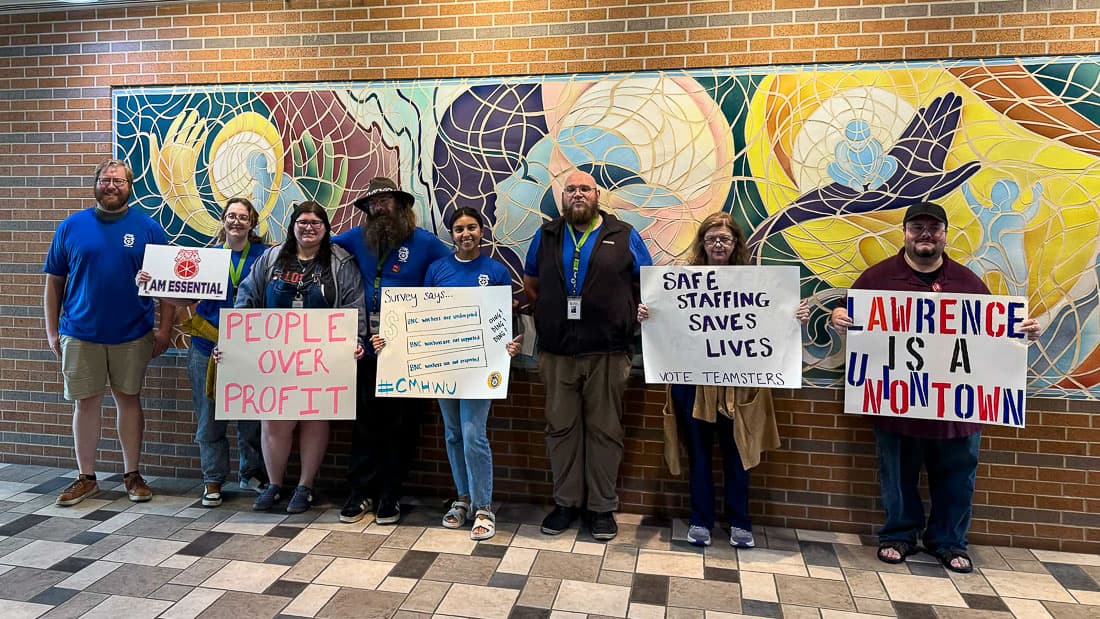
Bert Nash Community Mental Health Center workers are set to vote June 25 on whether Teamsters Local 696 will represent a 250-employee bargaining unit spread across several Lawrence sites, a decision employees say could shape caseload safety, retention and day-to-day care in Douglas County. For staff at the county’s largest mental health provider, the election is about more than a union label. It is about whether the center can steady its workforce while continuing to serve people in crisis.
Workers have said staffing shortages, low pay and disputes with management have made the job harder and put pressure on the mission of the agency. Howard Callihan said he would not be fighting so hard if he did not believe in Bert Nash’s mission, but he also warned that the center risks losing sight of that mission. Amy Munsterman said staff want a seat at the table so they can influence policies and procedures before problems reach clients. Workers also marched to management and delivered a letter asking for voluntary recognition after a union representative said a strong majority had signed cards.
The current case, 14-RC-387545, was filed May 26, 2026, in National Labor Relations Board Region 14 in Saint Louis, Missouri, and remains open. The petition names International Brotherhood of Teamsters, Local 696, and the docket lists 250 employees in the proposed unit. The case covers workers at 200 Maine Street, 346 Maine Street, 1000 West 2nd Street and 950 West 2nd Street in Lawrence.
This is not Bert Nash’s first labor fight. In January 2025, 308 employees were eligible to vote in a union election that ended 168 to 12 in favor of unionization under IBEW Local 304. The earlier organizing drive said the bargaining unit would cover 320 workers, including both professional and nonprofessional employees after a second question on whether they wanted one wall-to-wall unit. But after more than 100 hours of negotiations, IBEW filed a disclaimer of interest on May 22, 2025, withdrawing representation, according to Bert Nash CEO Kirsten Watkins.
The new push comes after a stretch of financial strain and service pressure at the center. In May 2025, Bert Nash projected a $3 million loss, said it would eliminate 6% to 8% of staff positions and temporarily cut salaries for non-union employees by 2% to 15%. The organization said its workforce grew to 415 staff members in 2024 from 191 in 2018, while total clients served rose to 6,142 from 4,689 over the same span. Its 2024 annual report said the center had more than 420 team members and offered 46 mental health programs and services.
Watkins later said Bert Nash closed 2025 in a stronger financial position, served more than 6,170 people and delivered more than 164,400 services. She also said the center was averaging nearly 2,500 individuals served each month, and that its Mobile Response Team responded to 976 referrals in 2025. The Treatment and Recovery Center saw an average of 225 people accessing crisis care each month and 165 admissions to stabilization crisis care monthly. For Douglas County, the vote will test whether workers can win a stronger voice without disrupting a system many residents depend on when they need help most.
This article was produced by Prism’s automated news system from verified source data, official records, and press releases, then run through automated quality and moderation checks before publishing. The system is built and supervised by the people who set the standards it runs under. Read our full AI policy.
Know something we missed? Have a correction or additional information?
Submit a Tip