Black Jack Battlefield links Douglas County to Civil War origins
Black Jack is Douglas County’s rare Civil War site you can still visit, with a 38-acre park, the Pearson farmhouse and a new advisory board shaping its future.
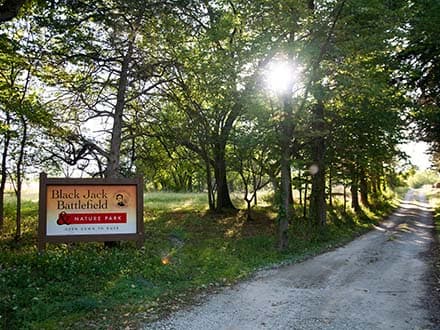
Black Jack Battlefield and Nature Park gives Douglas County something few places can: a site tied to the origins of the Civil War that residents can still drive to, stand on, and walk through today. The county identifies it as a county park site, but its significance reaches far beyond a standard park stop because the land is where the June 2, 1856 clash between John Brown and Henry C. Pate unfolded in the middle of Bleeding Kansas.
A place where national history is still on the ground
The battlefield sits at U.S. Highway 56 and County Road 2000, about three miles east of Baldwin City, and it is also commonly listed at 163 E 2000 Road in Wellsville, Kansas 66092. That geography matters because it turns a national story into a local one: this is not an abstract chapter in a textbook, but a named place in eastern Douglas County that people can still locate on county maps and tourism listings.
The National Historic Landmark nomination records the property under the historic names Evergreen Stock Farm and Pearson, Robert Hall, Farm, with site numbers 04000365, 04001373 and 04500000389. Those records show how the same landscape has moved through different identities over time, from farm land to preservation site to public historic resource. The Kansas Sampler Foundation also lists a phone number for the battlefield site, 785.883.2106, making it one of the few county landmarks with both a formal preservation file and a practical public-facing contact.
What happened here in 1856
The Battle of Black Jack is widely described as the unofficial first battle of the Civil War, and the details explain why. Civil War on the Western Border identifies the adversaries as John Brown and Samuel T. Shore on one side, and U.S. Deputy Marshal Henry C. Pate on the other, with more than 30 Free-Staters facing approximately five men on Pate’s side. Other historical accounts describe the fight as lasting about three hours and involving roughly 100 men overall, which underscores that this was a violent confrontation, not a symbolic skirmish.
That context places Douglas County inside the larger crisis of Bleeding Kansas, when armed conflict over slavery had already turned the territory into a preview of the Civil War. The battlefield links Baldwin City and the surrounding area to the national argument over slavery, federal authority and secession in a way that a courthouse exhibit or roadside plaque cannot match. The land itself carries that weight because the confrontation happened there, not somewhere else later interpreted from a distance.
What visitors can see now
Douglas County described the property in 2025 as a 38-acre site near Baldwin City, and said it includes the historic Robert Hall Pearson farmhouse and a 40-acre nature park. That combination is the site’s strongest local draw: one part preserves a historic structure tied to the land, while the other part gives the public open space to experience the battlefield setting rather than just read about it.
That mix also helps explain why Black Jack fits so well into Douglas County’s civic life. Families, walkers, teachers and travelers can encounter both history and landscape in one stop, which is why the site has been promoted through trail and tourism outlets including Kansas Trail Guide, Friends of Lawrence Area Trails, Explore Lawrence and Kansas Tourism. The National Park Service has also featured John Brown programming tied to the Battle of Black Jack at Brown v. Board of Education National Historical Park, extending the site’s relevance beyond county lines and into the broader public memory of Kansas history.
The land’s preservation story has another layer in the Black Jack Battlefield Prairie Restoration Project, which reflects the site’s value as open ground as well as historic ground. That matters in Douglas County, where preservation often has to balance development pressure, public access and long-term stewardship. At Black Jack, the historic significance and the natural landscape are not separate assets. They are the same place.
How the county is steering its future
Black Jack is also a current governance story, not just a historical one. In a September 2025 agenda item report, Sean Pederson, then deputy county administrator, described the Black Jack Battlefield property at 163 E. 2000th Road as a site of national historic significance and noted that the site includes the Robert Hall Pearson farmhouse and a 40-acre nature park. That framing put the battlefield squarely inside county decision-making about land acquisition and preservation.
By January 8, 2026, Douglas County was accepting applications for three appointments to a new advisory board that will help guide the future of Black Jack Battlefield and Nature Park. The board’s mission is to advise Baldwin City and Douglas County on preservation, maintenance and interpretation of the park for the access and enjoyment of residents and visitors, while preserving local history, enhancing open space and connecting natural and cultural heritage. That is a concrete sign that the site’s future will be shaped locally, through public appointments and county-city coordination rather than left to memory alone.
For Douglas County, Black Jack is rare because the past is still physically present. The battlefield, the farmhouse, the open land and the advisory board all point to the same conclusion: this is one of the county’s clearest links between present-day civic stewardship and the origins of a national conflict that began here long before the Civil War did.
This article was produced by Prism’s automated news system from verified source data, official records, and press releases, then run through automated quality and moderation checks before publishing. The system is built and supervised by the people who set the standards it runs under. Read our full AI policy.
Did this article answer your question?