Downtown Eudora history walk highlights 21 plaques, museum anchor
Twenty-one bronze plaques turn downtown Eudora into a walkable archive, anchored by 720 Main Street and a museum that has drawn more than 18,000 visitors.
The clearest place to read Eudora’s past is not in a textbook or a depot ruin, but on the storefronts and brick facades of Main Street. A self-guided walk through downtown now ties 21 bronze plaques to the working core of the city, with 720 Main Street serving as the natural starting point and strongest stop. The route is short on ceremony and rich in context: it shows how a small Douglas County downtown kept its memory visible while still functioning as a place to shop, eat, gather, and pass through.
Start at 720 Main Street
The anchor of the walk is the Eudora Community Museum at 720 Main Street, home to the Eudora Area Historical Society. The building was first built in 1866 by German immigrants, and the city says the society has invested the equivalent of $740,000 into the property. It is also listed on the State Register of Historic Places, which gives the museum a rare dual role in town life: it is both an exhibit space and one of the history stories the plaques are telling.
The museum is open Tuesday through Saturday from 12:00 p.m. to 5:00 p.m., making it easy to pair a downtown stroll with a visit inside. It opened to the public with a ribbon-cutting on April 4, 2015, then marked its 10th anniversary on April 4, 2025. More than 18,000 people have visited the museum in downtown Eudora, a figure that underscores how much this building has become a civic stop, not just a preservation project.
Inside, the museum archive reaches well beyond display cases. The society’s holdings include newspapers, photographs, yearbooks, correspondence, genealogy materials, and books related to Eudora and Kansas history. That matters for a walking tour because the plaques outside and the archive inside work together: one places names on buildings, the other preserves the paper trail behind them.
Why the downtown feels readable now
Downtown Eudora makes sense as a walking district because its older commercial life was concentrated in a small footprint. Local history notes show early business clustered along Main Street between Fifth Street and Eighth Street, with storefronts also on Church Street. Shoppers once moved beneath wooden balconies and along wooden sidewalks, then later walked over brick paving in the late 1890s and, eventually, concrete.
That layered street history is why the plaque walk feels less like a memorial route and more like a current-day map of how commerce evolved. The same blocks that once held the city’s early merchants still hold the downtown grid, so a visitor can stand in front of a modern storefront and imagine the different faces it has worn over time. The city’s downtown still includes shops, restaurants, and parks, which keeps the heritage story tied to everyday use rather than frozen behind glass.
The historical record behind those plaques is not guesswork. The local history site relies on newspapers dating back to 1889, 1927 Sanborn maps, interviews, and old manuscripts to reconstruct who occupied which building and when. Because addresses were not always fixed and buildings came and went, the downtown story has to be assembled from multiple sources. That makes the plaques more than decoration. They are the public-facing version of a careful documentary effort.
What the plaques show
Eudora’s plaque program began with city support. In 2012, the city installed 13 bronze signs on downtown buildings with funding from the Douglas County Heritage Conservation Council. The Eudora Area Historical Society says it has since installed 21 bronze plaques on historic buildings in downtown Eudora. At least one Main Street marker page identifies the signage as having been erected in 2012 by the Eudora Area Historical Society and the Douglas County Heritage Conservation Council, which helps place the program squarely in local preservation work rather than a one-off beautification effort.
The signs were developed using the Kansas Historic Resources Inventory, which helped standardize the building histories that visitors now read on the street. That means the walk does not only point out old walls and old names. It shows how preservation groups translate archival research into something legible for a casual passerby, a family on a weekend outing, or a neighbor revisiting streets they thought they already knew.
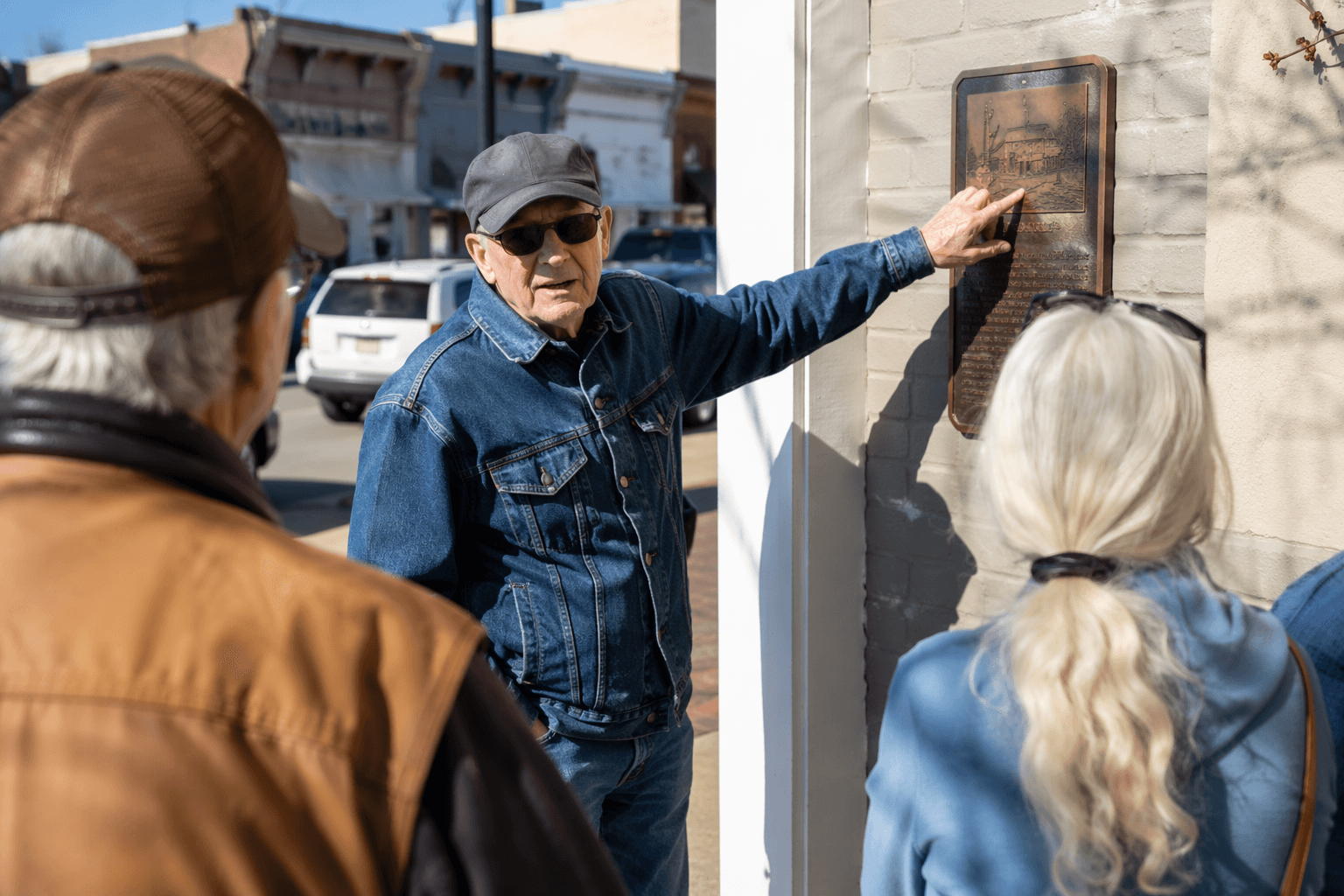
A strong cluster of historic properties reinforces that experience. A Kansas travel guide identifies three downtown buildings at 707, 720, and 722 Main as being on the national register. Another marker page notes that 707 Main Street was listed on the Kansas Register of Historic Places in 2012. Taken together, those listings show a preservation corridor rather than a single landmark, with several adjacent buildings carrying protected status along the same street.
The deeper history behind the storefronts
The plaques sit inside a broader story that reaches well beyond one downtown block. Eudora was established by German immigrants in 1857, after they purchased the town site from Shawnee chief Paschal Fish and named the town after his daughter, Eudora Fish. The city also notes that Native peoples, including the Kansa, Shawnee, and Delaware, lived in the area for thousands of years, and that Eudora sits near the Oregon Trail.
That history gives the downtown walk a broader social frame. The town’s 19th-century life included substantial Jewish and Black communities, which means the buildings on Main Street reflect a more layered population history than a simple founder’s story. The Sunflower Army Ammunition Plant, which opened in 1943, then accelerated growth in the area, tying Eudora’s development to wartime industry as well as local settlement.
For a reader walking downtown today, those facts change how the blocks feel. A plaque on a brick facade is not only about architecture. It becomes a trace of migration, land transfer, labor, commerce, and the way a small Kansas city absorbed each new era without erasing the one before it.
How to make the walk useful
The best way to approach downtown Eudora is to start at the museum and move outward along Main Street, then glance toward Church Street and the blocks that once held the city’s early commercial core. The walk works well as a self-guided stop because the buildings are close enough to read together, and because the plaques connect directly to the business district that still functions as the city’s center.
A practical visit can look like this:
- Begin at the Eudora Community Museum, 720 Main Street, open Tuesday through Saturday, 12:00 p.m. to 5:00 p.m.
- Read the plaques on Main Street as a sequence, not as isolated markers, so the street’s business history comes into view.
- Look for the historic building cluster around 707, 720, and 722 Main, where preservation is most visible.
- Notice how current storefronts, restaurants, and nearby parks sit inside the same downtown frame that once held wooden balconies and sidewalks.
That mix of archive and active street life is what makes downtown Eudora worth the stop. The plaques do not pull visitors away from the present-day city. They point straight into it, showing how a small downtown can keep its history readable while still doing the ordinary work of a living commercial center.
This article was produced by Prism’s automated news system from verified source data, official records, and press releases, then run through automated quality and moderation checks before publishing. The system is built and supervised by the people who set the standards it runs under. Read our full AI policy.
Did this article answer your question?