KU monarch study uses new tags to track monarch migration
New solar tags are showing monarch routes in near real time, giving Lawrence researchers proof that could reshape where Douglas County spends, plants and protects habitat.
What the new tags can prove
At the University of Kansas, Monarch Watch is using tiny solar-powered radio tags to do something older monarch tracking could not: follow individual butterflies across migration routes in near real time. The new system does not give exact GPS-style coordinates at every moment, but it can place approximate locations on a digital map, showing where a monarch has been, when it passed through, and how far it traveled.
For a species that has long been studied through limited tagging methods, that shift matters. Instead of learning only where a butterfly started or where it was finally recovered, researchers can now see much more of the journey itself, including the route through North America and the timing of movement along the way.
Why Lawrence is part of a bigger conservation test
Kristen Baum, Monarch Watch’s director and a KU professor in ecology and evolutionary biology, is leading the project from Lawrence with scientists in the United States, Canada and Mexico. Monarch Watch is an international program at KU that has operated since 1992, and this work puts Douglas County inside a continent-wide effort to turn long-running migration theories into direct evidence.
The project is part of the Project Monarch Collaboration, which was formed through a partnership between the Cape May Point Arts & Science Center and Cellular Tracking Technologies. Motus, the receiver network helping detect the tags, describes itself as an international collaborative research network that uses automated radio telemetry to track birds, bats and insects, and it is a program of Birds Canada.
How the tagging works
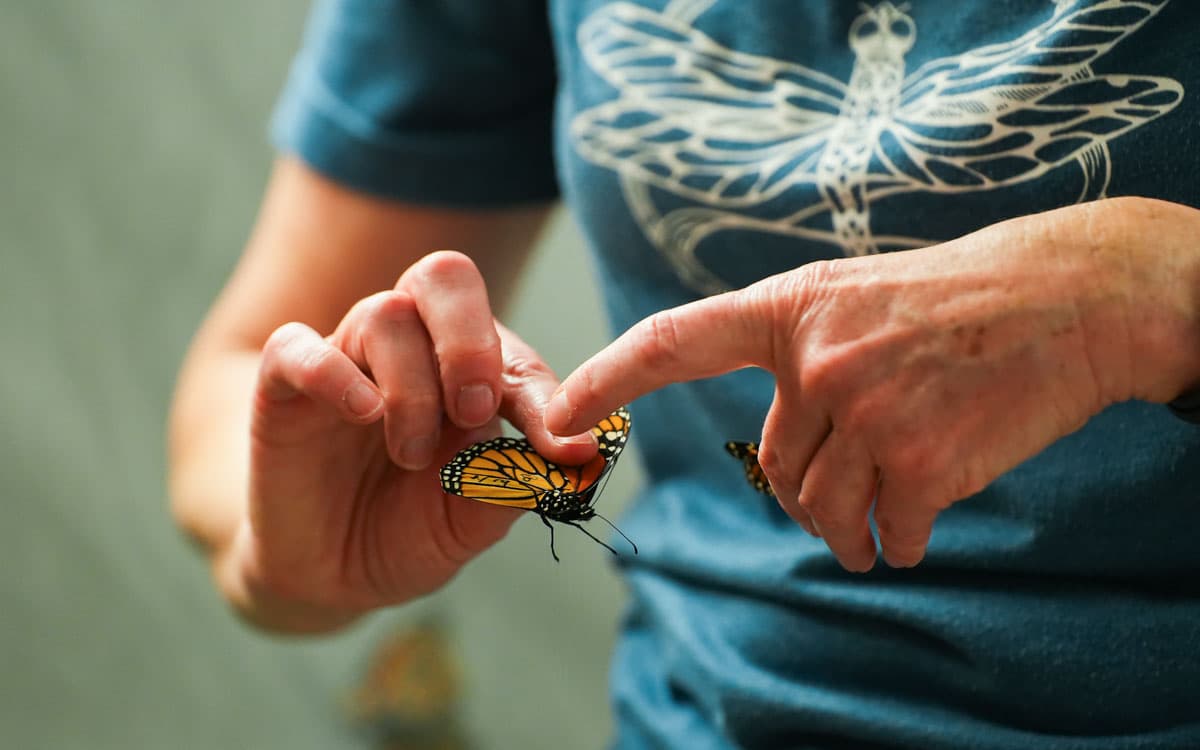
The hardware is small enough to handle by hand. Each BlūMorpho tag is only a few centimeters long, and the transmitters are solar powered, with a node that sends signals through passive Bluetooth detection and receiver stations such as Motus sites. Monarch Watch has also said the technology relies on Bluetooth crowd-sourced location networks to increase detections, giving researchers more chances to pick up a signal as a butterfly moves.
That matters because monarchs are too small to carry heavy equipment. The tags are built to fit the biology of the insect, and the method depends on many detectors rather than one perfect device on the butterfly itself. Baum has said the system still cannot pinpoint every exact location, but it reaches far beyond what traditional tagging can deliver.
What the first migrations have shown
Monarch Watch says it deployed more than 600 BlūMorpho solar-powered radio transmitters during the fall 2025 migration and another 150-plus ahead of the spring 2026 migration. The fall effort included 30 monarchs tagged in September 2025, and Monarch Watch says the spring project is now tagging first-generation monarchs in Texas, Oklahoma and Kansas to learn how far north they move.
The early results are the kind that can change a conservation argument. Monarch Watch says 10 of the 30 butterflies tagged in the fall made it all the way to Mexico, including some that reached overwintering sanctuaries such as the Monarch Butterfly Biosphere Reserve. A March 19, 2026 press release from Cellular Tracking Technologies said Project Monarch data had shown nine individual monarchs past the U.S. border and five deep into the United States, with fall-tagged butterflies also being observed as they headed north on the return leg of a complete, individually tracked migration generation.
What this could change in Douglas County
For Douglas County, the value is not just scientific curiosity. If researchers can identify more reliable migration corridors, the result could shape where conservation dollars go, which habitat sites get priority, and which planting plans best support monarchs as they move through Kansas.

That has practical consequences for:
- Native planting choices in Lawrence yards, school grounds and community spaces, especially milkweed and nectar sources that align with migration timing.
- Land management decisions on prairies, roadsides and preserved open space, where mowing, burns or other disturbance can be timed to reduce harm.
- Donor strategy, since conservation support can be aimed at projects that now have measurable migration data instead of broad assumptions.
The takeaway for local environmental policy is equally clear. A Lawrence-based research program can now help turn a symbolic species into a measurable case study, giving officials and land stewards a stronger basis for deciding where habitat protection will do the most good.
Why the timing matters now
Monarch migration has always inspired broad concern, but the new tagging system gives that concern sharper edges. It can show whether a corridor still functions, whether overwintering success lines up with northbound movement, and whether the butterflies crossing Kansas are part of a healthy migration chain or a broken one.
That is why the work in Lawrence matters beyond campus. Monarch Watch is not just collecting data on butterflies. It is helping build a record that could influence what gets planted, what gets protected and what gets funded across Douglas County and across North America. In a species where every mile counts, the difference between guesswork and proof can reshape the next round of conservation decisions.
This article was produced by Prism’s automated news system from verified source data, official records, and press releases, then run through automated quality and moderation checks before publishing. The system is built and supervised by the people who set the standards it runs under. Read our full AI policy.
Know something we missed? Have a correction or additional information?
Submit a Tip