Dubois County Museum murals bring early 1900s history to life
Dubois County Museum’s mural tour turns early-1900s town scenes into a countywide history lesson. The 15-piece Our Town Collection tracks how each community shaped local identity.
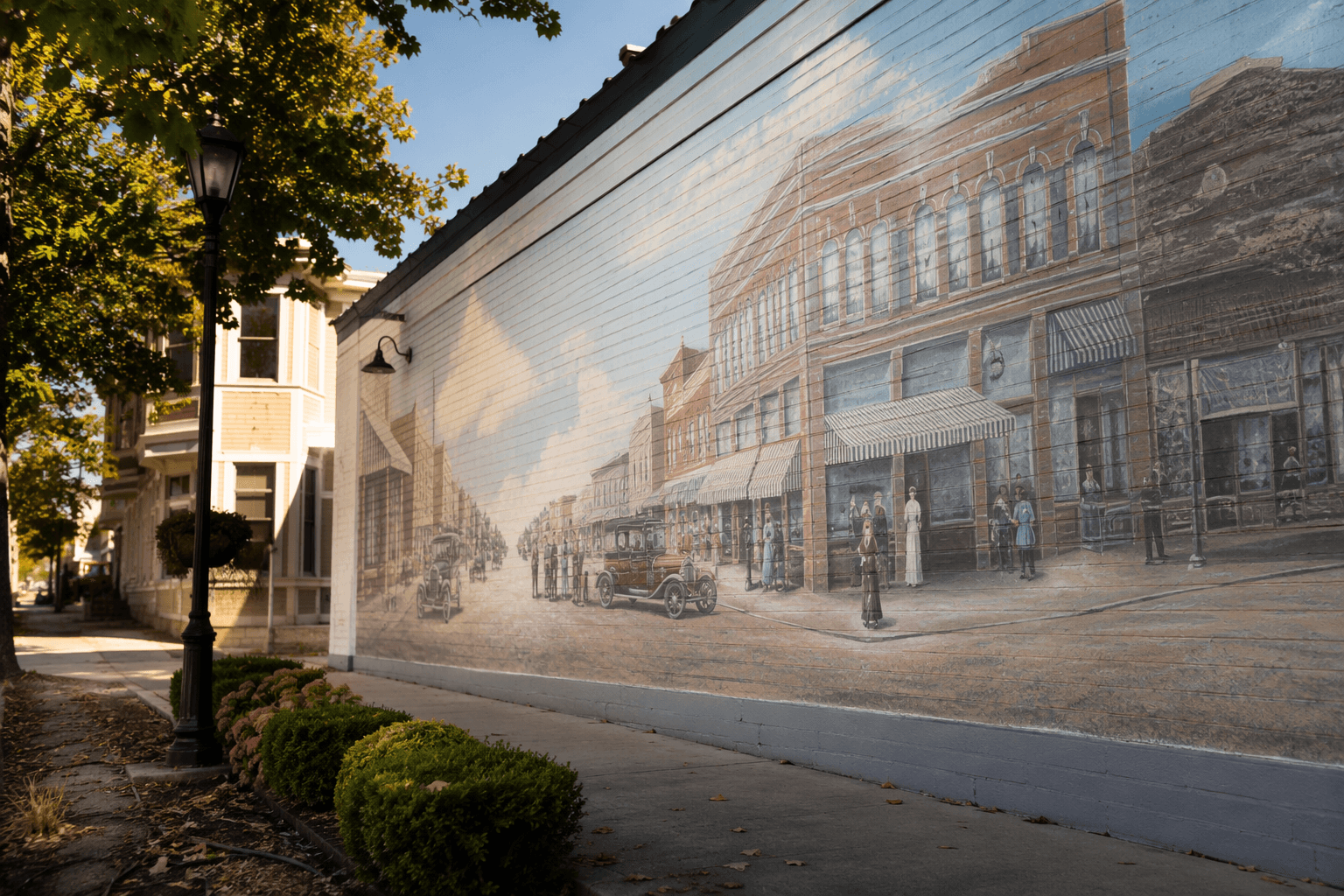
The Dubois County Museum’s mural tour turns a wall of artwork into a walk through the county’s past. Each mural shows important buildings and structures from Dubois County towns in the early 1900s, and each one has a description standing in front of it, so the history sits right beside the image.
What the mural tour shows
The museum frames the project as the Our Town Collection, and that name fits what the murals are doing. Instead of treating Dubois County as one blended place, the collection breaks it into distinct communities and lets each one speak for itself through architecture, streetscapes, and remembered landmarks.
That matters in a county shaped by German Catholic heritage and by church-centered rural development. In a place where parish life, schools, and small commercial centers often defined daily routines, the buildings in the murals are not decorative background. They are the places where people gathered, worked, worshiped, learned, and measured whether a town was growing or fading.
The collection grew community by community
By April 2025, the museum said the collection included 15 town murals. That count shows the project is not a one-off display, but a countywide effort built over time, with new communities added as the series expanded.
The growth is easy to trace in the public unveilings. The museum introduced St. Anthony and St. Marks as the latest additions to the Our Town Collection, and earlier murals already included Ferdinand, St. Henry/Johnsboro, Holland, Ireland and Port. Another public unveiling at the museum marked the opening of the Schnellville mural, reinforcing that each piece has arrived as its own community event rather than as part of a single release.
Kim Schroeder is the artist tied to that expansion. The museum’s April 2025 newsletter said Schroeder created 11 of the 15 murals, and the St. Anthony and St. Marks pieces were identified as her work as well. That gives the collection a clear artistic signature, while still leaving room for the individual town subjects to define the story.
Why the murals matter beyond the museum
The value of the tour is not only that it preserves old images, but that it shows how local memory is organized. George R. Wilson’s 1896 History and art souvenir of Dubois County and his 1910 History of Dubois County from its primitive days to 1910 both underline how much of the county’s identity has long been tied to settlement, schools, churches, and civic life. The murals translate that same idea into something you can stand in front of and read in minutes.
That is especially useful in Dubois County, where towns and unincorporated places often carry strong identities of their own. A mural of one community may emphasize a church-centered landscape, while another may focus on a downtown block or another landmark that once anchored everyday life. The contrast between them is part of the lesson: the county’s story is not one uniform pattern, but a set of local choices about what mattered enough to keep in view.
The Ireland Historical Society Museum offers a concrete example of why this approach resonates here. It is housed in a church built in 1878 by the Ireland Methodist Church, and the building is the oldest remaining structure in Ireland. That kind of continuity explains the appeal of the mural tour, because in Dubois County a building can remain meaningful long after its original use changes.
How to use the tour as a local outing
Visit Dubois County already promotes murals as a visitor activity, which makes the museum collection easy to fold into a day in Jasper or a drive through the county’s smaller towns. The tour works as a self-guided stop, but it also works as a comparison exercise: look at which buildings each community chose to remember, then compare those choices town by town.
A practical way to read the collection is to pair the murals with nearby local-history stops and with the town names themselves.
- Start at the Dubois County Museum and read the descriptions in front of each mural before moving on. Those panels supply the local context that turns the artwork into a history lesson.
- Compare the older mural subjects, including Ferdinand, St. Henry/Johnsboro, Holland, Ireland and Port, with later additions such as St. Anthony, St. Marks and Schnellville. The sequence shows how the collection kept widening its map of the county.
- If you are already in Ireland, stop by the Ireland Historical Society Museum to see how one surviving building can carry a town’s memory just as a mural can.
For families, the tour is an easy way to make county history visible without turning it into a lecture. For longtime residents, it is a reminder of how quickly familiar buildings can disappear and how much of a community’s identity survives through shared images, names and places. For visitors, it is one of the clearest introductions to Dubois County’s towns, because the murals show not just where people lived, but what they once considered worth preserving.
This article was produced by Prism’s automated news system from verified source data, official records, and press releases, then run through automated quality and moderation checks before publishing. The system is built and supervised by the people who set the standards it runs under. Read our full AI policy.
Did this article answer your question?