Field Sprayer Ignites After Striking 70,000-Volt Line Near Huntingburg
A field sprayer burned to a loss on County Road 400 South after its boom struck a 70,000-volt line, forcing Huntingburg firefighters to stand down until Hoosier Energy cut power to the circuit.
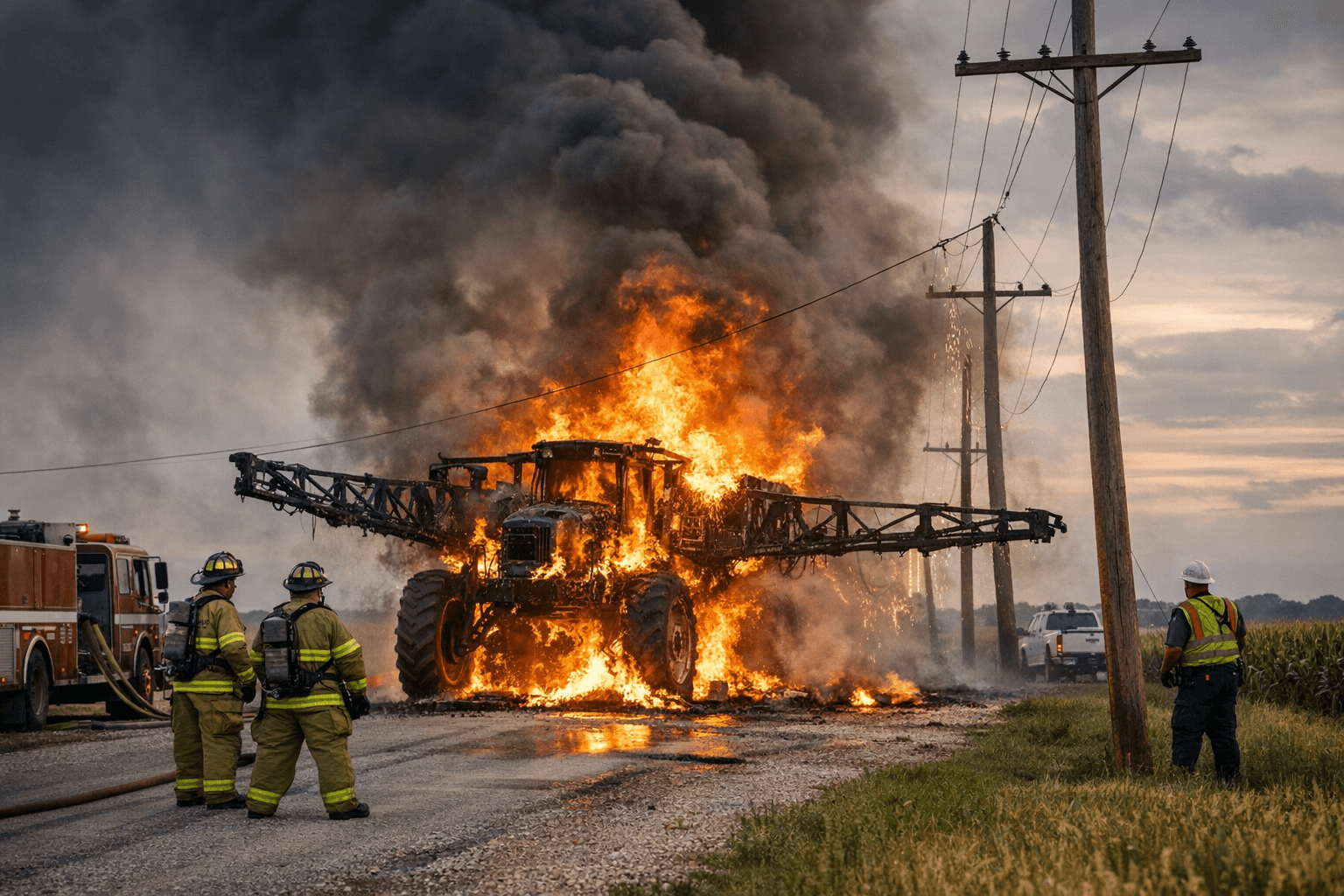
A field sprayer burned to a total loss along County Road 400 South north of Huntingburg on Tuesday after its boom struck a 70,000-volt Hoosier Energy transmission line, triggering a response that required utility crews to shut down the circuit before firefighters could get near the machine.
Huntingburg Fire Department arrived at approximately 1:38 p.m. on April 1 and found the sprayer fully engulfed and still in contact with the energized line. Direct suppression was not an option: water applied to equipment arcing against a 70,000-volt circuit turns a firefighter into a conductor. Crews held position and coordinated with Hoosier Energy to de-energize the affected segment, a process that requires utility dispatch, remote switching, and in some cases physical crew deployment to the transmission corridor. No injuries were reported.
The geometry of how this happens is familiar to anyone who has watched a wide-boom sprayer work a field corridor. Modern self-propelled sprayers can extend booms well past 100 feet, with raised fold sections reaching 12 feet or higher during transport or field turns. Transmission lines along rural rights-of-way in Dubois County sit at clearances that look adequate from the cab but leave little margin when a boom lifts unexpectedly over a grade change or road crown. The County Road 400 South corridor runs through active crop ground north of the city, where overhead infrastructure and seasonal fieldwork share the same narrow path every spring.
The financial damage is severe even before insurance calculations begin. New self-propelled sprayers list above $500,000, and losing a machine during early-season application windows compresses the schedule for pre-emergent passes across hundreds of acres in a way that cannot be recovered with a phone call to a dealer.
Beyond the equipment loss, the contact carried real stakes for the broader grid. A 70,000-volt fault can send current spikes through the system that trigger protective relays and create localized outages for farms and homes on the same circuit. Hoosier Energy serves more than 700,000 consumers across Indiana and Illinois through 17 member cooperatives, and a forced de-energization on a transmission segment requires coordination well beyond the field boundary before service is fully restored. The utility also needs to inspect the affected span for physical damage before returning the line to service.
The clearance standard is not ambiguous: cooperative safety programs advise maintaining at least 10 feet of horizontal and vertical clearance from overhead lines at all times, and sprayers that can reach 12 feet in a raised position make that margin tighter than it appears at field speed. Marking line heights at field access points and using a spotter when working near transmission corridors are the two most direct ways to prevent contact in the first place.
If contact does occur, stay in the cab unless fire forces exit. If exit is unavoidable, jump clear so both feet land simultaneously without touching the equipment, then shuffle away without lifting either foot from the ground. That technique prevents the body from becoming a path for step-potential voltage moving through charged soil between your feet. Call 911 immediately and report the contact to Hoosier Energy's emergency line.
Hoosier Energy and local authorities typically investigate such incidents to determine contributing factors, including terrain, boom angle, line sag, and operator sightlines. The April 1 contact along County Road 400 South is a direct reminder that transmission corridors and planting season arrive on the same calendar in Dubois County.
This article was produced by Prism’s automated news system from verified source data, official records, and press releases, then run through automated quality and moderation checks before publishing. The system is built and supervised by the people who set the standards it runs under. Read our full AI policy.
Did this article answer your question?