Courthouse Park tells downtown Fresno’s origin story
Courthouse Park is downtown Fresno’s compact civic record, where a railroad-era land dispute still shows up in the city’s walkable core, memorials, and county power.
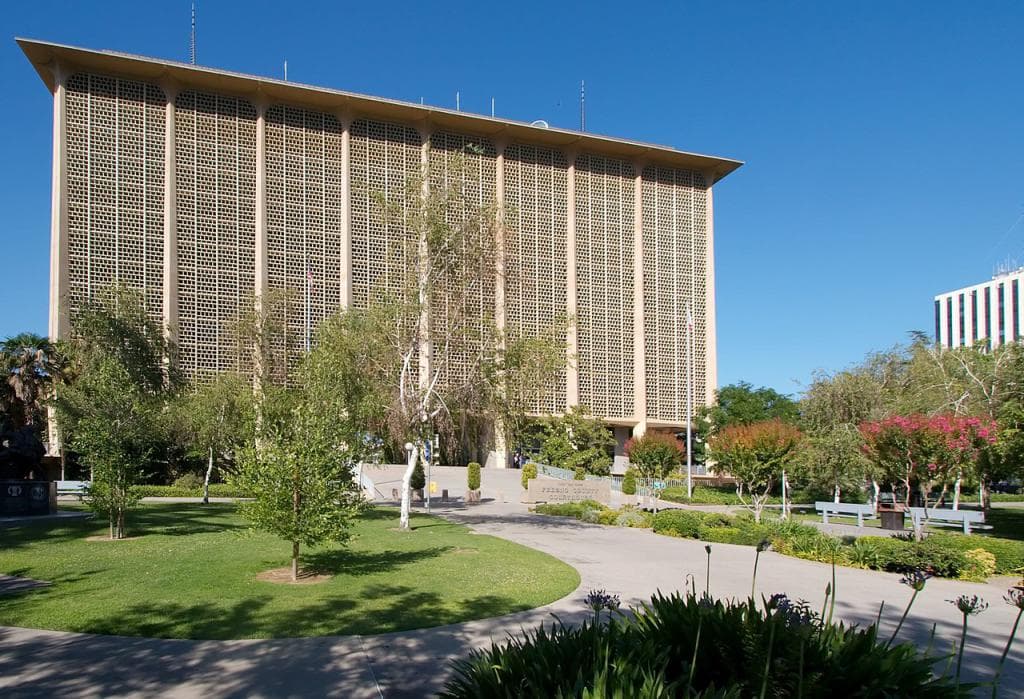
Courthouse Park is where downtown Fresno’s civic map was first argued out in public, and the answer still sits at Mariposa and Fresno streets. What began as a railroad-era offer of land became a park, a courthouse site, and a compact record of how the city chose to organize itself around government, commerce, and foot traffic.
How the park got its address
The origin story starts in 1872, when the Central Pacific Railroad laid out Fresno Station and offered a four-block parcel at O and Fresno streets for a park and a future courthouse. Local residents thought that site was too far from the business district on H Street, which is the kind of practical complaint that reveals how early Fresno actually functioned. They asked for land closer in, and the railroad gave four blocks at Mariposa and Fresno streets instead.
That swap matters because it was not just about a park. It was a decision about where people would walk, where they would do business, and where county power would be visible in daily life. Courthouse Park grew out of a debate over access and convenience, and that is still the right lens for understanding it now.
What the park holds now
The County of Fresno identifies Courthouse Park as the site of the Fresno County Courthouse in Downtown Fresno and says it has been a site of community activity since the 1870s. The county also says the park is home to many memorials and host to many events, which makes it less like a decorative green space and more like a civic stage that still gathers public life in one place. That mix is why the park works as both a place to pass through and a place to stop.
One of the clearest markers of that civic role is the Fresno County Peace Officers Memorial. A Fresno Bee item says the granite memorial was erected in 1998, while the names on it date back to 1889. The memorial is tied to an annual ceremony observed on May 15, which gives the park a recurring ritual of county remembrance rather than a one-time historical marker.
Another layer of the park’s identity comes from the Purple Heart memorial and the Anna Woodward memorial fountain. Fresno County Public Library’s landmark listings identify both as part of the park’s historic marker-and-sculpture landscape, showing that Courthouse Park holds more than one kind of public memory. ABC30 Fresno noted that the Anna Woodward fountain was being restored as part of a renovation project at the park, a reminder that the site is maintained not only as open space but also as a place with aging civic objects that need care.
The walk that ties it together
Courthouse Park does not sit on its own island. The County of Fresno says it is connected to the Fulton District and Eaton Plaza by the Mariposa pedestrian mall, which turns the park into part of a downtown walking circuit rather than a dead-end lawn. That connection matters in a city that still wrestles with downtown foot traffic, because the park only makes sense when it is read alongside the blocks around it.
Mariposa Plaza sharpens that idea by anchoring the pedestrian network at Fulton St & Mariposa St, Fresno, CA 93721. From there, Courthouse Park fits into a short downtown path that links civic space, public art, and the older commercial grid. The result is a route that shows how Fresno’s center city has been stitched together around blocks meant for walking, gathering, and looking at public institutions up close.
For anyone trying to understand downtown Fresno without treating it like a drive-through district, this is the simplest path to follow:
- Start at Courthouse Park and look for the courthouse itself, the Peace Officers Memorial, the Purple Heart memorial, and the Anna Woodward fountain.
- Continue along the Mariposa pedestrian mall toward the Fulton District and Eaton Plaza.
- Treat Mariposa Plaza as a fixed point in the downtown walking pattern, not just a plaza name on a map.
That route takes only a few blocks, but it reveals how the county, the city, and downtown commerce were meant to fit together.
Why locals still use it, and why that matters
The park’s usefulness is practical as much as historical. The county’s own description makes clear that it is a place for community activity, memorials, and events, which means it still serves multiple audiences at once: courthouse visitors, downtown workers, school groups, families, and people passing through on foot. It is also one of the few places in downtown Fresno where the city’s origin story can be read off the ground instead of in a book.
A ValleyHistory listing reinforces that role by offering a 45-minute Courthouse Park Walking Tour for $15. The existence of a paid walking tour signals that the park is already operating as an interpretive site, not merely a patch of grass beside government buildings. That matters in a downtown still defined by questions of upkeep, access, and whether public space actually draws people in.
Courthouse Park endures because it still does the same work it was chosen to do in the 1870s. It marks county authority, gives downtown a walkable center, and preserves the landmarks that make Fresno’s civic history visible in one compact place.
This article was produced by Prism’s automated news system from verified source data, official records, and press releases, then run through automated quality and moderation checks before publishing. The system is built and supervised by the people who set the standards it runs under. Read our full AI policy.
Did this article answer your question?