Fresno County Heritage Sites Offer Residents Rich Historical Exploration Opportunities
M. Theo Kearney's 5,400-acre estate anchors Fresno County's seven most compelling heritage sites, spanning a Japanese friendship garden, an 1887 railroad depot, and a 16-room Victorian mansion.
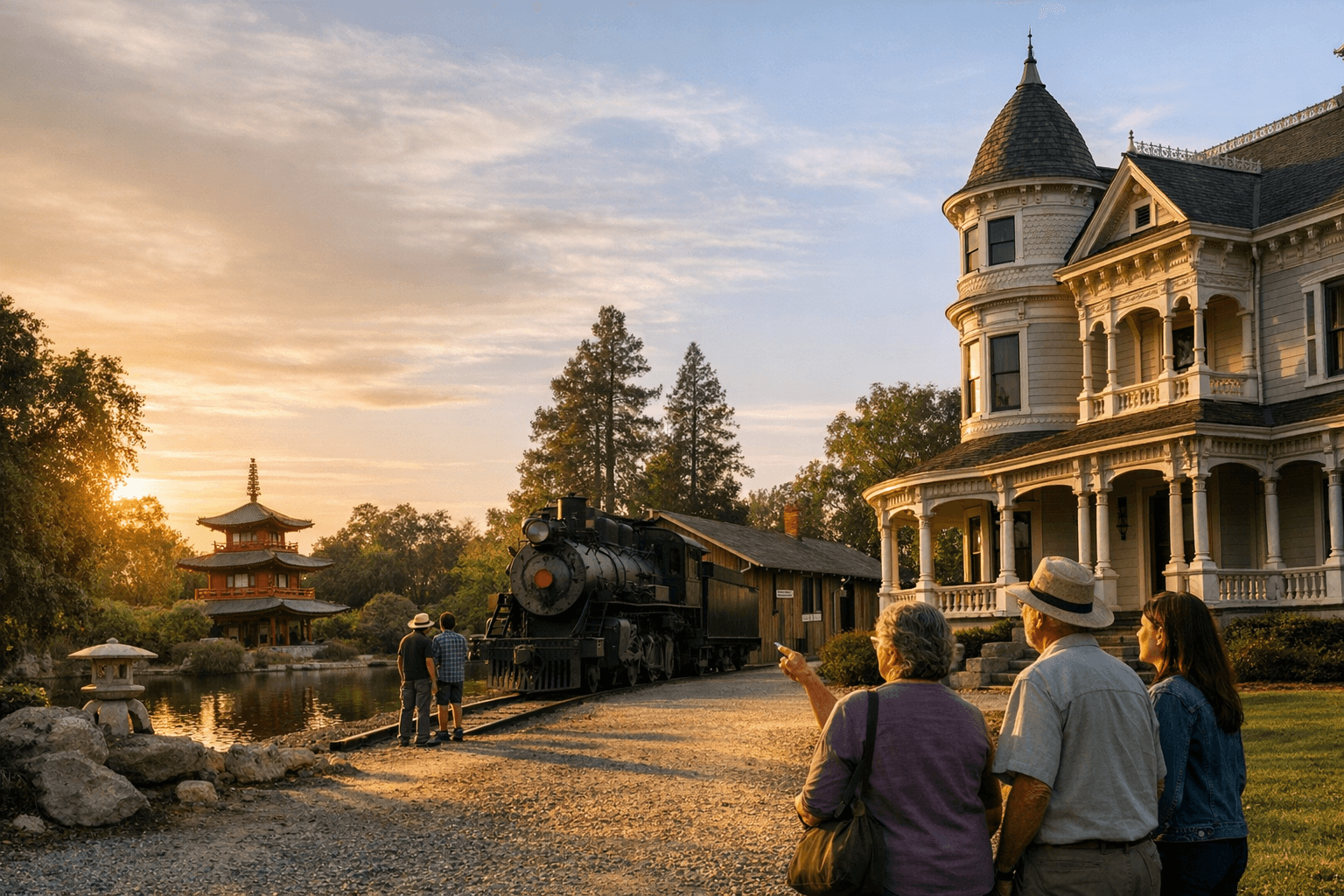
M. Theo Kearney assembled 5,400 acres of farmland in the San Joaquin Valley and earned a title that still follows his name: the Raisin King of California. His estate is one of seven Fresno County sites where that kind of history isn't archived behind glass but embedded in buildings, gardens, and landscapes visitors can still walk through.
Meux Home Museum: Victorian Fresno in 16 Rooms
Dr. Thomas Richard Meux completed his 16-room Gothic Victorian mansion in downtown Fresno in 1888, and it remains one of the most intact examples of that architectural style in the Central Valley. Docent-led tours run Fridays, Saturdays, and Sundays from noon to 3:30 p.m., with guides in period costume walking visitors through rooms that illuminate domestic life in a city still defining itself. Tours typically take 45 minutes to an hour, with the surrounding garden rounding out the visit. For anyone who has struggled to picture Fresno before the 20th century reshaped it, the Meux Home answers that question concretely, room by room.
Kearney Mansion Museum: The Raisin King's Estate
Martin Theodore Kearney (1842-1906) was a California agricultural pioneer who came to be known as the Raisin King, and guided tours of the Kearney Mansion Museum, also known as the Superintendent's Lodge, provide a glimpse of the San Joaquin Valley's agricultural beginnings through his life and times. The Lodge served as the ranch headquarters of Kearney's Fruit Vale Estate inside Kearney Park, southwest of downtown Fresno. At the time of Kearney's death, his estate consisted of $1.5 million and 5,400 acres of farmland. As early as 1899 Kearney had decided to leave his estate to the Regents of the University of California in hopes they would establish a college of agriculture there, a vision that never fully materialized but reflects how seriously Central Valley leaders took the long-term future of their industry. The 11-mile boulevard leading from downtown Fresno to the park was lined with alternating eucalyptus and palms, interspersed with 18,000 white and pink oleanders, a detail that conveys the scale of ambition Kearney brought to everything he built.
Sanger Depot Museum: Where the Railroad Built a Town
Built in 1887, the Sanger Railroad Depot sat beside the Southern Pacific Railroad that ran between Fresno and Porterville. Among the cargo that passed through was grain, citrus, and lots of lumber brought down from the mountains by Sanger's booming lumber operation. When that commerce eventually subsided, the building turned out to be the oldest surviving structure in Sanger, and community advocates transformed it into the Sanger Depot Museum. Sanger is located about 10 miles east of Fresno in California's Central Valley, right at the foot of the Sierra Nevada Mountain Range, and today the city is known as "the Nation's Christmas Tree City." The museum's rolling-stock artifacts and rail commerce exhibits trace a story that runs well beyond Sanger itself, connecting local commerce to the rail infrastructure that shaped the entire Central Valley economy.
Reedley Historical Society and Historic Homes Tour
Reedley's story is inseparable from the immigrant farming communities who built its orchards and packing industry. The Reedley Historical Society preserves that legacy, and its periodic historic homes tours give visitors a close look at early 20th-century residential architecture that reflects the economic ambitions and cultural identities of those communities. Reedley's historic downtown functions as an open-air record of how a small agricultural city evolved, with storefronts and homes that document decades of industry-driven growth. The tours offer something museum exhibits rarely provide: the human scale of how people actually lived and worked in this landscape.
Fresno Chaffee Zoo: Civic Heritage and Public Space
The Fresno Chaffee Zoo is primarily an attraction, but its long arc of civic development earns it a place in any serious tour of Fresno County's heritage. The site's expansion and entrance planning over the decades reflect sustained community investment in conservation education and public green space, a tradition that stretches back generations. As one of the region's most visited institutions, the zoo connects present-day Fresno to a lineage of civic vision that has consistently prioritized public access to shared spaces.
Woodward Park and Shinzen Friendship Garden: Built for Two Cities
The initial development of a Japanese garden was envisioned in 1967, and the donation of land by Ralph Woodward to establish Woodward Park helped launch the Woodward Park Japanese Development Committee, led by Ben Nakamura. The idea was to create a Japanese garden complete with stone lanterns and a teahouse to be dedicated to Fresno's Sister City Kochi, Japan, as a symbol of friendship and international brotherhood. Design work by Kodo Matsubara gave form to what became the Shinzen Friendship Garden. The Clark Bonsai Collection, opened in the fall of 2015, added a major new display area to Shinzen, with over 100 special bonsai serving as a living museum of the art form through lectures, training, and workshops. The garden also hosts the Fall Festival, the Spring Blossom Festival, and the Toro Nagashi Lantern Event, making Woodward Park considerably more than a recreational landmark.
Historic Downtown Clovis: Turn-of-the-Century Architecture Still in Use
Clovis built its downtown core around the turn of the century, and much of that storefront architecture survives in the district today. The city has maintained a commitment to historic preservation that distinguishes it within Fresno County's broader urban landscape. Annual community traditions, including the Big Hat Days rodeo and Western-themed festivals, layer living culture onto the preserved physical environment in a way that keeps the district active rather than merely archived. Walking Old Town Clovis provides a sense of small-city California identity that complements the larger scale of Fresno proper and shows what sustained preservation investment can accomplish over decades.
Planning Your Visit
Spring and fall offer the most comfortable conditions for walking tours and outdoor exploration across these sites. Many museums operate weekend docent schedules, and calling ahead or checking official pages before visiting avoids a wasted trip. Most locations offer free or low-cost admission, with reduced rates commonly available for students and seniors. Taken together, these seven sites build a coherent picture of Fresno County's economic and cultural foundations: from raisin farming and railroad commerce to Japanese-American community building and Victorian domesticity. No single afternoon covers all of them, but the county's compact geography makes it realistic to build a meaningful heritage itinerary across a long weekend.
This article was produced by Prism’s automated news system from verified source data, official records, and press releases, then run through automated quality and moderation checks before publishing. The system is built and supervised by the people who set the standards it runs under. Read our full AI policy.
Did this article answer your question?


