Goochland conservation easements protect farms, forests, and historic land
Goochland’s easements keep farms and forests working while limiting development, offering tax benefits in exchange for long-term protection.
What a conservation easement does in Goochland
A conservation easement is not a land giveaway. It is a voluntary legal agreement that keeps land in private hands while limiting future development rights so the property can stay farmed, forested, or otherwise put to compatible uses. In Goochland, that matters because the county sits at the edge of development pressure that can quickly change rural character, strain natural resources, and reshape historic landscapes.
The county presents conservation easements as a practical tool for preserving farmland, open space, forests, and historically important land for future generations. Goochland’s Planning and Zoning office also lists conservation easement programs among its responsibilities, which shows this is part of the county’s day-to-day land-use work, not just a preservation slogan.
Why the county sees easements as a growth strategy
Goochland’s easement page frames the issue plainly: development pressure can place strain on Virginia’s natural and cultural resources. For a county with rural roads, working farms, and scattered historic places, the question is not simply whether land changes hands. It is whether the land keeps performing the same local roles over time.
That is why easements are so central to the county’s future growth picture. They do not stop all change, but they can shape where growth goes and what remains intact. In practice, they help preserve the kind of landscape that makes Goochland distinct, while giving landowners a way to keep land productive instead of carving it into lots.
The tradeoff landowners accept
The appeal for landowners is straightforward: an easement can be tailored to the owner’s goals, allowing the property to remain viable and productive while preventing future development that would permanently alter it. Under Virginia Outdoors Foundation rules, easements are permanent deed restrictions, and they can still allow farming, forestry, recreation, wildlife habitat, and other compatible uses.
That permanence is the core tradeoff. Once the deed is signed and recorded, the restriction stays with the land. Landowners can change their minds up until that point, but after recording, the decision becomes part of the property itself. For families holding large tracts, that can be a serious long-term choice, even when the land remains in active use.
Why some owners say yes
The county notes that donating an easement may qualify a landowner for income tax and property tax benefits, and those incentives can matter as much as the preservation goal itself. Virginia Tax says the state land preservation tax credit equals 40% of the fair market value of a donated land interest or easement, with a yearly statewide cap of $75 million and an annual taxpayer limit of $20,000.
Those numbers help explain why easements can work for farmers, forestry owners, and families planning for the next generation. The Virginia Department of Conservation and Recreation says federal, state, and local tax benefits may be available for donated easements, and the Virginia Outdoors Foundation notes that easements can also be a powerful estate-planning tool. In other words, the arrangement can help land stay in the family or remain in agricultural use even when market pressure would otherwise push toward development.
Goochland’s place in Virginia conservation history
Goochland is not just participating in the conservation story. It is where that story began. The county says the first recorded conservation easement in Virginia was donated in June 1968 by James M. Ball Jr. to the Virginia Outdoors Foundation, covering a 104-acre parcel in Goochland County. A Virginia Outdoors Foundation fact sheet gives a closely related account, saying the foundation recorded its first easement on June 13, 1968, on a 102-acre property owned by the University of Richmond in Goochland County.
The two accounts point to the same broad fact: Goochland holds the earliest recorded easement chapter in Virginia, even if the acreage is cited slightly differently. That detail matters because it places the county at the start of a statewide preservation movement that has since become a major part of how Virginia protects working lands and open spaces.
How much land is protected now
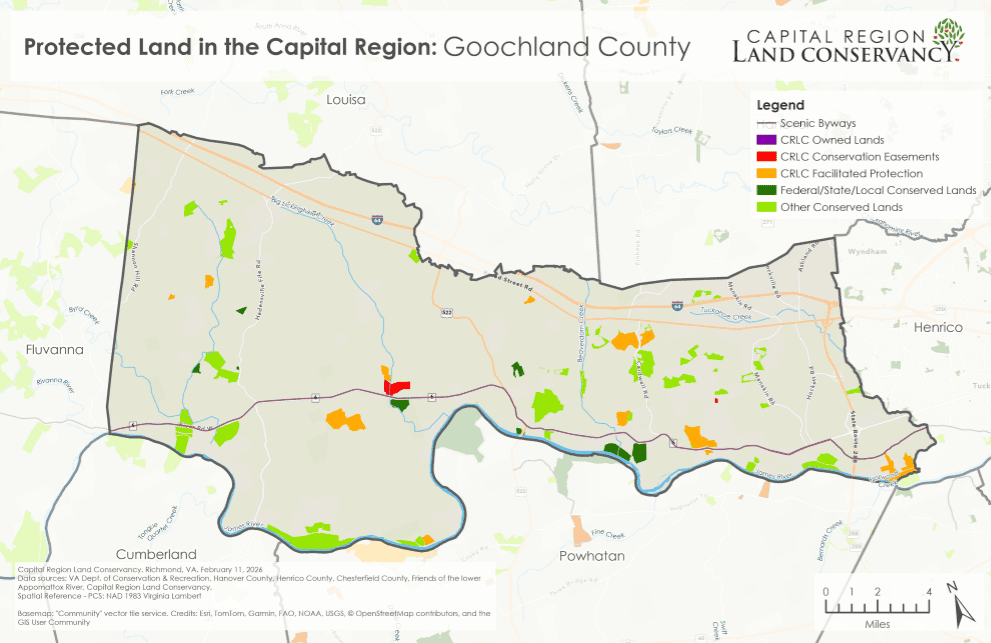
The local picture is still modest in scale but significant in meaning. Goochland says more than 800 acres in the county are now under conservation. That is not enough to stop all growth, but it is enough to show that preservation remains active rather than symbolic.
Statewide, the numbers are much larger. The Virginia Department of Conservation and Recreation says that as of June 2024, about 17.08% of Virginia’s land, or 4.32 million acres, was permanently protected. The Virginia Outdoors Foundation says it protects more than 910,000 acres of farmland, forestland, parkland, and other open spaces across Virginia, and that its easements account for about 80% of all open-space easement acreage in the state.
What VOF protects beyond Goochland
The Virginia Outdoors Foundation says it manages more than 4,000 open-space easements statewide. Its protected lands help safeguard more than 4,200 miles of streams and rivers, 380,000 acres of high-quality farm soils, 340,000 acres of high-priority forestland, 4,300 historic sites, and 375 miles of scenic roads and rivers.
Those figures show why easements are often treated as more than a property-rights issue. They connect land use to water quality, working agriculture, forestry, heritage, and scenic corridors. For a county like Goochland, that broader network helps explain why preservation is discussed alongside local land-use decisions rather than apart from them.
A local example at Leake’s Mill Park
Leake’s Mill Park offers a visible Goochland example of how easements can support both preservation and public use. More than half of the 176-acre park has been protected by a Virginia Outdoors Foundation easement since 2010, and the park includes nine miles of mountain biking trails built and maintained by volunteers.
That combination is important. It shows that conservation easements do not always mean land is locked away from the public. In the right setting, they can help protect a landscape while still supporting recreation, stewardship, and community access.
A preservation network built with partners
Goochland says roughly 30 land trusts operate in Virginia alongside counties and state agencies to preserve rural landscapes and character. That network matters because easements usually depend on private owners, public policy, and conservation organizations working together.
The county’s conservation easement page functions as a guide to that system. It points residents toward land trusts and the Virginia Department of Conservation and Recreation’s map explorer, making clear that the county sees preservation as an ongoing land-use strategy. In a place where development pressure and rural identity are constantly in tension, easements are one of the few tools that can preserve farms, forests, and historic land without taking property out of private ownership.
This article was produced by Prism’s automated news system from verified source data, official records, and press releases, then run through automated quality and moderation checks before publishing. The system is built and supervised by the people who set the standards it runs under. Read our full AI policy.
Did this article answer your question?