Grand Traverse County closes Boardman River stretch after flood debris risks
Grand Traverse County shut a Boardman River segment after flood debris made paddling life-threatening, leaving a key stretch closed while cleanup continues.
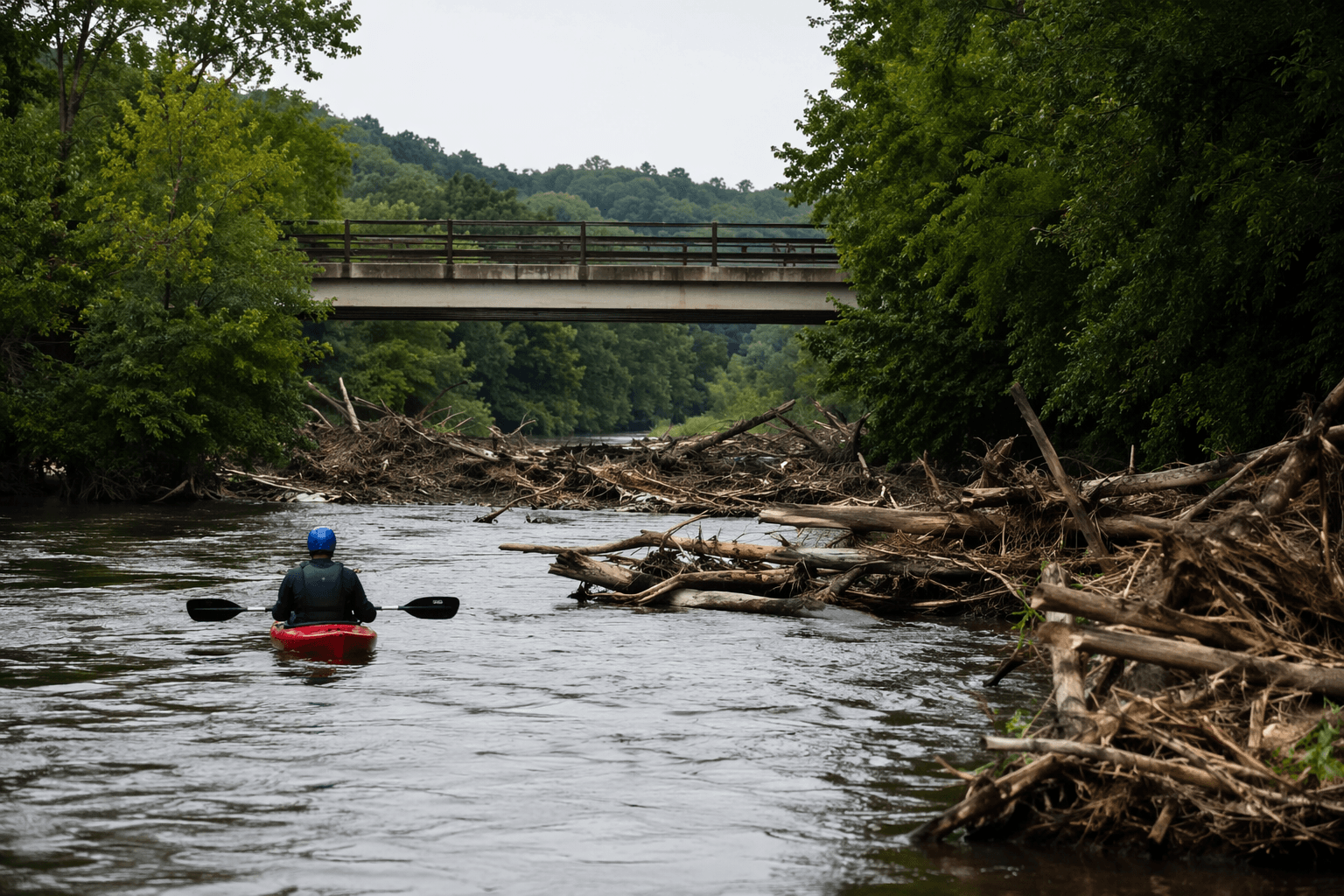
Paddlers on the Boardman River now face a hard stop between Brown Bridge Landing and Jack’s Landing, where Grand Traverse County has closed access because flood debris created life-threatening conditions. Officials say submerged snags, logs and other obstacles could flip boats or trap people in the current, turning a familiar route into a serious hazard.
The closure matters because the Boardman, also known as the Ottaway, is one of the county’s most heavily used river corridors. Some reaches remain open, including the stretch from Forks Campground to Scheck’s Campground and from Scheck’s Campground to Brown Bridge Canoe Landing, but the closed segment in between means a normal trip plan may no longer work without a portage or a full reroute. For canoeists, kayakers and casual river users, the county’s message is clear: check access before launching and do not assume a routine run is safe.
The danger traces back to the April 14 flood, when the Boardman River at Beitner Road reached 7.8 feet and the water did enough damage to collapse Beitner Bridge and force evacuations along the river. County officials said the local state of emergency was intended to improve coordination of public-safety resources and recovery efforts, and the river closure fits that broader effort to keep people out of unstable areas while conditions are still being assessed.
Cleanup is still underway. A post-storm effort on May 22 brought volunteers and river partners to the lower Boardman/Ottaway River between FishPass and West Grand Traverse Bay, and the Grand Traverse County Road Commission approved a contract to remove the collapsed culverts at Beitner Bridge. That work is part of a wider recovery push aimed at restoring safe access while also dealing with the damage left behind by fast-moving floodwater.
The long-term significance of the Boardman corridor is part of why the closure has drawn attention. The Boardman/Ottaway River Restoration Project removed three aging dams, restored more than 250 acres of wetlands and floodplain habitat, and reconnected more than 160 miles of river and tributaries. That history makes the current debris problem more than a temporary inconvenience. For now, it is a safety boundary on a river that remains in recovery.
This article was produced by Prism’s automated news system from verified source data, official records, and press releases, then run through automated quality and moderation checks before publishing. The system is built and supervised by the people who set the standards it runs under. Read our full AI policy.
Did this article answer your question?