Historic courthouse remains Grand Traverse County’s civic hub in Traverse City
Grand Traverse County’s courthouse is still a working government center, not just a landmark. Its preservation, downtown location and daily public use keep Washington Street at the heart of civic life.
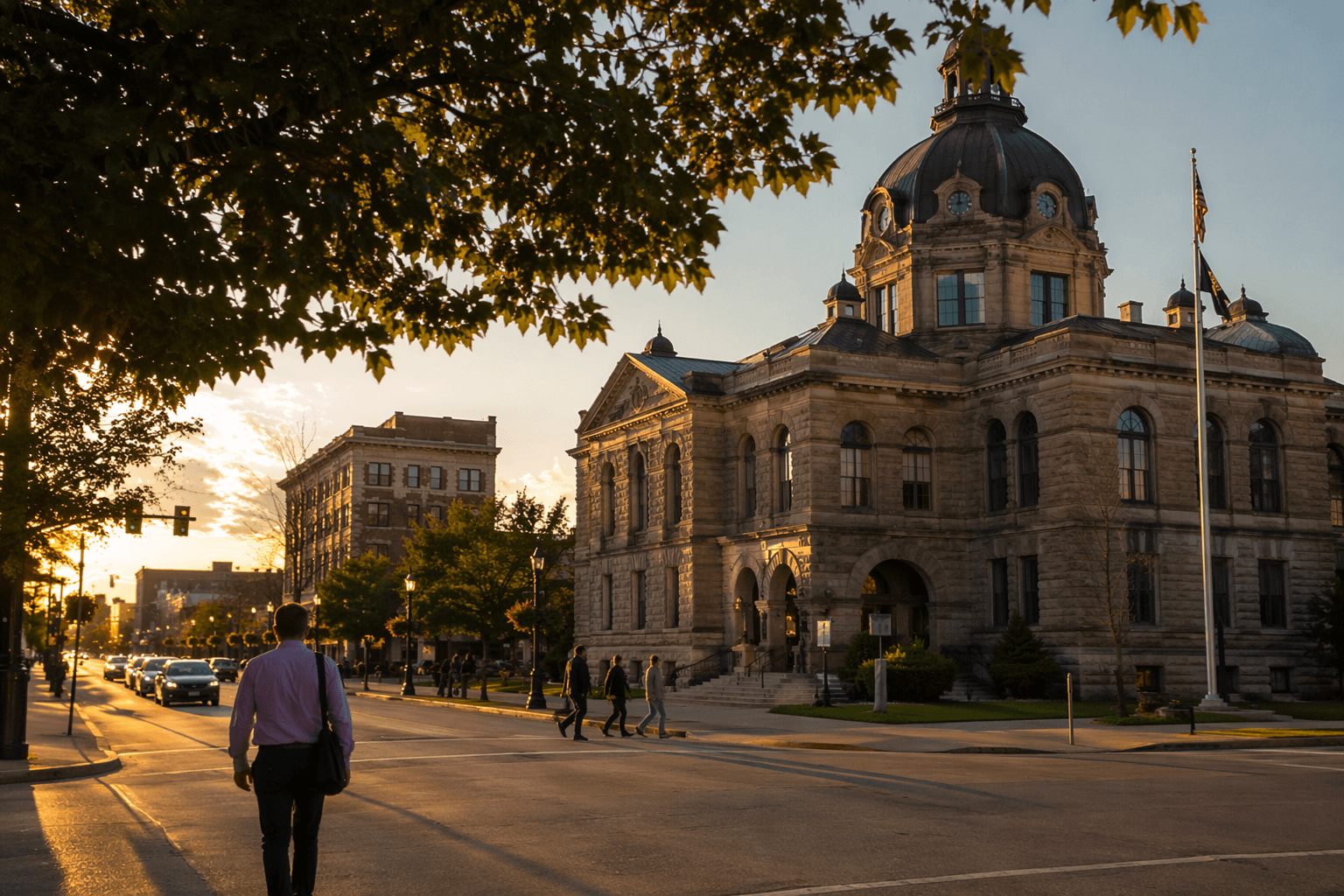
Grand Traverse County’s historic courthouse at 328 Washington Street still does the job it was built to do: bring county government into the center of Traverse City. The brick-and-stone building houses active court and probation-related offices, draws residents seeking records and services, and anchors a stretch of downtown where public access and business traffic still intersect.
A courthouse built to hold the county together
Grand Traverse County was officially organized in 1851, and its first courthouse and jail went up in 1854 for $600 on land donated by Hannah, Lay and Company. That wooden building burned in 1862, leaving the county to rely on rented quarters for decades while officials carried out basic government business without a permanent home.
The present courthouse changed that. In 1898, the county accepted plans from the Grand Rapids architects Rush, Bowman and Rush, and the new brick-and-stone building was completed in 1900 at a cost of $35,665. Built on the site of the original courthouse, it gave the county a fixed civic address on Washington Street, where the courthouse could serve both as an institution of government and as a visible sign of local stability.
A working government building, not a frozen relic
The Historic Courthouse is still part of the county’s day-to-day operations. Grand Traverse County’s facilities listing says the building houses the 13th Circuit Court, Circuit Court Administration, Friend of the Court and the Michigan Department of Corrections. That means the courthouse is not simply a preserved exterior or a place for occasional tours. It remains a place where people come for hearings, administrative matters and services tied directly to the legal system.
The county’s online records and document-search systems extend that function beyond the building itself. Through its website, residents can search basic document information online, and the county also provides access to record databases for dog licenses, marriage licenses, parcel data and more. Together, the building and the digital systems make the courthouse a two-part public-service hub: one physical, one electronic, both tied to routine civic needs.
Why the building still shapes downtown Traverse City
The courthouse’s downtown location is part of its enduring value. On Washington Street, it places core county functions where people already move through the city for work, errands and business, instead of pushing government to the edge of town. That matters because access is not abstract: a central courthouse shortens trips, keeps public business visible and puts county services within reach of nearby offices, shops and restaurants.
The same location also helps explain why preservation is more than sentiment. A courthouse that remains active keeps people coming downtown for official business, and that steady flow supports the civic core of Traverse City. The county gains more than a maintained building. It keeps a functioning public place in the center of daily life, where government remains easy to find and downtown stays connected to the institutions that serve it.

The preservation fight that saved the courthouse
The building’s current form owes a major debt to a voter-backed renovation campaign in 1975, led by County Historical Society President Jennie Arnold. The remodel cost $1.7 million, and the courthouse was rededicated on July 4, 1981. That sequence matters because it shows the building survived not by accident, but through a deliberate public decision to keep it in use.
The rededication also marked a turning point in how the county treated the structure. Instead of treating the old courthouse as a leftover from another era, voters and preservation advocates chose to invest in it as a working public asset. That decision preserved the building’s place in downtown while allowing county government to continue operating there.
A place that once stood at the center of community life
The Traverse Area Historical Society says that when the courthouse was built in 1900, it was considered the center of the community. That description fits more than a romantic memory. Courthouses once concentrated the most important functions of local government in one place, and in Traverse City that made the Washington Street building a gathering point for civic life as well as legal business.
The same historical account notes that William Jennings Bryan spoke on the courthouse steps. That detail captures how public the place once was, and still is in a different way. A courthouse that hosts major civic names, public proceedings and county offices becomes part of the town’s identity, not just its architecture. The building helped shape the downtown core when it opened, and it still helps define where Grand Traverse County looks for government.
How to understand the courthouse’s broader public value
The courthouse also fits into a larger preservation framework. The National Park Service says the National Register of Historic Places is the official list of historic places worthy of preservation and part of the federal effort to identify and protect historic resources. That context matters in Traverse City because the courthouse is not just old. It is the kind of building that links public memory, active government and the physical character of downtown.
For Grand Traverse County, the real question is not whether the courthouse has historical charm. It is whether the county wants its civic life concentrated in a place that remains easy to find, easy to use and embedded in downtown’s daily flow. On Washington Street, the answer has already been built into the brick and stone: the courthouse still serves the public, still draws people into the city center and still gives the county a visible place where government can be seen, used and preserved.
This article was produced by Prism’s automated news system from verified source data, official records, and press releases, then run through automated quality and moderation checks before publishing. The system is built and supervised by the people who set the standards it runs under. Read our full AI policy.
Did this article answer your question?