Greensboro College rebounds, keeps intimate setting for first-generation students
Greensboro College has rebuilt enough to post a record incoming class and 1,012 students, a turnaround that steadies downtown Greensboro and matters for first-generation families.
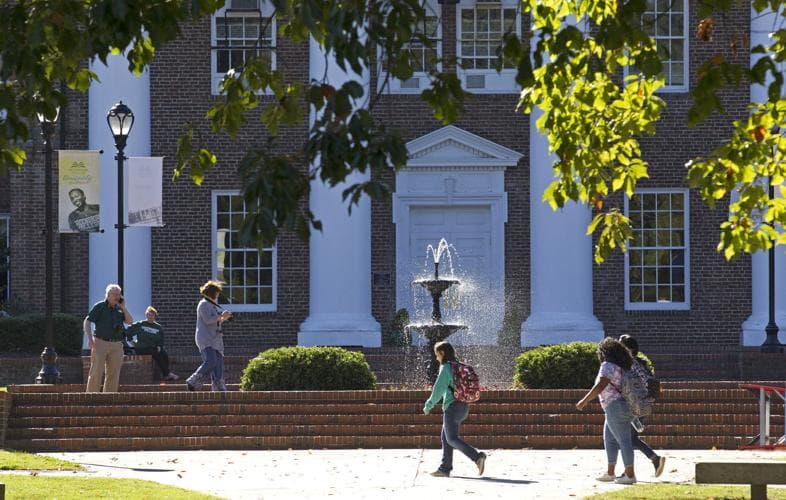
Greensboro College is no longer reading like a campus on the brink. After years of pressure and a deliberate rebuild, the small downtown institution at 815 W. Market Street says 1,012 students are now working toward a degree there, including the largest incoming class in its 187-year history.
That recovery matters in Guilford County because Greensboro College is more than a campus. It is an employer, a neighborhood anchor, and a place where first-generation students can find a smaller, more navigable path into higher education at a time when families are weighing cost, stability, and whether a college will still be standing strong four years from now.
A recovery built on leadership and continuity
The turnaround has been tied closely to leadership decisions. Greensboro College said Lawrence D. Czarda assumed the presidency in 2010, in the years after the Great Recession, and that the Board of Trustees unanimously extended his contract in May 2018 from June 30, 2020, to June 30, 2024. In May 2025, the board extended his contract again, this time through June 30, 2029.
That continuity matters at a private college that spent years managing financial strain and enrollment pressure. In June 2024, the college said Arnold Henning became chief financial officer and would work remotely, with his first campus visit planned for early August. A year earlier, Greensboro College had already pointed to a major fundraising success, saying its six-year capital campaign totaled $21,104,963, more than $6 million above its $15 million goal.
For a small college, those are not cosmetic moves. A long presidential tenure, a capital campaign that outperformed expectations, and a CFO brought in to help oversee the books all point to an institution trying to stabilize itself, not just market itself.
Why the small-campus model still pulls students in
Greensboro College was founded in 1838 and says it serves undergraduate and graduate students through a “true liberal-arts education” in a coeducational, independent learning environment. The college says it has approximately 1,000 undergraduate students, and that scale has become part of its identity rather than a drawback.

Its own messaging leans into that difference with the phrases “Small Campus Attention” and “Big City Connection.” The college also says it helps students build “a life of fulfillment, achievement and impact.” For first-generation students, that kind of setting can matter because it can mean more direct access to faculty, more personal guidance, and a campus culture where it is easier to be known by name instead of lost in a crowd.
That intimacy is part of the college’s history as well. Greensboro College’s Alumni Association was created in 1884, 46 years after the school’s founding, a sign that the institution has spent generations building a network that extends far beyond campus gates.
Enrollment gains are the clearest sign of momentum
The strongest evidence of the college’s rebound is in enrollment. Greensboro College announced the largest incoming class in its 187-year history and said 1,012 students were enrolled toward a degree, a 6 percent increase from the previous year. The college credited strong academics and athletics for helping drive that growth.
That figure matters locally because enrollment is the lifeblood of a private college. More students can mean more housing demand, more classroom activity, and more foot traffic for nearby businesses near downtown Greensboro. It also sends a signal to alumni and families that the institution is not simply hanging on, but adding momentum.
The college has tried to keep its academic offerings current as well. It has promoted a new AI minor, a sign that even a liberal-arts institution centered on personal attention is adjusting to the expectations of students who want both breadth and relevance in the labor market.
Costs, aid, and the questions families ask next
Stability is one part of the equation. Affordability is another. Greensboro College lists its 2025-26 tuition at $386 per credit hour for traditional undergraduates, adult undergraduates, graduate students, TESOL, and online programs. Its 2025-26 room-and-board page says housing and board costs are approved through financial aid.
That makes financial planning central for the families most likely to compare Greensboro College with larger public and private options across the region. In a county where higher education is closely tied to workforce development and social mobility, the combination of tuition pricing, aid, and the college’s smaller scale can shape whether a student sees Greensboro College as reachable.
The city around it is crowded with options. Greensboro says it is home to six colleges and universities, a growing two-year community college, and a law school. More than 47,000 undergraduate and postgraduate students are part of that educational landscape, and that density makes the market competitive. It also means one college’s health ripples outward into the city’s identity, hiring, and commercial life.
What Greensboro College means now
Greensboro College has spent nearly two centuries adapting to change, and its latest rebound shows how much of a local institution depends on confidence as much as cash. The campus at 815 W. Market Street still offers the kind of personal scale that first-generation students often need, while its recent enrollment growth and leadership stability suggest it has moved farther from the edge.
For Guilford County, that translates into more than a campus story. It means a steadier downtown presence, more certainty for students deciding where to enroll, and a small private college that still has a role in the city’s economic and educational future.
This article was produced by Prism’s automated news system from verified source data, official records, and press releases, then run through automated quality and moderation checks before publishing. The system is built and supervised by the people who set the standards it runs under. Read our full AI policy.
Did this article answer your question?