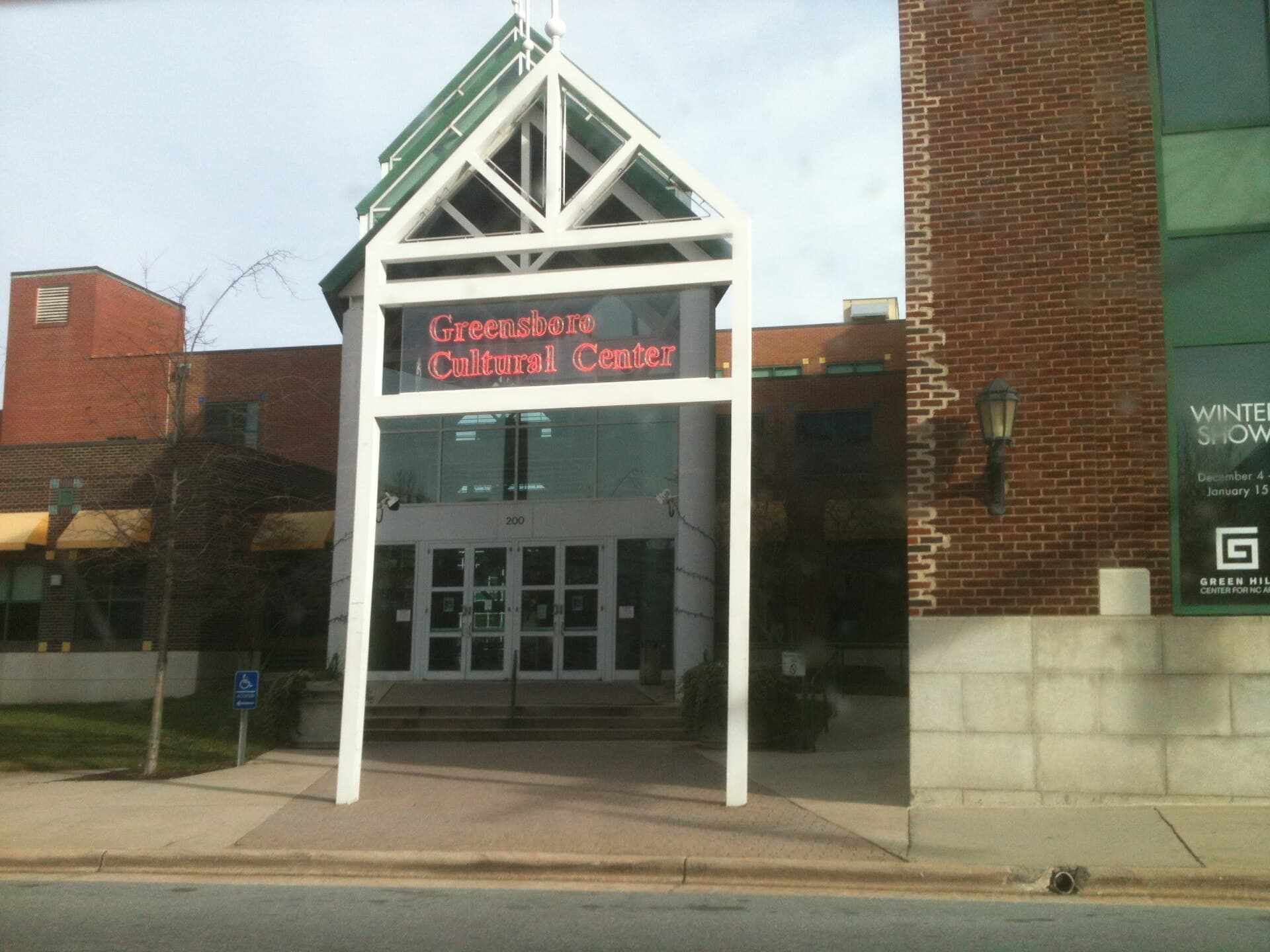
Greensboro Cultural Center anchors downtown arts, classes and performances
Downtown Greensboro’s former newspaper building now houses 17 arts groups, a 300-seat black box theater and low-cost space that keeps the block active all week.
A downtown arts campus with daily civic value
At 200 N. Davie St., the Greensboro Cultural Center operates less like a single venue than a shared arts campus. It houses 17 nonprofit arts organizations, public galleries, music studios, studio rentals and flexible creative space, giving downtown Greensboro a steady center of activity that reaches far beyond opening night or festival weekends.
That matters because the building is not just a place to see art. It is a place where art is made, taught, rehearsed and presented, and where those functions spill into the sidewalks and businesses around it. The result is a building that supports downtown foot traffic in a way splashy one-time events rarely do.
Who works inside the building
The city’s tenant list shows how broad that ecosystem really is. Among the organizations based there are African American Atelier, Art Alliance, Bel Canto Company, Casa Azul, Center for Visual Artists, Community Theatre of Greensboro, Dance Project, Eastern Music Festival, GreenHill, Greensboro Ballet, Greensboro Community TV, Greensboro Downtown Parks, Greensboro Opera, Greensboro Symphony Orchestra, Guilford Native American Art Gallery, North Carolina Folk Festival and Triad Pride Performing Arts.
That mix gives the Cultural Center a practical role in the local arts economy. Visual artists, dancers, musicians, presenters and community arts organizers share the same address, which makes the building a hub for rehearsals, meetings, exhibitions and audience-building. It is also one of the clearest places in Guilford County to see how many different disciplines rely on the same underlying infrastructure to stay visible and solvent.
The city describes the center as home to nonprofit arts organizations and public art galleries, with music lessons and studio rentals built into the daily rhythm of the building. That combination lowers the barrier to participation for residents who may not be stepping into a gallery for the first time, but are taking a class, reserving studio time or attending a rehearsal-driven performance.
Why the building itself matters
The Cultural Center’s value is tied not only to who is inside it, but to what the structure represents. CambridgeSeven describes it as an adaptive reuse project that transformed the former home of the Greensboro Daily News into a four-level arts center. The project added 20,000 square feet and brought the total footprint to 114,000 square feet, with space for galleries, dance, theater, printing and music studios, plus offices for arts and community organizations.
That redevelopment preserved part of the city’s older civic landscape instead of replacing it. CambridgeSeven says original ornamental plaster moldings from the newspaper company’s former lobby were kept and woven into the new arts center, a detail that gives the building a visible link to Greensboro’s past even as it serves current creative work.
For downtown Greensboro, that kind of reuse is more than architectural trivia. It means an existing landmark was converted into a productive public asset, keeping a large building active in the urban core rather than leaving it underused or disconnected from daily street life.
Creative Greensboro’s role in the center’s present-day use
Creative Greensboro says it has served as Greensboro’s arts-and-culture hub since its launch in 2019, supporting the city’s creative community through programs, services and partnerships. Within the Cultural Center, that role helps turn the building from a static collection of tenants into a managed public resource with regular programming and access points for local artists and audiences.
One of the clearest examples is the Van Dyke Performance Space, a 300-seat black box theater in the Cultural Center. A city news release said Creative Greensboro took over management of the space on October 14, 2021. The city also said the theater opened in 2017, shaped by the vision and generosity of Jan Van Dyke, founder of Dance Project.
The city’s decision to manage the space was tied to access. In 2021, rental rates started at $50 per hour or $250 per day, a pricing structure intended to draw new and diverse users into a professional performance venue. In practical terms, that makes the theater one of the more affordable places in downtown Greensboro for organizations that need stage space without the cost structure of a major commercial venue.
What residents can use it for
The Greensboro Cultural Center is useful because it serves different audiences at once. A resident may come for a class, a rehearsal, an exhibition or a performance, while a downtown worker may stop in between errands or lunch and discover a gallery, student showcase or community event. The city’s description of the building as a place for public art galleries, music lessons and studio rentals shows how deliberately it is built for regular use, not occasional spectacle.
That is also why the center continues to matter to tourism and everyday downtown life. Its location in the heart of Greensboro makes it easy to pair with other activities nearby, and its steady programming gives people a reason to return. In a downtown district, repetition is not a weakness. It is what turns a cultural site into a dependable destination.
The Greensboro Residency for Original Works keeps the campus producing new work
Creative Greensboro also says Guilford County-based creative individuals and organizations can use the Greensboro Residency for Original Works, known as GROW. In 2026, the residency features Andy Eversole from April 7 through May 26, 2026.
Eversole’s residency shows how the Cultural Center functions as a production site, not just a showcase. During the program, he is working on Banjo Earth: North Carolina and using the space for free workshops, live podcast recordings, jam sessions and ticketed Sunday screenings. That mix of public programming and working time underscores the center’s broader value: it helps creators develop new work in public view while also giving audiences multiple ways to enter the process.
The residency matters for downtown because it generates sustained activity rather than a one-night spike. People return for workshops, screenings and recordings, and that repeat presence gives nearby businesses more consistent traffic than a single marquee event can deliver.
Why this civic anchor still matters
For longtime residents, the Greensboro Cultural Center is one of those places that can be easy to take for granted because it is always doing something. For newcomers, it is a compact introduction to how Greensboro’s arts infrastructure works in practice: nonprofit tenants, affordable space, adaptive reuse, and city-backed programming all operating under one roof.
Its endurance comes from that structure. The building at 200 N. Davie St. is not just an address for the arts. It is downtown Greensboro infrastructure, one that supports artists, audiences and neighboring businesses day after day. In a city that wants a lively core, that kind of steady civic utility is as important as any headline event.
This article was produced by Prism’s automated news system from verified source data, official records, and press releases, then run through automated quality and moderation checks before publishing. The system is built and supervised by the people who set the standards it runs under. Read our full AI policy.
Did this article answer your question?