Guilford County nonprofit funding process draws scrutiny over transparency, politics
A $200,000 museum grant has sharpened questions over who gets Guilford County nonprofit dollars, what rules decide awards, and what the public can actually inspect.

A $200,000 award to the International Civil Rights Center & Museum has put Guilford County’s nonprofit funding system back under a sharp public glare. The county still describes the program as competitive, but the public can no longer see the same recommendation trail that once linked applications to a public discussion and vote.
A process that still looks competitive on paper
Guilford County says its community-based organization funding remains a competitive process with a standard application and required training for every applicant seeking resources. The county also says the money is meant for 501(c) nonprofits that provide economically, culturally, and civically valuable services that qualify as a public purpose under North Carolina law.
The county’s funding policy gives the clearest clue about how selections are supposed to be made: priority goes to applications that most closely align with Board of Commissioners priorities in that funding cycle. After awards are made, organizations must submit quarterly financial and performance reports, creating an accountability trail that is supposed to continue beyond the initial vote.
That framework matters because it shows the county has rules, not an open checkbook. It also shows where the controversy starts: the rules are public, but the reasoning behind individual awards is less visible than it used to be.
The money is real, even if it is only part of the budget
The scale of the program is large enough to shape local civic life. In FY2024, Guilford County said it received 115 applications from 112 organizations seeking more than $10 million in funding, which means the county is deciding among far more requests than it can satisfy.
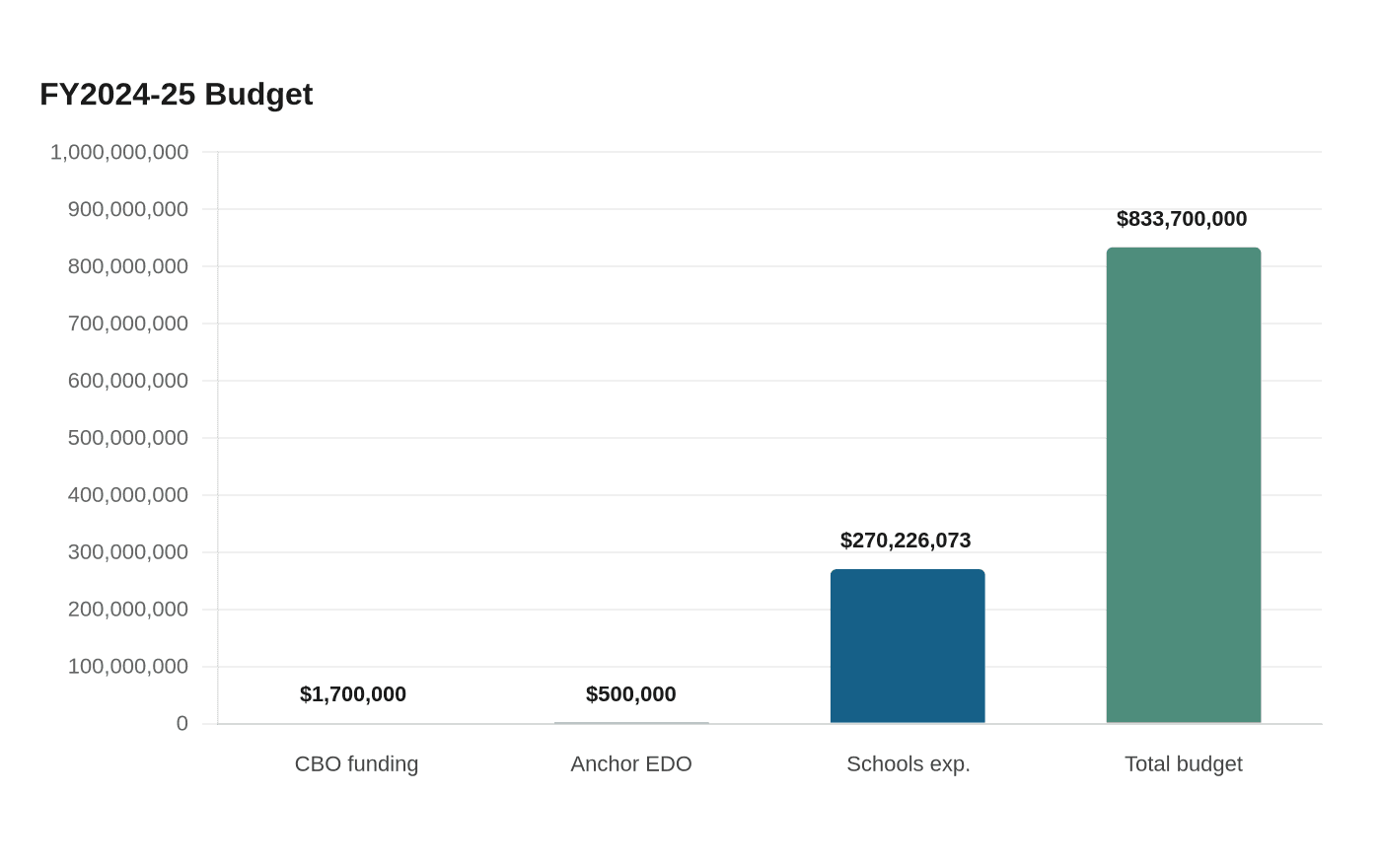
That same adopted budget set aside $1.7 million for community-based organizations and another $0.5 million for anchor economic development organizations, for a total of $2.2 million. The county adopted its FY2024-25 budget on June 20, 2024, at $833.7 million and kept the property tax rate at 73.05 cents per $100 of value.
The broader budget helps explain why the nonprofit line item draws scrutiny. The same ordinance allocated $270,226,073 to Guilford County Schools current expense, showing how every county dollar sits inside a bigger annual fight over schools, services, and tax rates. In that setting, even a comparatively modest grant pool can decide whether a local institution survives, expands, or stalls.
Why the museum award drew so much attention
The most politically charged example is the International Civil Rights Center & Museum, located in the former Woolworth’s building in downtown Greensboro, the site of the 1960 Greensboro sit-ins. The building itself carries enormous civic weight, which helps explain why any county support for the museum attracts attention well beyond the usual nonprofit-grant debate.
The museum was co-founded by Melvin “Skip” Alston, who now serves as chairman of the Guilford County Board of Commissioners. County records describe Alston as a Greensboro-based real estate businessman and civil rights advocate, and the county noted in 2025 that he could not vote on at least one museum-related budget item because of a conflict of interest.
That history makes the $200,000 award in the newly adopted FY2026-27 budget especially sensitive. For critics, the question is not whether the museum is important, but whether the county can show a clean and public rationale for why this institution got funded while others with different ties to commissioners did not.
What residents can actually inspect
The public record does contain pieces of the process. Guilford County’s community-based organizations page, its CBO funding policy, the FY2024 adopted budget, the FY2025 application checklist, and the budget ordinance all lay out parts of the system. Taken together, they show the application rules, the funding purpose, the priority standard, the annual budget totals, and the audit threshold.
The county’s Budget and Management Services department also plays a direct role. Its responsibilities include budget support, projections, recommendations, training, policy evaluation, and grant management for CBO funding, which means staff involvement has not disappeared even if the recommendation list is no longer as easy for the public to follow.
One concrete safeguard appears in the FY2025 CBO application checklist: organizations requesting more than $100,000 must submit a current annual audit. That requirement suggests the county knows larger awards deserve deeper vetting, but it does not answer the bigger transparency question of why one applicant gets funded and another does not.
The missing safeguard is a clearer public explanation of how the county moves from application to award. If the county wants taxpayers in Greensboro, High Point, Jamestown, and Gibsonville to trust the process, it will need more than a competitive label and quarterly reports. It will need a visible record that shows the reasoning behind the money, not just the money itself.
This article was produced by Prism’s automated news system from verified source data, official records, and press releases, then run through automated quality and moderation checks before publishing. The system is built and supervised by the people who set the standards it runs under. Read our full AI policy.
Did this article answer your question?