Rare Civil War officer portrait from High Point preserved and framed
A framed albumen print of a Confederate officer points back to Camp Fisher, where High Point helped train North Carolina troops in 1861.
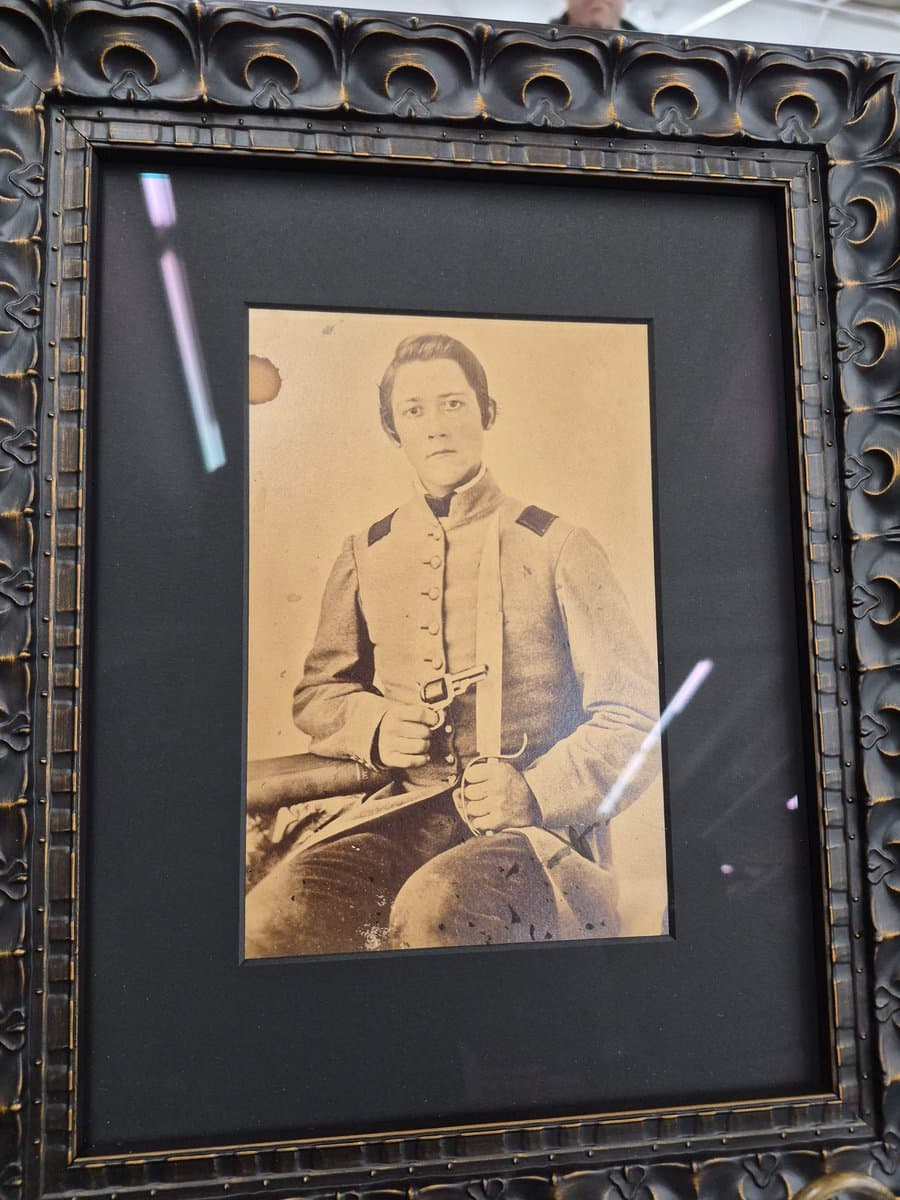
A rare albumen print of a Confederate officer, armed with a revolver and Bowie knife, now preserves a hard local fact about High Point: the city was not just a stop on the map, but a place where North Carolina troops were trained for war. The image has been professionally framed and preserved, and its value has been estimated at $2,500 to $3,500.
The portrait ties directly to Camp Fisher, the Confederate camp of instruction that operated in High Point in 1861 and 1862. The marker at the site says the camp was named for Col. Charles Fisher of Salisbury after his death at First Manassas. The marker also reinforces the camp’s local footprint near North Main Street and East English Road, where the city’s wartime history still remains visible in the landscape.

The strongest military match for the photograph is the 34th North Carolina Infantry Regiment, organized at Camp Fisher near High Point on Oct. 25, 1861. Company E, the Shady Grove Rangers, was mustered into state service there the same day. The regiment drew companies from Ashe, Rutherford, Rowan, Lincoln, Cleveland, Mecklenburg and Montgomery counties, which shows how High Point briefly served as a gathering point for men from across the state.
That regiment’s record was costly. One historical account says 1,525 men served in the 34th North Carolina Infantry Regiment, with 208 killed or dying of wounds, 248 dying of disease, 401 captured, 73 disabled, 4 missing and 50 deserting. In that context, the portrait becomes more than an isolated likeness. It is evidence of how soldiers were presented, armed and remembered at the start of the Civil War.
The image also fits the wider visual culture of the era. The Smithsonian says Bowie knives were especially popular from the 1840s through 1865 and were widely used by Confederate soldiers. The Library of Congress holds similar Civil War-era portraits of unidentified Confederate soldiers posed with revolvers and Bowie knives. The pose in the High Point photograph reflects that wartime style, while its preservation helps place a local face on a larger national conflict.
High Point historians are handling that connection through collection work and public access, not nostalgia. The High Point Historical Society, founded in 1966, owns and cares for the High Point Museum collection, which includes more than 37,000 artifacts, photographs and archival collections. The museum’s online collections and identification work regularly seek help from the public in naming people and places in historic photographs, and that same approach gives the preserved portrait value as a research tool as well as an artifact.
The preservation also fits a broader state effort. The North Carolina Archives says its military collection focuses on original historical materials about the state’s military past, and the Civil War digital collection is a joint project of the State Archives and State Library of North Carolina. In that larger network of records, the High Point portrait helps explain why Camp Fisher still matters: it connects a local site, a state regiment and the continuing work of preserving memory with care.
This article was produced by Prism’s automated news system from verified source data, official records, and press releases, then run through automated quality and moderation checks before publishing. The system is built and supervised by the people who set the standards it runs under. Read our full AI policy.
Did this article answer your question?