Federal Judge Orders Perry's Steakhouse to Pay $21 Million in Tip Theft Case
Perry's Steakhouse owner Christopher Perry was ordered personally liable in a $21.2M tip-theft judgment covering 707 Houston servers who earned as little as $2.13 an hour.

At Perry's Steakhouse's six Houston-area dining rooms, servers earning the federal tipped minimum of $2.13 an hour were required each week to feed 4.5 percent of their total sales, roughly a quarter of their tips, into a mandatory pool that paid morning prep workers who never served a single customer. U.S. District Judge Robert Pitman ruled that illegal, and on March 24 entered a final judgment of $21.2 million against the chain and its owner, Christopher V. Perry, personally.
The judgment covers 707 current and former servers who worked across Perry's 13 Texas locations between January 2019 and January 2022. Pitman, sitting in the Western District of Texas, sided with the plaintiffs' own damage calculations after rejecting Perry's competing proposal, which had placed the company's exposure at roughly $7.7 million. The ruling came four months after Pitman first found the chain liable in November 2025.
The final tab breaks down as follows: $3.44 million in unpaid wages, matched dollar-for-dollar by $3.44 million in mandatory legal penalties; $7.07 million for misappropriated tips, doubled again by $7.07 million in additional penalties; and roughly $263,476 in payroll taxes. Attorneys' fees remain to be determined by the court, meaning the total recovery for workers will climb higher still.
Under federal law, tip pools are legal when limited to employees who "customarily and regularly" receive gratuities from customers. Perry's ran its pool differently. Court records show the chain directed servers' contributions to AM hosts, bussers, and other staff whose shifts ended before the dining room opened to guests, workers whose contact with paying customers Pitman found too minimal to qualify. That arrangement violated the Fair Labor Standards Act.
The court also found the violations willful, a determination that extended the FLSA's statute of limitations from two years to three. That finding was grounded in Perry's own record: the company had been investigated by the Department of Labor in 2003 for FLSA infractions, faced prior tip-pool litigation, and received employee complaints including an NLRB charge, yet made no corrective changes to its tip-pool structure.
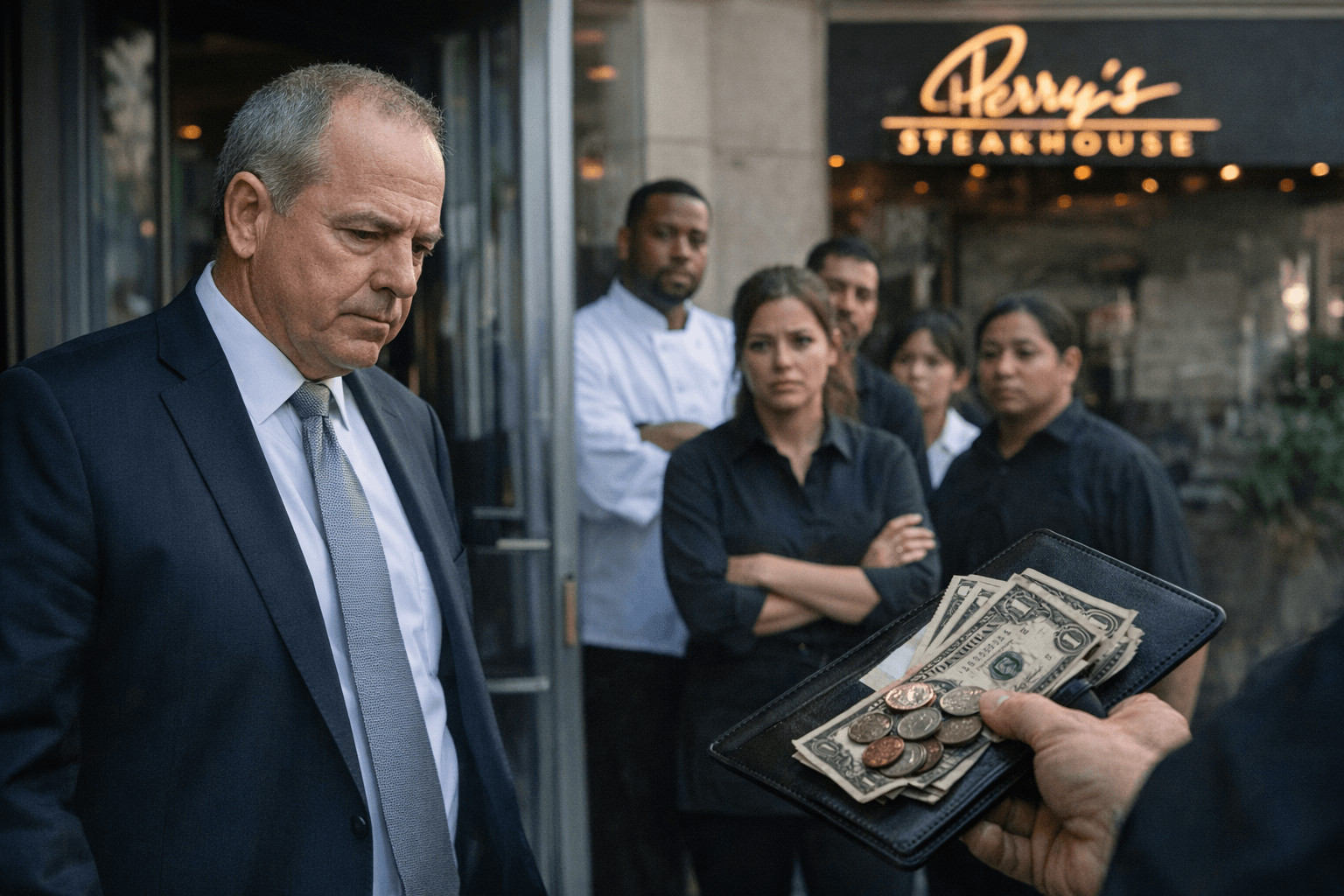
Perry's COO Rick Henderson said in a statement that the company "respectfully disagree[s] with the trial court's decision" and described the chain as "committed to treating employees fairly." Perry's intends to appeal to the U.S. Court of Appeals for the Fifth Circuit, which means the final financial outcome could shift materially, and the 707 servers could wait years to see payment.
Averaged across the class, the judgment works out to roughly $30,000 per server, though individual awards depend on hours worked and the size of each person's tip-pool contributions over the three-year period. For workers earning $2.13 an hour before tips, that figure represents years of reclaimed wages.
The ruling carries immediate implications for other Houston-area restaurant operators. Mandatory tip pools that include back-of-house or pre-opening staff are common in large, full-service dining groups, and the case now sets a documented price tag for noncompliance. Herrmann Law, the firm representing the plaintiffs, filed a new federal lawsuit against Perry's on January 8, 2026, targeting the same practices and open to any server who worked at a Texas, Alabama, North Carolina, or Tennessee Perry's location since December 31, 2023. A Colorado federal judge reached a parallel conclusion against the chain on February 3, 2026, ruling that distributing tip-pool funds to pre-opening employees violated both federal and state wage law.
For any server in Harris County navigating a tip-pool arrangement at their own restaurant: federal law permits mandatory pools only among employees who regularly interact with customers. A pool that includes cooks, managers, or workers on shifts closed to the public is not lawful, and as Perry's case illustrates, the liability for running one is not limited to the company itself.
This article was produced by Prism’s automated news system from verified source data, official records, and press releases, then run through automated quality and moderation checks before publishing. The system is built and supervised by the people who set the standards it runs under. Read our full AI policy.
Did this article answer your question?