Harris County Eyes Desalination to Meet Rising Drinking Water Demand
EPCOR wants to build a desalination plant on Galveston Bay that could produce up to 26.5 million gallons a day for Harris County, at a projected cost of up to $5.80 per 1,000 gallons.
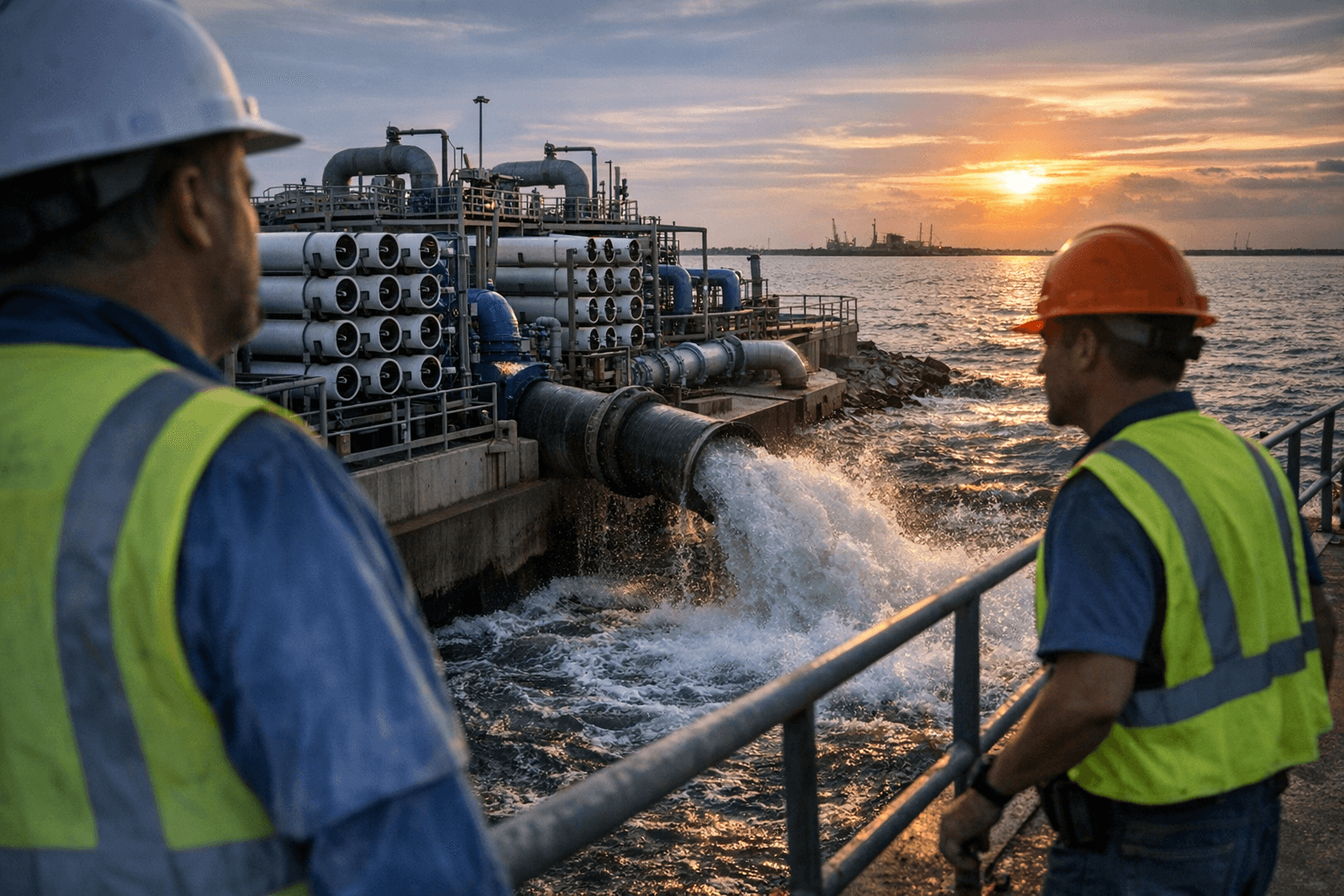
The footprint of the old P.H. Robinson Power Generating Station on the San Leon Peninsula, roughly 30 miles southeast of downtown Houston, has sat mostly empty since Hurricane Ike tore through in 2008. EPCOR Utilities Inc. now wants to rebuild something there that could flow directly into Harris County faucets: a seawater desalination facility capable of producing up to 26.5 million gallons of drinking water per day for a region of nearly 8 million residents.
EPCOR filed a discharge permit application with the Texas Commission on Environmental Quality on October 3, 2025, for the proposed Bayshore Desalination Facility in Texas City. That permit, which is still under review, is a required step before construction can begin. If approved, the plant would draw from Galveston Bay, strip salt and minerals through reverse osmosis, and deliver potable water to Harris and Galveston counties, which state projections show could face a water supply shortage of nearly 790,000 acre-feet per year by 2080.
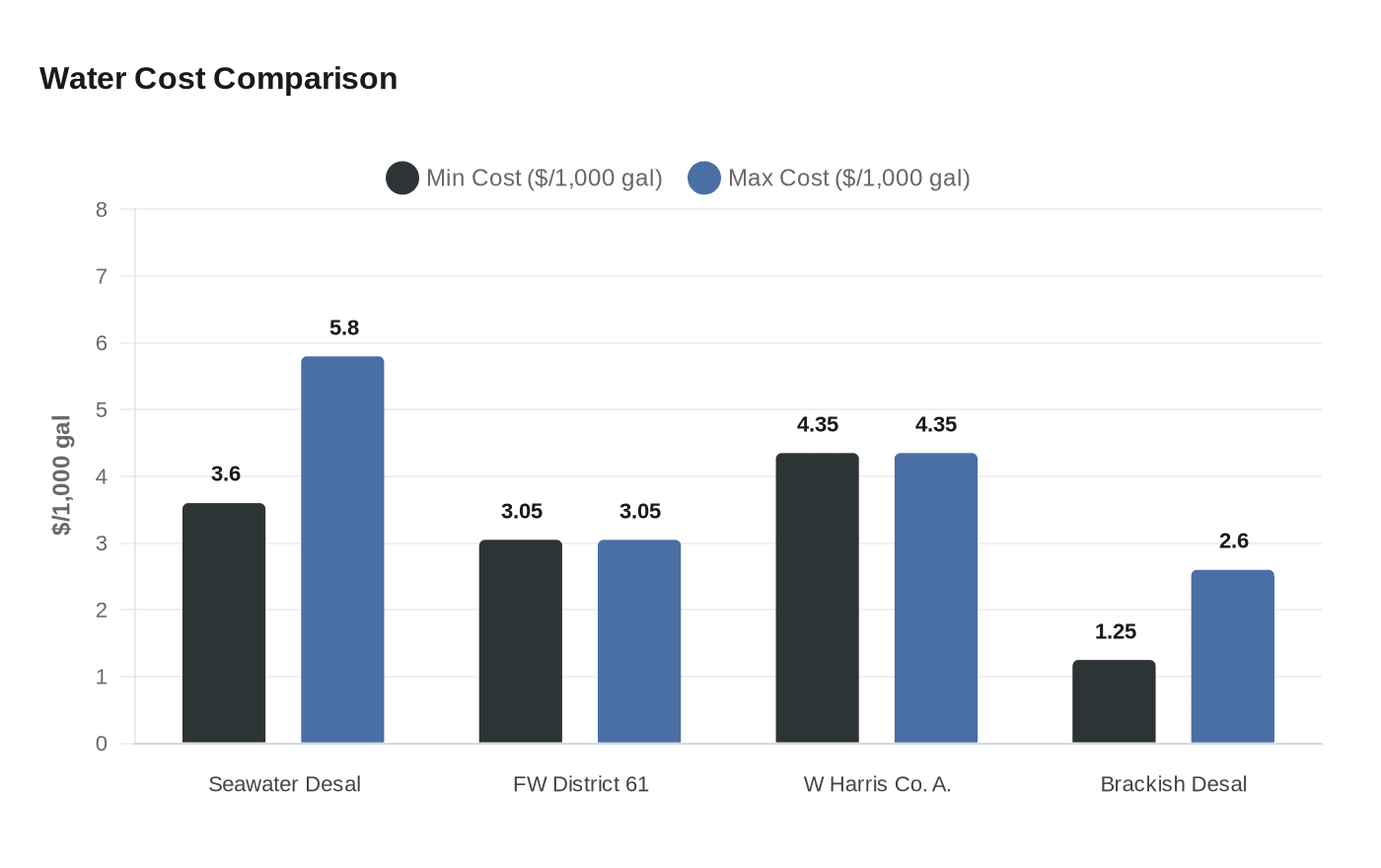
The cost question is the one most likely to land on a Harris County water bill. The Texas Water Development Board pegs seawater desalination at $3.60 to $5.80 per 1,000 gallons, before transmission costs are layered on. Harris County Fresh Water Supply District No. 61 just raised its rate to $3.05 per 1,000 gallons after transitioning to surface water in March 2026, while the West Harris County Regional Water Authority charges $4.35 per 1,000 gallons for surface water. Brackish groundwater desalination, which draws from underground saline aquifers rather than the open bay, runs considerably cheaper at $1.25 to $2.60 per 1,000 gallons. Water reuse and conservation programs remain the lowest-cost options of all.
EPCOR President and CEO John Elford said the company is "proud to bring forward a proposal that delivers a resilient, sustainable water supply solution while safeguarding the health of local ecosystems." Senior communications advisor Matthew Atwood added that "desalination technologies have continued to improve performance and cost efficiency" and are already in use across Texas.
Not everyone around Galveston Bay is convinced. At a March 26, 2026 town hall packed with more than 50 residents at the Bacliff Volunteer Fire Department, commercial fishers voiced sharp objections. "Spent most of today meeting with Galveston Bay shrimpers and oystermen, the last of a breed," one Bacliff-area resident wrote in a community Facebook group. "They [are] very concerned about the proposed desalination debacle and its impact on our Galveston Bay." EPCOR commissioned two independent environmental studies from Texas A&M University-Galveston to assess how brine discharge would affect bay salinity and marine habitats.
The San Leon Peninsula site also carries well-documented hurricane exposure: Ike caused severe damage to the P.H. Robinson station in 2008, and that same coastline remains in the direct path of Gulf storms. Two recent cautionary examples underscore the difficulty of the path ahead. Corpus Christi voted to halt its own long-planned desalination plant in late 2025 due to ballooning costs and environmental opposition; a proposed Freeport project stalled when the developer could not secure committed customers.
EPCOR acknowledges that permitting, design, construction, and pre-certification testing would take "several years" even under favorable conditions. Without new sources of any kind, Texas state planners warn that severe drought could produce a statewide water deficit approaching 7 million acre-feet by 2070, with economic damages near $150 billion. The TCEQ permit review will determine whether the region's most ambitious water solution gets to face its next test: finding municipalities willing to pay for it.
This article was produced by Prism’s automated news system from verified source data, official records, and press releases, then run through automated quality and moderation checks before publishing. The system is built and supervised by the people who set the standards it runs under. Read our full AI policy.
Did this article answer your question?