Katy ISD weighs $15 million bus seat belt retrofit, deadline looms
Katy ISD said 552 buses still need three-point belts, a $15.7 million job that puts safety against other transportation spending.
Katy ISD was staring at a $15.7 million safety bill for 552 buses that still lack three-point seat belts, a cost that works out to about $40,000 per bus and leaves families with a blunt question: how quickly can the district make every ride compliant before the September 2029 deadline?
At a May 11 board meeting, transportation chief Paul Landis said the age of the fleet would make the upgrade expensive. Katy ISD operates or contracts for 840 buses, and 288 already have the required three-point belts, meaning about 65 percent of the fleet still needs to be brought into compliance under Texas Senate Bill 546.
The new state law, passed by the 89th Texas Legislature after the fatal 2024 Hays CISD bus crash that killed a pre-kindergarten student, requires three-point seat belts on school buses unless a district qualifies for a budget or warranty exception. It also lets districts accept gifts, grants and donations to help pay for installation, and the Texas Education Agency says a future grant opportunity may be available.
TEA’s reporting window runs through May 29, 2026, and districts that say their budgets cannot absorb the mandate must do so in public, listing how many buses have no seat belts, two-point belts and three-point belts, along with the estimated cost to equip each bus. That reporting requirement pushes the issue out of the board agenda and into a public accounting of what Katy would have to spend, and what it might have to delay or trim elsewhere in its transportation budget.
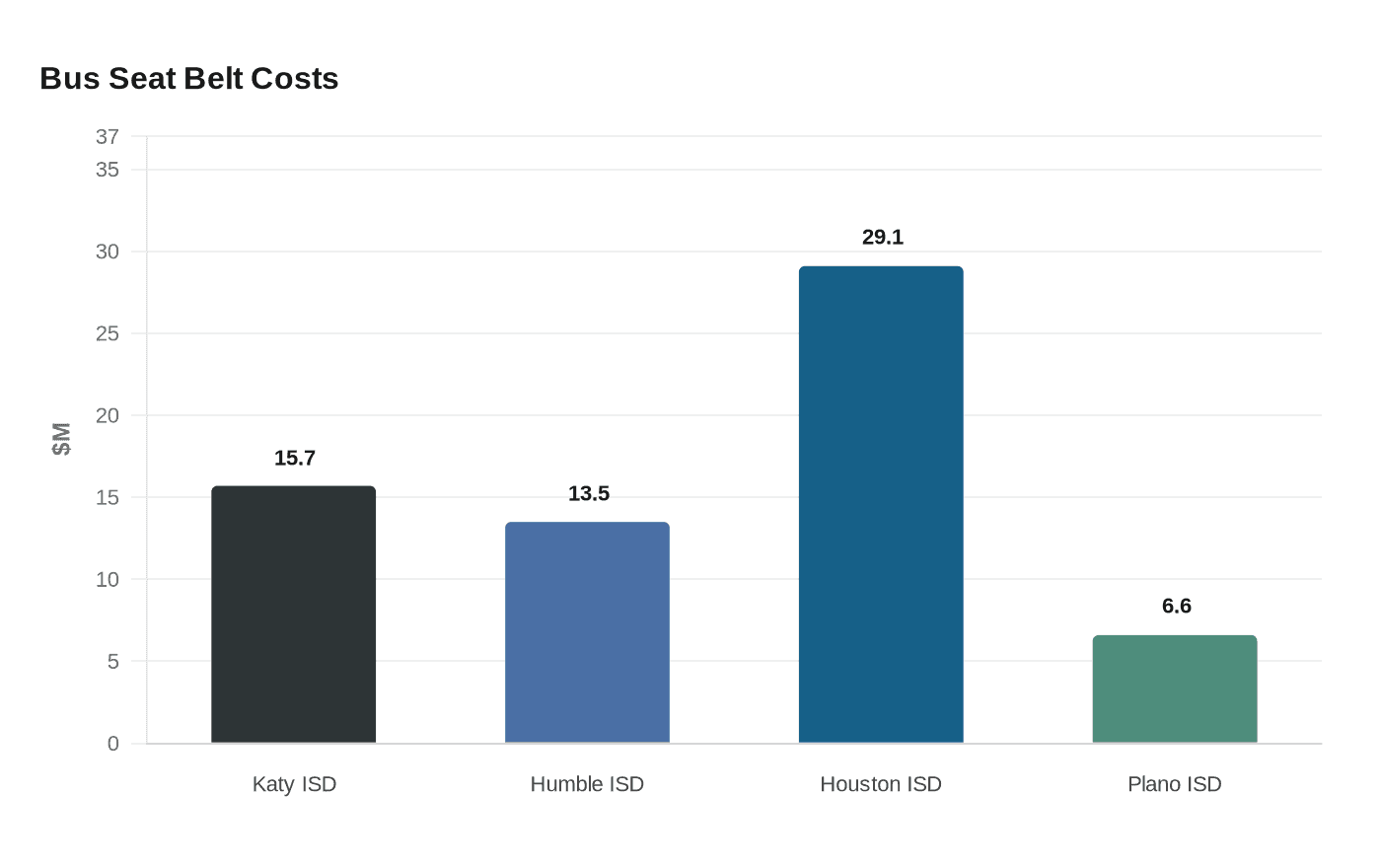
The tradeoff is not unique to Katy. Humble ISD estimated a $13.5 million price tag, with 94 buses already outfitted with three-point belts, 66 with two-point belts and 148 with none. Houston ISD put its compliance cost at about $29.1 million and requested an exemption, while New Caney ISD estimated almost $11 million and also asked for relief.
Katy’s decision now sits between retrofitting buses, replacing older vehicles and preserving other transportation needs. In Plano, officials described that same math in sharper terms, estimating more than $16 million to replace buses lacking three-point belts or $6.6 million to retrofit them. For Katy, the final number will shape not only when students ride on seat-belt-equipped buses, but how much of the district’s transportation budget must be redirected to get there.
Know something we missed? Have a correction or additional information?
Submit a Tip

