Brooksville walking tour spotlights historic homes, county’s living archive
Brooksville’s downtown streets form a self-guided route through the county seat’s past, from a Victorian museum to the courthouse blocks that still anchor Hernando County.

Brooksville’s historic core works best as a walking route because the city still wears its civic history in plain view. A few blocks connect the county museum, the courthouse complex, and homes tied to pioneer families, city leaders, and local commerce, making the county seat feel less like a backdrop and more like a living record of how Hernando County grew.
Start at the museum and the county seat
Begin at the Hernando County Historic Museum at 601 Museum Court, a four-story Victorian home that gives the route its clearest first stop. The first four rooms were built in 1856, and the house reflects an 1885 appearance, so even before you reach the rest of downtown you are standing in a structure that bridges Brooksville’s earliest years with its later civic identity. From there, the walk naturally moves toward 20 North Main Street, where Hernando County government offices and the Board of County Commissioners are based in the Government Center.
That address matters as more than a mailing point. The Board meets in the John Law Ayers room on the first floor on the second and fourth Tuesdays of the month at 9 a.m., which makes the county seat visible in a very practical way: this is where public business still happens in the middle of the same downtown grid that shaped Brooksville’s early growth. Brooksville is a full-service city with a council-manager form of government and an estimated population of about 8,000, yet its civic footprint carries a much larger county role because the city sits where U.S. 41, U.S. 98, and State Road 50 meet.
Follow the street pattern that built the town
The best walking route does not need to chase distant landmarks. It works because Brooksville’s older blocks still read like a courthouse town, with named homes and public buildings clustered close enough to show how settlement, commerce, and government reinforced one another. The city says Brooksville was originally known as Melendez, was settled around 1845, became Brooksville in 1856, and was incorporated on October 13, 1880. That timeline explains why the streets around downtown hold so many structures from the late 19th and early 20th centuries.
One of the most revealing stops is the Lanier-Dent House at 403 E Jefferson Street. Part of it was built with lumber from the old wooden county courthouse, which was dismantled in 1911. That detail turns the house into a direct physical link between one county-seat era and the next, showing how Brooksville’s civic buildings were not just replaced but recycled into the town’s residential fabric. The current Hernando County courthouse complex, a Classical Revival building constructed in 1913 and 1914, sits within that longer sequence of courthouse-town evolution.
The houses that make the downtown route worth the walk
A few short blocks away, the Saxon-Scarborough House at 200 Saxon Avenue gives the route an earlier architectural marker. Built by Frank Saxon in 1874, it is a Queen Anne Revival home, one of the styles that gives Brooksville its recognizable mix of decorative detail and front-porch scale. Nearby, the Christmas House at 103 Saxon Avenue adds another layer: in the 1930s, it once served as the Book Shop of the Tamiami Trail. That makes it a useful reminder that Brooksville’s streets were shaped not only by local family life but also by the region’s travel and trade corridors.
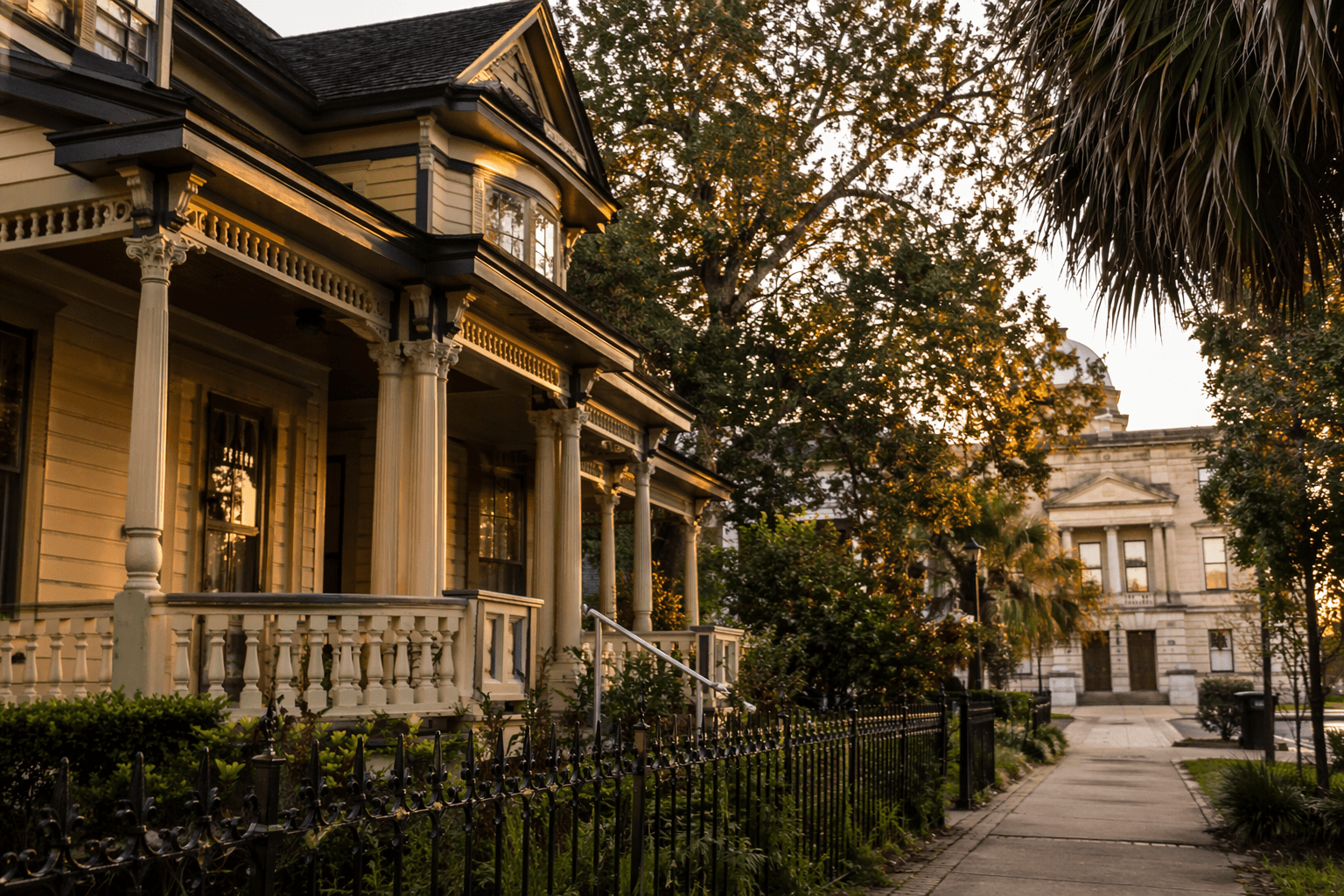
The Amstutz House at 619 E Ft. Dade Avenue pushes the story into the early 20th century. It was built around 1910 by the family that owned the Brooksville Ford dealership from 1926 to 1957, tying domestic architecture to the rise of auto-era commerce. At 510 E Liberty Street, the Hawkins House connects the route to public service and local political history through Lena Culver Hawkins, who became Brooksville’s first lady mayor in 1928. Taken together, these stops show a county seat where family names, business histories, and civic leadership still map onto the street system.
Why Brooksville still reads as a county archive
The most surprising share-worthy detail in the loop may be the courthouse timber in the Lanier-Dent House. It is the kind of fact that changes how a visitor sees an ordinary block: a demolished county building did not vanish, it was absorbed into a house that still stands in the same town. That is the larger Brooksville story in one object, and it is one reason the downtown walk feels unusually complete for a small city.
Brooksville’s preservation work helps protect that legibility. The city has established a preservation ordinance, and its historic-preservation approach is still developing through design guidelines and a historic structure survey. The Downtown Brooksville Historic District has also been surveyed and found eligible for listing on the National Register of Historic Places, a formal recognition that underscores the district’s architectural and civic value.
Brooksville Main Street adds another layer to the route’s present-day meaning. The organization says it is dedicated to revitalization and historic preservation and identifies itself as a Main Street America accredited program. That places the walking tour inside a broader effort to keep downtown useful, visible, and economically active rather than letting it slip into the role of a pass-through corridor. The city’s community-redevelopment plan makes the stakes clear: before interstate-era traffic patterns changed how people used downtown, Brooksville was a destination for more than 100 years.
How to walk it in a half day
A practical loop works best when you keep the route compact and unhurried. Start at the Hernando County Historic Museum, move to the courthouse block at 20 North Main Street, then continue through the residential streets that hold the Lanier-Dent House, the Saxon-Scarborough House, the Christmas House, the Amstutz House, and the Hawkins House. The walk does not require a rigid order so much as a willingness to notice how each address reveals a different piece of the county seat’s past.
What makes the route durable is the way it blends public business, domestic architecture, and local memory into one walkable core. Brooksville is still the place where county government meets at 20 North Main Street, where a former courthouse’s lumber survives in a home on Jefferson Street, and where a Victorian museum still anchors the story of a city settled around 1845 and incorporated in 1880.
This article was produced by Prism’s automated news system from verified source data, official records, and press releases, then run through automated quality and moderation checks before publishing. The system is built and supervised by the people who set the standards it runs under. Read our full AI policy.
Did this article answer your question?