Tour BVL showcases historic downtown Brooksville on a walking trail
Tour BVL turns Historic Downtown Brooksville into a QR-coded walk past the depot, courthouse and Woman’s Club, linking preservation with downtown traffic.
Tour BVL makes Historic Downtown Brooksville feel less like a postcard and more like a living route through the county seat’s core. QR codes on buildings send walkers block by block past the courthouse, the depot, the First National Bank and the Woman’s Club, so the downtown itself becomes the attraction.
How the trail works
Tour BVL says its mission is simple: document the history of Historic Downtown Brooksville and give people a resource to learn about and explore the city’s historic homes and buildings. The project began with the In With The Old Committee of Brooksville Main Street and is now coordinated by a small group of volunteers, which gives it a preservation-first feel instead of a polished tourism pitch.
That matters in Brooksville because Brooksville Main Street is a nonprofit focused on revitalization and preservation in the historic downtown. Florida’s Adventure Coast also promotes Tour BVL as a way to explore the city’s historic homes and buildings, putting the walking trail into the region’s wider visitor network rather than leaving it as a neighborhood-only project. The tour’s website says visitors can use a phone camera on QR codes placed throughout Historic Downtown Brooksville, and the site also works as an online archive for people who are not standing on those streets.
The trail is not a single loop with one story to tell. Tour BVL’s walking-tour index includes multiple themed routes, among them a 1920s Walking Tour, a 1950s Walking Tour and a Significant Buildings Walking Tour. Promotional materials say the series includes ten themed historic walking tours, and a separate travel listing describes ten distinct self-guided routes. That range gives the project staying power, because a first-time visitor can follow the broad downtown route while a repeat visitor can return for a tighter subject such as a decade-specific walk or a buildings-only tour.
The downtown stops that define Brooksville
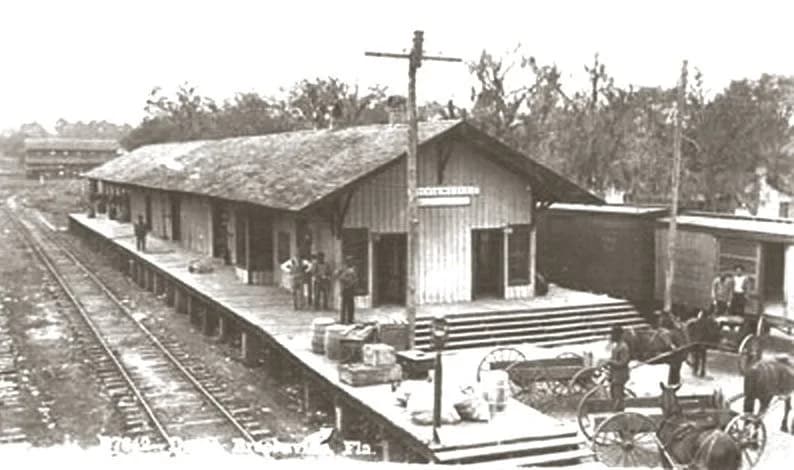
The landmark list is what gives Tour BVL its downtown pull. At 70 Russell St, the 1885 Train Depot marks Brooksville’s rail-era link to the outside world, and it is also operated by the Hernando Historical Museum Association. At 31 S Main St, the Old Water Tower Posts and the Old City Limit Marker point to the way the city once defined its own edges, while 20 N Main St brings the Courthouse Water Well and the Hernando County Courthouse into view.
Other stops tighten the downtown map even further: 1 N Main St for the First National Bank and 109 S Broad St for Brooksville Methodist Church. Those locations are not just old buildings. Together they show how Brooksville’s center formed around government, finance, worship and rail access, the kind of mix that still gives the historic core its shape.
An older walking and driving map described the full route as about 4 miles and roughly 4 hours long. That scale helps explain why the trail works so well as a downtown tool: it is long enough to keep people moving past multiple blocks, but compact enough to keep the experience inside the historic core instead of pushing them to the edge of town. For a downtown that depends on people lingering, that is the point.
Why Brooksville’s history is concentrated downtown
Brooksville’s downtown carries extra weight because the city has been the county seat of Hernando County and was settled around 1845. It was first known as Melendez, then Benton, before taking the Brooksville name, and it incorporated in October 1880. The city describes itself as the county seat for more than 100 years, and that long civic role explains why so many of the trail’s key landmarks cluster around Main Street and Broad Street.
The city’s Community Redevelopment Agency adds a policy layer to that history. Brooksville says the CRA is meant to remove blighted areas and support redevelopment under Florida’s Community Redevelopment Act of 1969. In practical terms, a tour like this helps downtown by making old buildings part of the city’s active identity instead of treating them as background scenery. When visitors are drawn to the courthouse, depot and church fronts, preservation becomes visible on the street, not just on a planning map.
Women’s history gives the trail another layer
Tour BVL’s story also reaches beyond architecture. One of its featured figures is Lena Culver Hawkins, whom the tour identifies as Brooksville’s first female mayor. Born September 23, 1866, and dying June 6, 1949, Hawkins is identified in biographical sketches as a civic leader, suffragist and politician.
Her stop at 131 South Main Street, tied to the Brooksville Woman’s Club, deepens the preservation angle. Preservation accounts describe Hawkins as the architect who drew the sketch for the clubhouse and oversaw its construction, and a Florida Preservationist piece says the women-focused walking tour grew out of five years of research into women’s roles in Brooksville’s history. That kind of research changes what downtown memory looks like: it moves the story from courthouses and rail stops alone to the women who shaped civic life and the buildings that carried that work.
What the walking trail gives the downtown
Tour BVL is strongest as a downtown impact story because it creates a reason to stay on foot. The QR-code system, the themed routes and the online archive all widen the audience, while the landmark list funnels that audience past the civic blocks that built Brooksville. The trail does not just explain the city’s past; it gives people a route through the part of town where preservation, redevelopment and visitor attention meet.
For Hernando County, that is the practical value. The trail turns historic streets into an accessible public asset, links the downtown to Brooksville Main Street’s preservation goals and gives the county seat a walkable identity that still fits the blocks where the city grew up.
This article was produced by Prism’s automated news system from verified source data, official records, and press releases, then run through automated quality and moderation checks before publishing. The system is built and supervised by the people who set the standards it runs under. Read our full AI policy.
Did this article answer your question?