UF issues statewide call to report invasive Asian swamp eels
A finless, snake-like “eel” in a Florida canal could be an invasive swamp eel. UF scientists want sightings reported to IVEGOT1 to track spread and protect native wildlife.
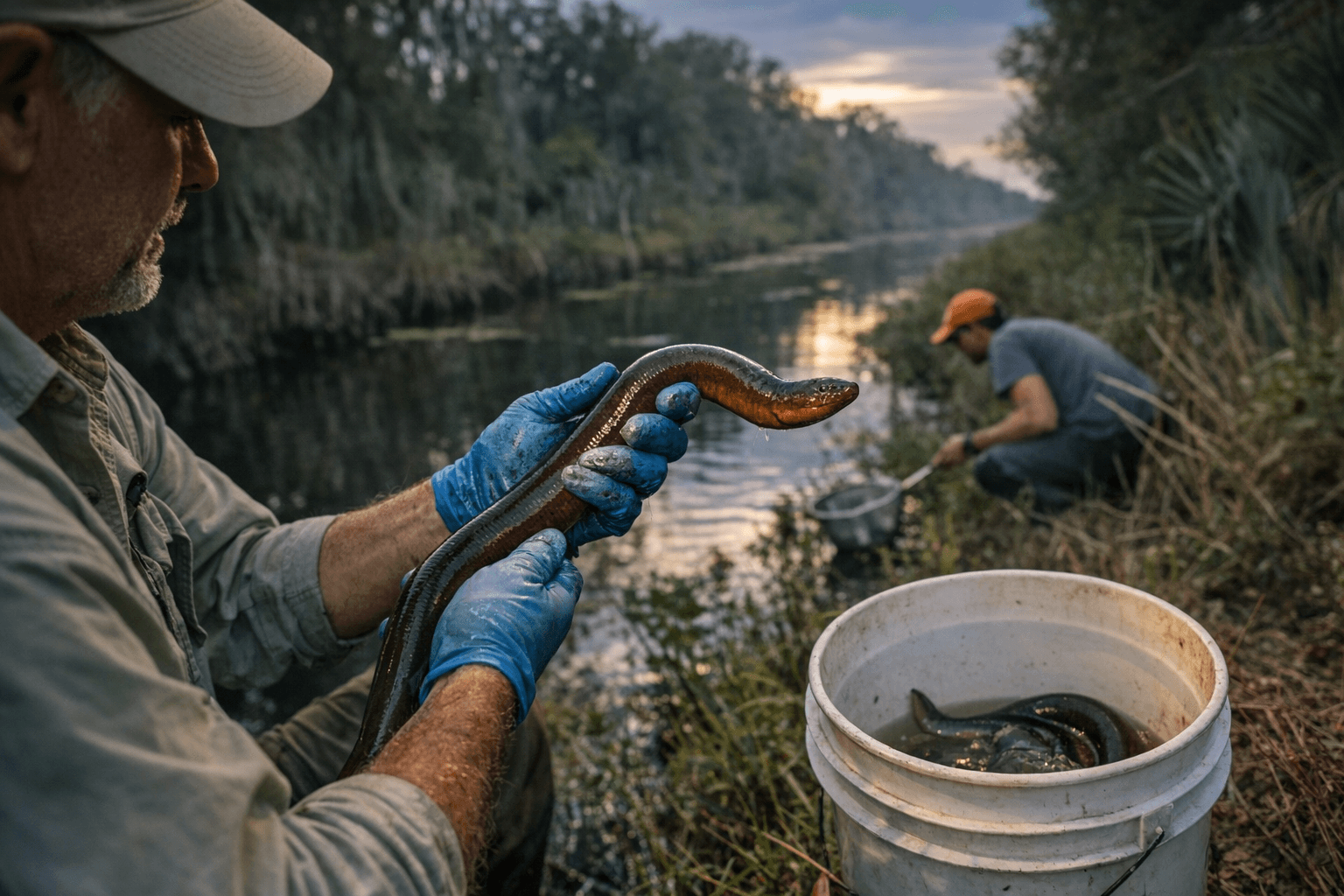
A finless, snake-like fish coated in slick mucus is exactly the kind of “eel-like” sight University of Florida scientists want documented, photographed, and reported before it slips deeper into Florida’s freshwater network. UF’s Institute of Food and Agricultural Sciences has issued a statewide advisory urging residents to help track invasive Asian swamp eels, a hard-to-detect predator linked to ecological damage in the Everglades.
The call for reports was carried locally in an April 10 Hernando Sun roundup, but UF/IFAS framed the push as a statewide early-warning effort tied to April’s Citizen Science Month, with special emphasis on western Palm Beach, Broward, and Miami-Dade counties and watersheds connected to the Everglades. Frank J. Mazzotti, a UF/IFAS wildlife ecology professor based at the UF/IFAS Fort Lauderdale Research and Education Center, put the capacity problem bluntly: “We can’t be everywhere all the time, but collectively, the public can.”
Asian swamp eels are native to East and Southeast Asia. UF/IFAS has said the fish were first detected in the United States in the 1990s and later observed in the Florida Everglades in 2007. The Florida Fish and Wildlife Conservation Commission reports swamp eels were first collected in Florida in 1997 and are now abundant in multiple southeast Florida canals, with documented populations also tied to the Tampa Bay area in drainages such as the Little Manatee River and Bullfrog Creek.
For identification, FWC describes swamp eels as finless and “snake-like,” often dark reddish-brown with a lighter tan-to-orange abdomen. Some individuals can appear orange, pink, or white with calico-like markings. They prefer shallow, sluggish, vegetation-choked waters and can persist where dissolved oxygen is extremely low because they breathe air. Their ability to burrow into mud and survive dry periods, plus mostly nocturnal activity, makes them difficult to spot through routine daytime surveys.
Scientists’ concern is not theoretical. A 2024 peer-reviewed synthesis of Florida records and long-term monitoring concluded the risk was initially underestimated and that swamp eels likely contributed to population crashes of crayfishes and small fishes in parts of the eastern Everglades, with spread continuing unchecked. Mazzotti also warned that invasive species can undermine restoration even if managers “get the water right.”
UF/IFAS is urging Floridians who encounter a suspected swamp eel to take clear photos showing the overall body and head and report immediately through the IVEGOT1 hotline at 1-888-IVEGOT1, or through the IVEGOT1 mobile app or online reporting portal. UF scientists say public reports help refine surveillance and guide where to target environmental DNA water sampling, a lab method that can detect genetic traces even when the fish stays hidden.
This article was produced by Prism’s automated news system from verified source data, official records, and press releases, then run through automated quality and moderation checks before publishing. The system is built and supervised by the people who set the standards it runs under. Read our full AI policy.
Did this article answer your question?