Hidalgo County's Bootheel Offers Sky Islands, Desert Grassland, and Wildlife Havens
New Mexico's remote Bootheel hides sky island ranges, vast desert grasslands, and wildlife corridors that draw serious birders, hunters, and backcountry explorers.
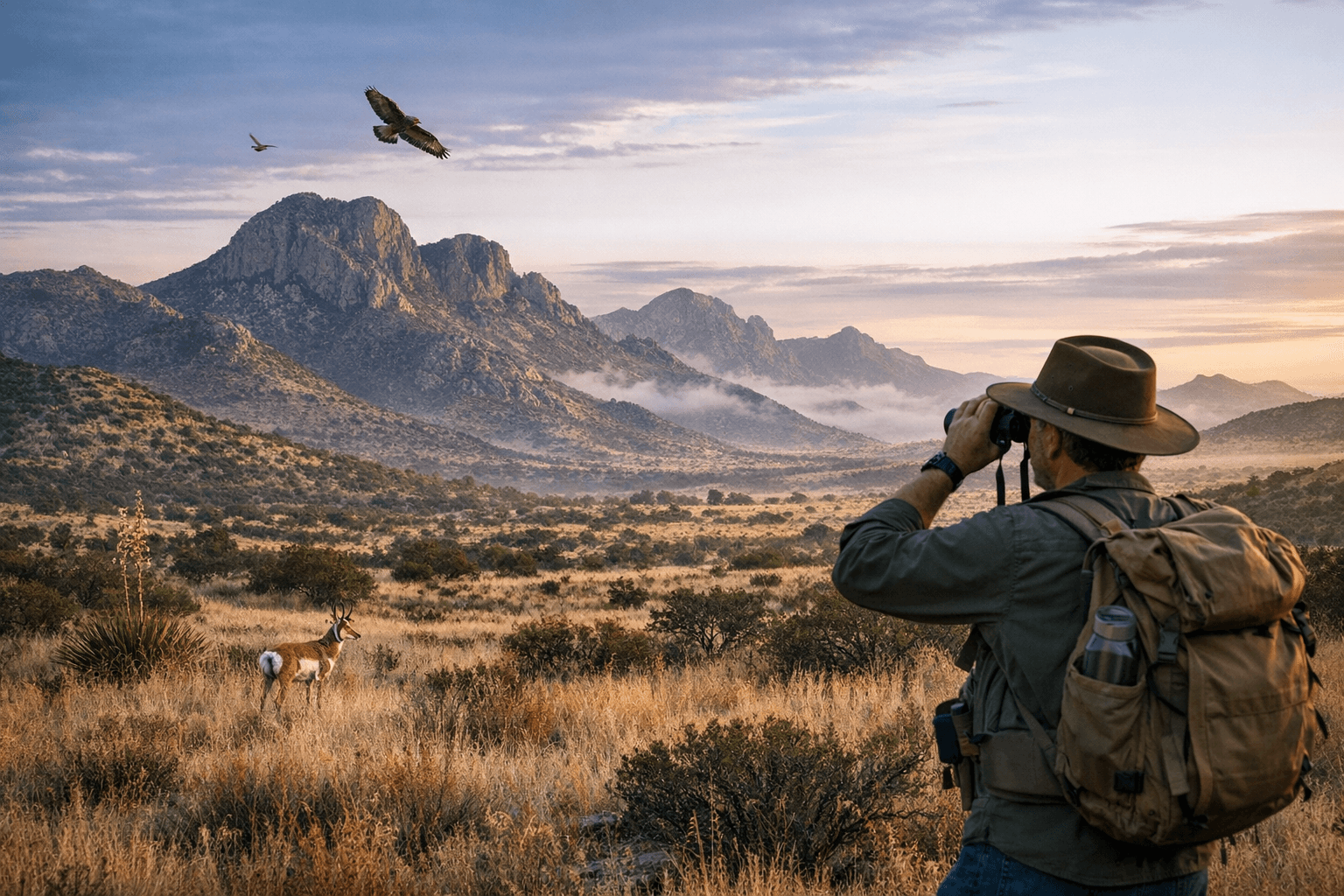
Few corners of New Mexico feel as genuinely remote as Hidalgo County. Tucked into the southern tip of the state's distinctive Bootheel, this sparsely populated stretch of high desert and rugged mountain terrain sits at a crossroads of ecological zones that scientists and naturalists have studied for generations. The result is a landscape unlike anything else in the Southwest: jagged sky island ranges rising from open grassland, wildlife corridors of international significance, and enough backcountry to keep hikers and hunters exploring for years without repeating a trail.
Sky islands: The Peloncillo Mountains and beyond
The term "sky island" describes mountain ranges that rise abruptly from surrounding desert, creating isolated ecological communities as distinct from their lowland surroundings as oceanic islands are from the sea. Hidalgo County holds some of the finest examples in the American Southwest, with the Peloncillo Mountains anchoring the western edge of the county along the New Mexico-Arizona border.
The Peloncillos are not dramatic in the way that the Rockies announce themselves. They rise gradually, their ridgelines draped in oak, juniper, and piñon that give way to open desert grassland at the base. That transition zone is exactly what makes them ecologically rich. Species from the Sierra Madre of Mexico reach the northern limit of their range here, while Great Basin and Chihuahuan Desert species overlap in the canyon bottoms. For anyone willing to leave the pavement, the Peloncillos offer hiking through terrain that carries a genuine sense of wildness.
Access points into the range exist along Forest Service and Bureau of Land Management roads throughout the county, though conditions vary seasonally and a high-clearance vehicle is strongly recommended for most routes. The reward for navigating those roads is solitude: visitor numbers here are a fraction of what you'd find in better-known New Mexico ranges like the Sandias or the Organs.
The Continental Divide through the Bootheel
The Continental Divide cuts through Hidalgo County, adding another layer of geographic drama to a landscape already defined by contrast. Along the Divide, the terrain shifts between open desert grassland and rocky uplands, offering long views across both the Chihuahuan and Sonoran Desert transitions. The Divide Trail corridor here is less traveled than its counterparts in the northern part of the state, which means hikers willing to do their route-planning homework can find stretches of genuine backcountry with minimal company.
For hunters, the Continental Divide area and the surrounding public lands represent productive territory for pronghorn, mule deer, and other species native to the high desert. New Mexico Game and Fish manages seasons and licensing for the region, and the unit structure covering Hidalgo County includes areas with historically strong populations of both game animals and predators, including mountain lion.
Desert grassland: A vanishing ecosystem
The open grasslands that roll across much of Hidalgo County represent one of the most threatened ecosystems in North America. Chihuahuan Desert grassland once covered an enormous expanse of the southwestern United States and northern Mexico, but a combination of historical overgrazing, drought cycles, and shrub encroachment has reduced intact grassland to a fraction of its former range. What remains in Hidalgo County is among the most significant in the region.
These grasslands support a suite of species that require large, unbroken expanses to survive: pronghorn antelope that need open sightlines to detect predators, grassland birds like the Chihuahuan meadowlark and Sprague's pipit that nest only in undisturbed grass, and raptors that hunt across the wide plains. Walking or driving through this landscape in early morning or late afternoon, when the light goes golden across the grass and the mountain ranges frame every horizon, offers an experience that's genuinely difficult to find elsewhere in the United States.
Birding: An internationally significant flyway
Hidalgo County sits within one of the most important bird migration corridors in North America. The combination of sky island ranges, desert grassland, and riparian corridors along seasonal drainages creates a concentration of habitats that supports an extraordinary list of species across all seasons.
For birders, the county is best known as one of the few places in the United States where Mexican species regularly appear. The Peloncillo Mountains and their associated canyon systems have recorded rare and sought-after visitors from south of the border, making Hidalgo County a destination for serious birders willing to make the drive to Lordsburg, the county seat, and then venture further into the backcountry.
Migration seasons, particularly spring and fall, bring waves of neotropical migrants moving through the canyon systems. Riparian areas along dry washes and seasonal creeks act as funnel points, concentrating warblers, flycatchers, and other species in numbers that reward patience and early starts. Resident species include several southwestern specialties that are difficult to find elsewhere in New Mexico.
Birding here requires self-sufficiency. Cell service is limited across much of the county, water sources in the field are scarce, and distances between points of interest are significant. Carrying detailed topographic maps, extra water, and a full tank of gas before leaving Lordsburg or Animas is not overcautious; it is simply practical.
Planning a visit
Hidalgo County covers a large area with limited services, and that is precisely what defines its appeal. The towns of Lordsburg and Animas serve as the primary bases for visitors, offering fuel, basic supplies, and lodging options. From either town, day trips into the Peloncillos, along the Continental Divide corridor, or across the grasslands are feasible with proper preparation.
Seasons matter considerably here. Spring brings the best birding and comfortable temperatures for hiking. Summer monsoon season, typically July through September, transforms the grasslands and fills seasonal drainages, but afternoon thunderstorms can make backcountry roads impassable and lightning a genuine concern on exposed ridgelines. Fall is prime time for hunting seasons and for the second wave of migration. Winter in the county is cold and dry, with occasional snow at higher elevations, but the clear skies and empty roads offer their own rewards for those who come prepared.
The remoteness that makes Hidalgo County exceptional also demands respect. The Bootheel's sky islands, grasslands, and wildlife corridors have persisted precisely because they sit beyond the edge of casual attention. That quality is worth preserving.
This article was produced by Prism’s automated news system from verified source data, official records, and press releases, then run through automated quality and moderation checks before publishing. The system is built and supervised by the people who set the standards it runs under. Read our full AI policy.
Did this article answer your question?