Mexican gray wolf crosses into Mexico, highlighting border wall concerns
Cedar’s crossing into Chihuahua came through the last wall-free stretch of the Bootheel, just as federal barrier work moves deeper into Hidalgo County.
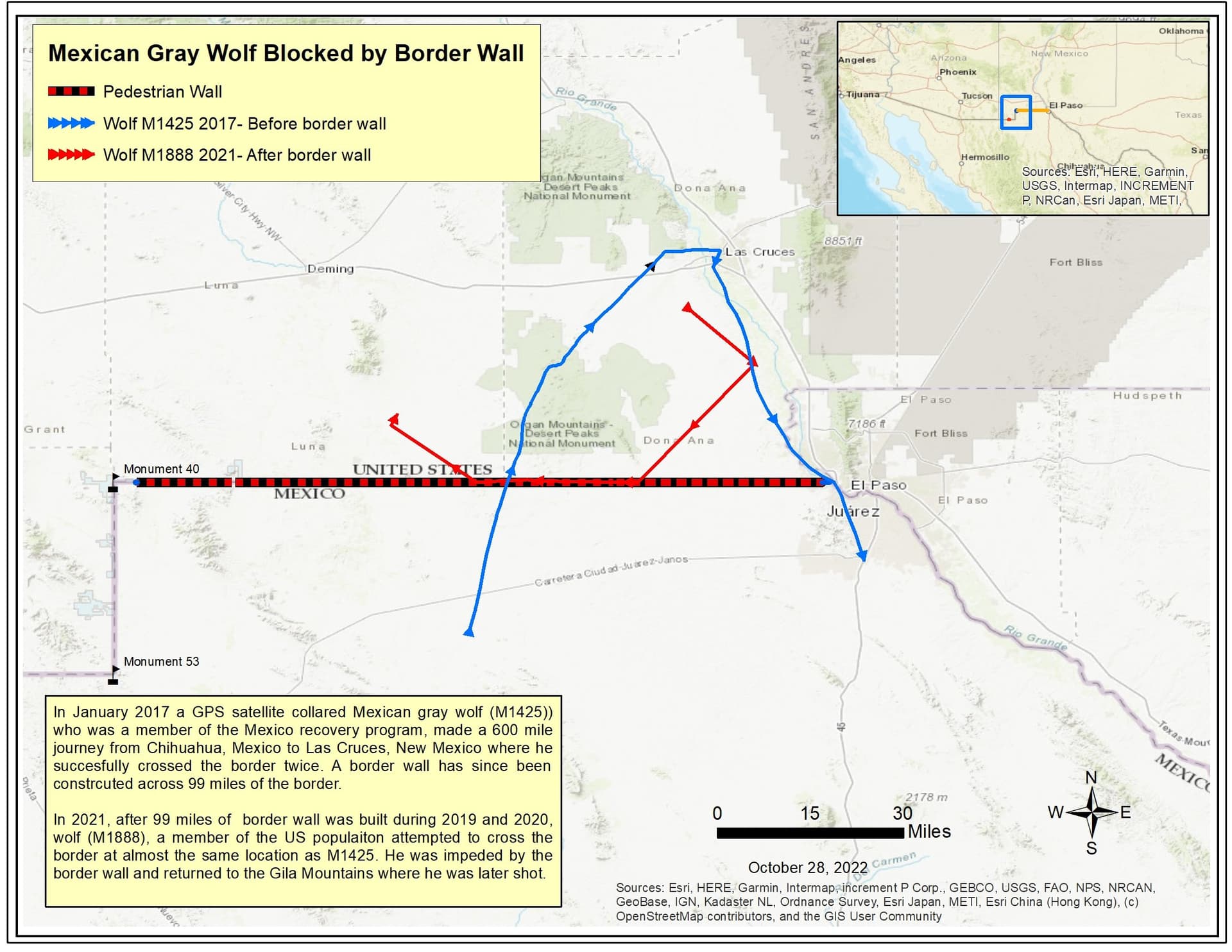
Cedar, a radio-collared Mexican gray wolf, slipped from New Mexico into Chihuahua through the last wall-free stretch of the Bootheel, a crossing conservationists say was the first of its kind in decades and a warning sign for the borderlands around Hidalgo County.
The wolf, an adult male from Arizona’s Rocky Prairie Pack and the younger brother of Asha, traveled south through remote country before entering Mexico, where he may now have a chance to find a mate. Wildlife advocates say that movement matters because Mexican wolves still depend on open space across the border to move naturally, mix genes and avoid the isolation that has long constrained recovery on both sides of the line.
That concern lands squarely in Hidalgo County, where U.S. Customs and Border Protection has already begun planning additional barrier construction. The agency’s December 2025 environmental document for Hidalgo County said the Department of Homeland Security issued a waiver on December 18, 2025, to speed construction, and a separate CBP notice outlined about 23.1 miles of primary border barrier south of the USBP Deming Station. In January, federal contracting reports said Fisher Sand & Gravel Co. won a roughly $1.6 billion deal for 49 miles of wall in New Mexico’s Bootheel.
Conservationists say those projects could cut off one of the few remaining wildlife corridors in the region. The same habitat strip that lets a wolf like Cedar move into Mexico also supports broader borderland connectivity for rare species such as jaguars. In a landscape defined by ranchland, public lands and federal border policy, the issue is not abstract: it is whether animals can still move through southern New Mexico and into northern Mexico without being blocked by steel and fill.
The Mexican wolf’s recovery depends on that movement. The U.S. Fish and Wildlife Service listed the species as endangered in 1976, then began a binational captive-breeding effort after the wild population nearly vanished. The first captive wolves were released in Arizona and New Mexico in 1998. Federal recovery documents now stress genetic diversity, and the revised 2022 recovery plan specifically addresses genetic and demographic stressors.
Population counts show some progress, but the wild numbers remain thin. The service said the U.S. wild population reached a minimum of 286 wolves in 2024, an 11 percent increase and the ninth straight year of growth. It said Mexico provided only a minimum count that year, after reporting an estimated 20 wolves in 2022, including nine released or translocated wolves that survived to breeding age and counted toward genetic recovery criteria. Arizona Game and Fish said the wild population had expanded into Arizona and New Mexico and reached at least 319 by 2025. Cedar’s crossing makes clear that the next phase of recovery may depend as much on what gets built in the Bootheel as on what survives there.
This article was produced by Prism’s automated news system from verified source data, official records, and press releases, then run through automated quality and moderation checks before publishing. The system is built and supervised by the people who set the standards it runs under. Read our full AI policy.
Did this article answer your question?