Historic Betty Lazar portrait returns to Lordsburg City Hall
Betty Lazar’s portrait is back in Lordsburg City Hall, restoring a civic landmark tied to the town’s first woman mayor and a nearby World War II POW camp.

The portrait of Betty Lazar is hanging again in Lordsburg City Hall, where residents pass it on the way to council chambers and city business. After briefly going missing in April, the restored oil painting returned on June 19, 2026, putting one of the city’s most recognizable pieces of civic history back in public view.
For a town of 2,335 people that serves as the Hidalgo County seat, the image carries more weight than decoration. Lazar was Lordsburg’s first woman mayor and served from 1970 to 1972, a milestone that still stands out in the city’s political history. Mayor Martin Neave stood beside the restored portrait at City Hall on Thursday, underscoring that the painting belongs in the daily life of the building, not hidden away from it.
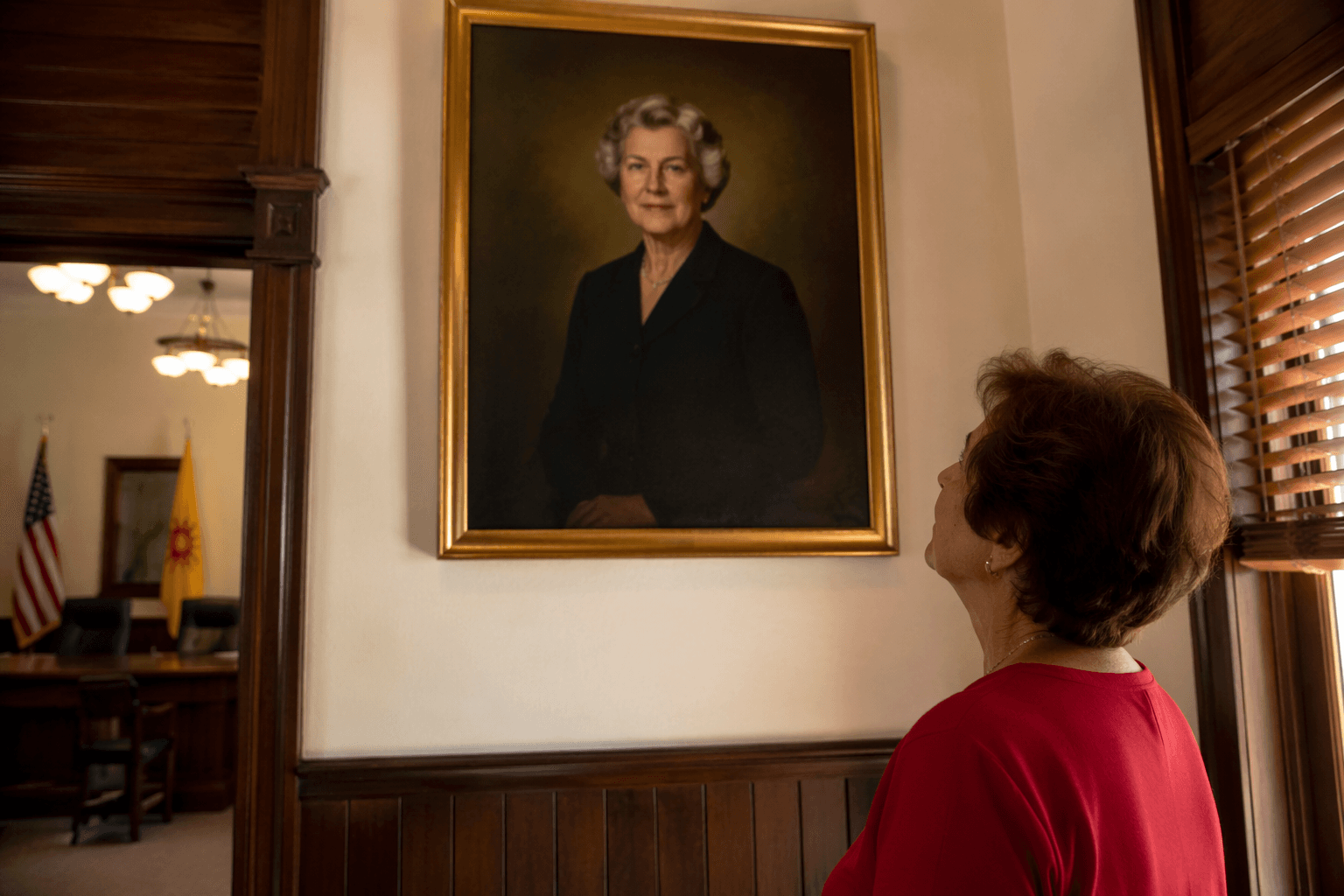
The portrait’s origin gives it an even wider historical reach. It was painted in 1943 by an Italian artist who was being held as a prisoner of war at Camp Lordsburg, the wartime site east of town that linked the city to World War II in a direct and unusual way. Historical accounts place Camp Lordsburg about three to three-and-a-half miles east of Lordsburg, first as a detention site for Japanese civilians and later as a prisoner-of-war camp for Italian and German soldiers.
Sources place as many as about 4,000 prisoners at the camp, and Italian POWs were held there from roughly the fall of 1943 through the summer of 1944, though some accounts say the camp remained open until early 1946. That history makes the portrait a rare artifact: it connects a local mayor, a wartime camp, and a piece of art made under captivity within a few miles of the city it now serves.
Lazar’s own history is woven tightly into that story. She moved to Lordsburg in the 1930s and leased the Hollen Hotel in 1940. Her oral history, preserved by the New Mexico Farm & Ranch Heritage Museum, includes recollections of the Japanese internees at Camp Lordsburg and the later German and Italian prisoners of war held there. She also recalled how close the camp sat to the border with Mexico, a detail that gives the portrait’s place of origin a sharper local edge.
The return of the painting does more than replace an object on a wall. It restores a visible link between City Hall and the people, wartime events, and political milestones that shaped Lordsburg’s identity. For residents who walk into the building today, Betty Lazar’s portrait once again helps tell the story of who led before them and how the city remembers itself.
This article was produced by Prism’s automated news system from verified source data, official records, and press releases, then run through automated quality and moderation checks before publishing. The system is built and supervised by the people who set the standards it runs under. Read our full AI policy.
Know something we missed? Have a correction or additional information?
Submit a Tip