Southeast Bakersfield residents urge action after Hale Street brush fire
A brush fire near Hale Street was surrounded by dumped debris. Hidalgo County spent $8.6 million on trash removal last year as cameras and housing dollars compete for attention.
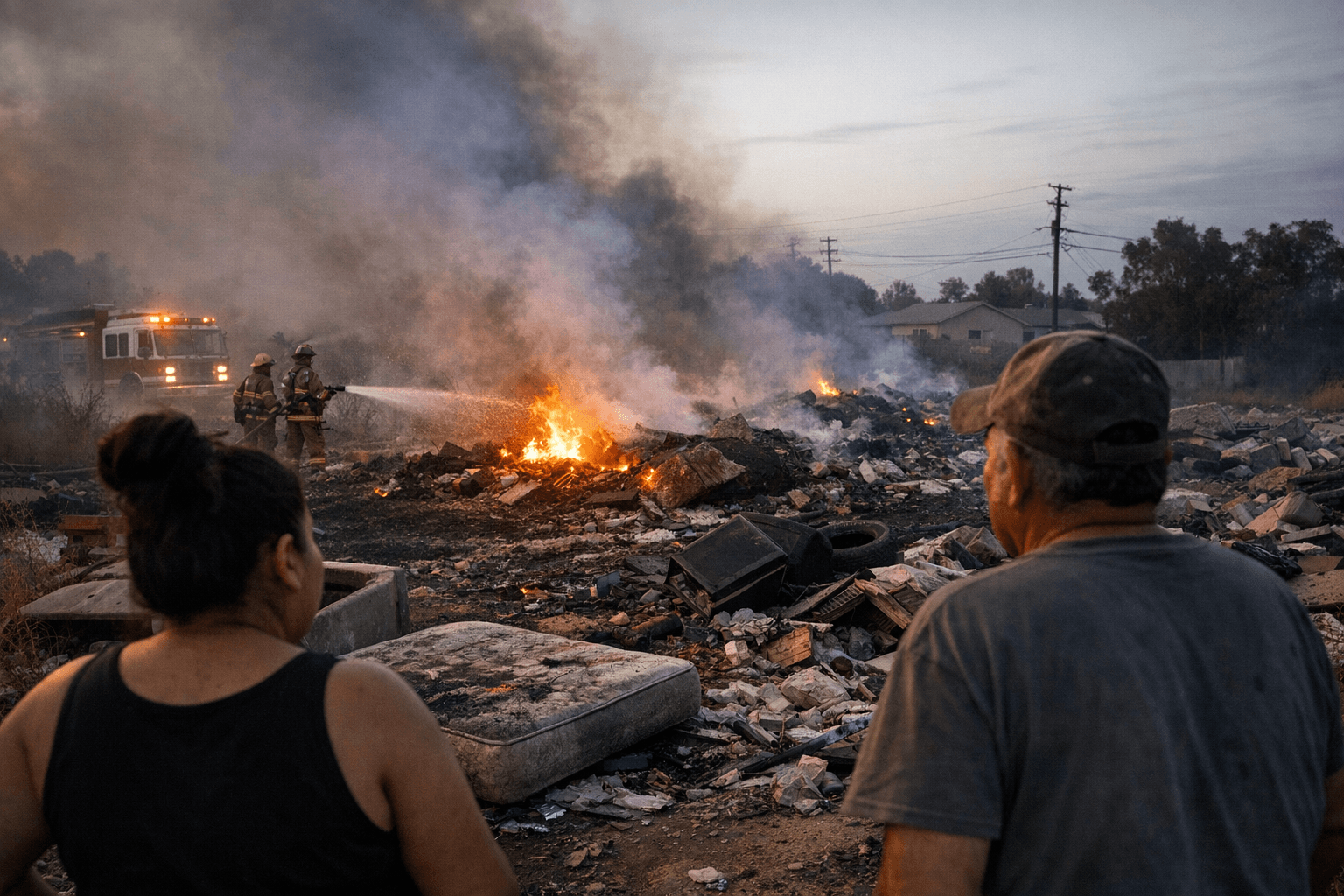
Firefighters rushed to the 3600 block of Hale Street near Cottonwood Road and East Planz Road after a brush fire sent dark smoke over southeast Bakersfield, an area officials said has seen rising illegal dumping. The scene has a familiar feel in Hidalgo County, where officials say cleanup costs and homelessness services are colliding with public-safety enforcement.
Bakersfield fire officials said the vegetation fire broke out at about 11 a.m. Wednesday, April 8. The cause was under investigation, and there were no immediate reports of injuries or property damage. With summer approaching, firefighters urged residents to clear brush and debris from around homes, a reminder that dumped trash and dry vegetation can turn a small fire into a fast-moving emergency.
The concerns around Hale Street land on top of Kern County’s worsening homelessness picture. The 2024 federal point-in-time snapshot for the Bakersfield-Kern County Continuum of Care counted 2,669 people experiencing homelessness, including 1,646 unsheltered. Local outreach leaders have described shelters running near capacity, and the county’s own long-running reviews have pointed to cleanup demands and a tight housing market as pressure points.
Bakersfield has leaned on a mix of enforcement and shelter expansion. City operations have included encampment clearings supported by police and code enforcement, while the Brundage Lane Navigation Center has been described by city materials as a year-round emergency shelter designed to move people indoors and connect them to longer-term housing.
Hidalgo County is living its own version of the same equation, especially along canals, drainage ditches and easements that attract dumping and outdoor sleeping. In July 2023, Bonnie Bladey, a Zumba instructor who works with older adults, described learning of an illegal dumpsite a block from her McAllen studio: “Oh, my goodness! Why can’t they take care of this on their own? Why do they have to mess up somebody else’s perfect environment and then bring this unhealthy environment to the elderly?”
Hidalgo County Constable Precinct 4 Atanacio “J.R.” Gaitan pointed to surveillance and enforcement as part of the response: “We’ve got signs up posted on the county. We’ve got you know, cameras out there. So, if you’re illegal dumping, you know, we’re gonna catch you.” In March 2025, investigators arrested Juan Carlos Rios after authorities said he dumped more than eight tons of trash on a public roadway in rural Edinburg, a state jail felony case that underscored how quickly dumping can overwhelm rural shoulders and drainage paths.
Still, illegal dumping is also a services problem, tied to disposal access, poverty and housing instability. In May 2021, Hidalgo County Precinct 3 Commissioner Everardo “Ever” Villarreal warned after fires linked to burning brush and trash displaced families, saying, “It’s a huge problem for the area and we just want to let the people know that this is dangerous,” while also stating the county was “spending over eight million dollars in illegal trash that is being dumped.” County sanitation figures cited at the time put collection and disposal in unincorporated areas at $8.6 million the prior year.
On the homelessness side, Hidalgo County’s Urban County Program reports receiving $7,472,660 in HOME-ARP funds intended to reduce homelessness and housing instability, and the county’s 2025 point-in-time report counted 259 people experiencing homelessness. With hotter months ahead, the lesson from Hale Street is stark: without both targeted enforcement and real pathways to legal disposal and stable housing, dumped debris and outdoor living can keep turning into smoke, displacement and preventable health risk.
Sources:
Know something we missed? Have a correction or additional information?
Submit a Tip