Holmes County’s Spellacy Covered Bridge draws visitors, spans Mohican River
Spellacy Covered Bridge is more than a scenic stop: Holmes County’s $9.5 million span now carries road traffic, campground visitors and national engineering acclaim.
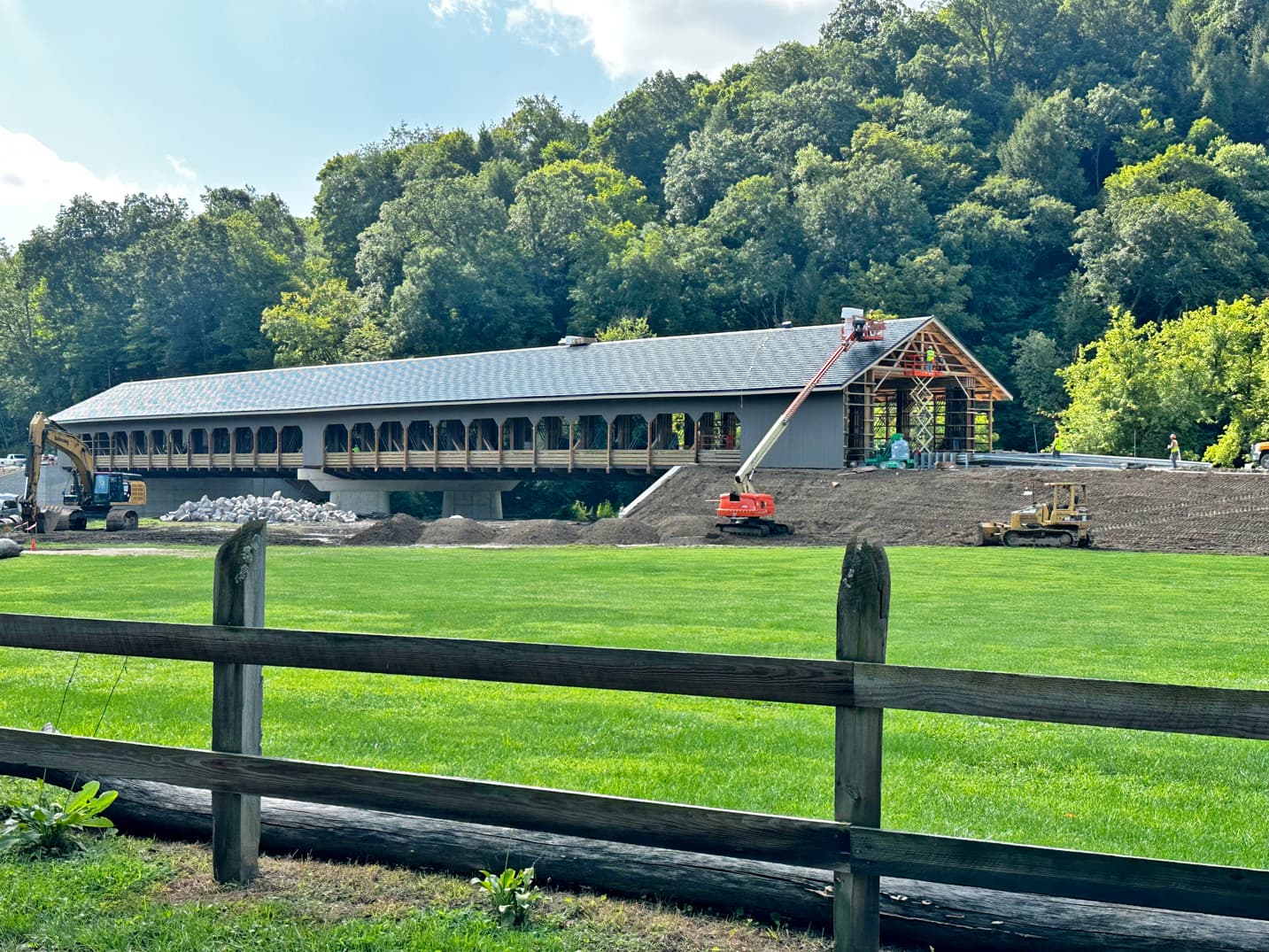
Spellacy Covered Bridge rises as both a working road and a destination, a 300-foot span that changed how people move through the Mohican River corridor in Holmes County. It carries County Road 23 along the Wally Road Scenic Byway, crossing the river near Arrow Point Campground and Lost Horizon Campgrounds, and it has quickly become a place where local infrastructure and tourism meet in the same frame.
A bridge built to be seen, and used
The scale is what catches the eye first. At about 300 feet long and roughly 24 feet wide, Spellacy Covered Bridge is one of the longest covered bridges in the United States, and its size gives the structure a visual weight that smaller historic spans cannot match. It opened to traffic on September 1, 2023, and a dedication ceremony two weeks later drew more than 100 people, a turnout that reflected both the novelty of the bridge and the local interest surrounding it.
That attention is not accidental. Holmes County designed the replacement as a public asset with a long service life, not just as a decorative throwback. The project was built to last about 125 years and was estimated at $9.5 million, making it the county’s largest infrastructure job to date. In a rural county where roadwork can fade into the background, this project was built to stand out and to keep paying off through daily use.
Why the old bridge had to go
Spellacy Covered Bridge replaced a deteriorating iron-truss bridge built in 1993. The earlier structure wore out too soon, and one account says faulty construction materials contributed to its premature deterioration. That history gives the current bridge its practical edge: it is not a nostalgic add-on, but the county’s answer to a failed span that no longer met the need.

That before-and-after matters because it shows how local government sometimes has to solve a transportation problem in plain view. Holmes County did not simply restore an old crossing. It replaced a weak link with a structure designed for longevity, while also turning the new crossing into a point of pride for residents and a destination for visitors moving through the Mohican area.
A route shaped by rail history
The bridge’s setting carries its own story. The road follows the path of the former Walhonding Valley Railroad, often called the Wally Railroad, which ran between Coshocton and Loudonville from 1892 to 1942. That rail corridor shaped travel in the valley long before the bridge opened, and the new span keeps that corridor visible in a modern form.
The bridge is named for Matthew Spellacy, an Irish immigrant connected to railroad construction in the area. That name ties the project to the labor, migration and engineering that helped build the region’s transportation network in the first place. The bridge therefore reads as both a present-day county road project and a marker of the older systems that once connected Holmes County to the rest of the region.
How the bridge functions as a local asset
Spellacy Covered Bridge does more than move cars across the Mohican River. It also supports the flow of campground traffic and gives travelers on the Wally Road Scenic Byway a reason to slow down and stop. That makes the bridge useful in the most practical sense while also strengthening the county’s image as a place where scenery, craftsmanship and access are joined together.
Chris Young, Holmes County’s engineer, said residents were proud of the bridge and visitors were amazed by it. Dave Hall said the bridge would be a major attraction for the area. Those reactions fit what the structure already does on the ground: it serves daily traffic, but it also functions as a landmark for photographers, bridge fans and families heading into the Mohican region.
The surrounding businesses benefit from that mix of utility and interest. Travelers using the corridor have a built-in pause point, and the bridge’s size encourages people to stop where they might otherwise drive through. In a county where tourism and road access often overlap, that kind of stop can matter as much as the crossing itself.
Recognition that reinforces the draw
The bridge’s profile grew beyond Holmes County when it began collecting design honors. It won the 2024 Engineering News-Record Best of the Best Award in the Small Project category and also took the ENR Midwest Best Project award in the same category. OHM Advisors has described the bridge as one of the nation’s top engineering achievements, and that recognition adds another layer to its appeal.

Awards matter here because they validate the county’s decision to treat a transportation replacement as a showcase project. The bridge is not only scenic; it is also a vetted piece of infrastructure that has been judged on design, execution and construction quality. That combination helps explain why it has drawn interest well beyond the immediate Mohican Valley.
The team behind the span
The project brought together Holmes County, the Ohio Department of Transportation, OHM Advisors, Palmer Engineering, Kokosing Construction Co. and Smolen Engineering. That list underscores how much coordination it takes to turn a local bridge replacement into a structure that can carry traffic, fit the setting and last for generations.
The result is a bridge that answers a county need while also serving a wider audience. Drivers on County Road 23 get a dependable crossing, campers and day-trippers get a landmark, and Holmes County gets a new image asset tied to the Mohican River. Spellacy Covered Bridge now functions as road, attraction and statement piece all at once, and that is what gives it staying power.
In a county known for its landscapes and back roads, the bridge has become a public work that people actually notice. That is rare, and it is exactly why the structure has already earned a place in Holmes County’s present tense.
This article was produced by Prism’s automated news system from verified source data, official records, and press releases, then run through automated quality and moderation checks before publishing. The system is built and supervised by the people who set the standards it runs under. Read our full AI policy.
Did this article answer your question?