Arcata revises Jacoby plaque to acknowledge Wiyot ancestral lands
Arcata is rewriting the Jacoby Building plaque to drop a phrase about “Indian troubles” and name Wiyot ancestral land. The change reopens a fight over who gets to define Plaza history.
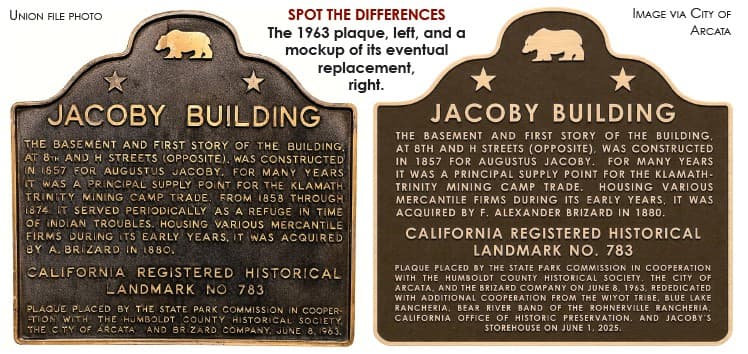
Arcata’s revised Jacoby Building plaque strips out the old language that described the building as a refuge in “Indian troubles” and replaces it with an explicit acknowledgment that the City of Arcata sits on the unceded ancestral lands of the Wiyot Tribe.
That shift matters because the Jacoby marker has never been just a plaque. It has long helped define what people at Arcata Plaza are told about the city’s past, and the old wording had become a flashpoint for its treatment of Wiyot history as a vague backdrop to settler life. The new text turns that around, naming Wiyot land directly and framing the revision as a correction to a public message that had stood for years.
The building itself, California Historical Landmark No. 783, dates to 1857, when Augustus Jacoby had the basement and first story constructed at the southeast corner of Eighth and H streets. California State Parks’ landmark description says the building “served occasionally as a refuge in time of the Indian troubles from 1858 through 1864,” a line that has remained visible in the official record even as the plaque language changed. The property later passed to A. Brizard in 1880 and was added to the National Register of Historic Places on June 17, 1982.
The plaque now being reworded was first placed on June 8, 1963, by the State Park Commission in cooperation with the Humboldt County Historical Society, the City of Arcata and Brizard Company. That makes the current change less like a new interpretive sign than a revision of a 1960s-era civic message, one now being brought into line with Arcata’s current land acknowledgment.
Arcata’s own official language says the city rests on the unceded ancestral lands of the Wiyot Tribe and on land known as Goudi’ni, meaning over in the woods or among the redwoods. The city says that acknowledgment is intended to help dismantle settler-colonial legacy narratives, a goal that now appears to be reflected in the plaque’s new wording.
The broader context is familiar in Arcata. In 2018, the city removed the McKinley statue from the Plaza and voted to replace another historic monument, underscoring how often the city’s public spaces become battlegrounds over memory, identity and power. The Jacoby plaque revision continues that pattern, but with a sharper point: whether Arcata is correcting history, sanitizing it, or trying to do both at once.
This article was produced by Prism’s automated news system from verified source data, official records, and press releases, then run through automated quality and moderation checks before publishing. The system is built and supervised by the people who set the standards it runs under. Read our full AI policy.
Did this article answer your question?