Dows Prairie Grange works to stay vital in McKinleyville community
Dows Prairie Grange is still feeding students, funding scholarships and hosting local groups in McKinleyville. Its future now depends on whether those practical services can outlast nostalgia.
Why Dows Prairie Grange still matters
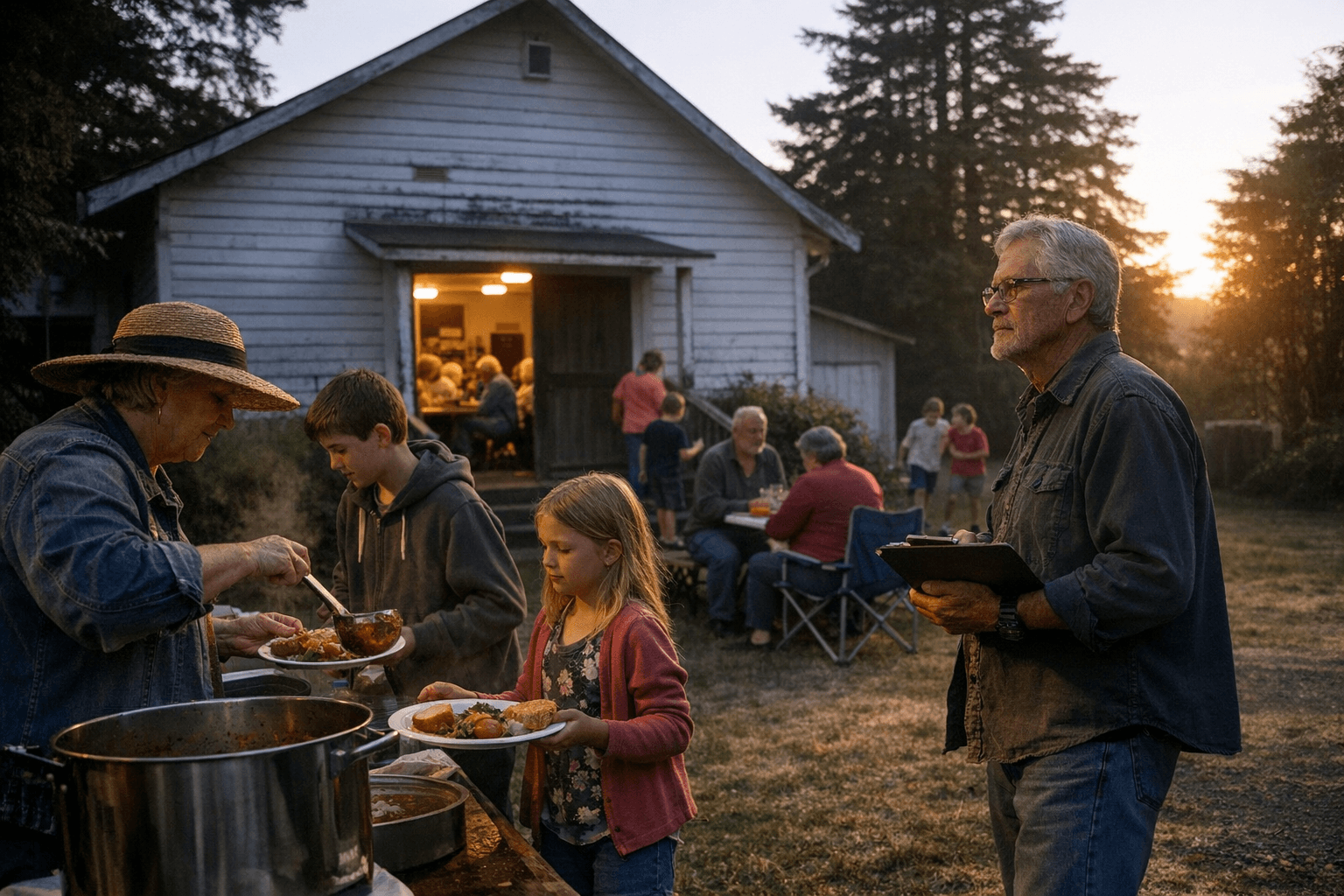
Dows Prairie Grange #505 is trying to prove something simple in McKinleyville: a rural hall survives only if it solves real problems. That means food for students, space for youth groups, a place for emergency training and a gathering spot that still feels useful when families are stretched thin.
Tracie Ahlberg, a lecturer at the Grange, says the organization traces its roots to 1867, the same year the National Grange was founded in Washington, D.C. But in McKinleyville, the question is less about origin than function. The Grange is working to stay visible by serving the people around it, not just preserving a building or celebrating a tradition.
Food, scholarships and other services families can actually use
The clearest case for the Grange’s relevance is the way it fills gaps that can be hard to cover elsewhere. Its work includes support for the McKinleyville High School Crisis Pantry, scholarships for McKinleyville High graduates and food support for local students. In a community where even small expenses can derail a family budget, that kind of help is not symbolic.
A 2026 report from the Mad River Union said Dows Prairie Grange delivered more than 150 pounds of food, additional snacks and $150 in Safeway gift cards to the McKinleyville High School Crisis Pantry in time for spring break. That donation was part of a 20-year tradition, which gives the Grange a long record of responding to the predictable strain that comes when school is out and student needs rise.
The group’s scholarship work carries the same practical weight. In June 2025, Dows Prairie Grange awarded $400 scholarships to three students. That is not a ceremonial gesture, especially in a county where transportation, books, fees and basic living costs can make college or training feel out of reach for students graduating from McKinleyville High School.
A community hub, not just a hall
The Grange also stays relevant by offering space that other institutions can use without a lot of friction. Its hall has a 2,400-square-foot main hall with a stage, which makes it a flexible place for meetings, gatherings and community events. That matters in a part of Humboldt County where shared indoor space is valuable and often hard to replace.
According to the Grange’s own community engagement information, the hall provides venue space for Community Emergency Response Team training, hosts eight Girl Scout troops for meetings and supports the Lions Club Winter Express event. The Winter Express serves more than 700 local elementary school children, which means the Grange’s reach extends well beyond its own membership.
That network of use gives the building a different kind of public value. It is not just where people gather for a meal or a fundraiser. It is where youth groups meet, neighbors train for emergencies and organizations with different missions overlap in the same physical place.
A small library with a larger purpose
One of the most visible signs of that everyday usefulness is the new Little Free Library box outside the building. Because Dows Prairie Grange sits directly across from Dows Prairie Elementary School, the library has a built-in audience of children, parents and teachers moving through the neighborhood every day.
Ahlberg describes it as a place where people can take a book, leave a book or simply read and spend time there. That small service matters because literacy access is often uneven in rural communities. A free book box does not solve that problem on its own, but it does make reading visible, easy and normal right where families already pass.
The location adds to the point. Being across from Dows Prairie Elementary School turns the Grange into a daily presence, not a special-occasion venue. In a community where connection can depend on routine, that kind of ordinary access is part of the institution’s value.
From local history to living infrastructure
The history of the Dows Prairie Grange helps explain why it still feels rooted in McKinleyville rather than detached from it. The Grange says its charter was obtained on December 14, 1932, and that it has been an important part of the community since then. Its history page says early meetings were held at Washington School, now Blair House, before the organization moved to Clam Beach Hall in 1934.
The current hall was built across from Dows Prairie School on land purchased from Hammond Lumber for $50. That detail says a lot about the era in which the building took shape, and it also helps explain why the site still carries local memory. The hall is not simply old. It is part of the physical record of how McKinleyville organized itself around shared needs.
That record now includes multiple generations of youth support, community events and practical aid. The Grange says it supports local high school students, offers food pantry help and hosts events such as game nights and pancake breakfasts. Those events raise money, but they also create regular opportunities for people to see one another, trade information and keep the institution present in everyday life.
Trying to stay modern without losing its roots
Ahlberg says the Grange is collaborating with the wider community to increase outreach and re-establish itself as a useful, modern resource rather than a relic. That tension is at the center of its future. The organization can lean on a long history, but history alone will not keep a rural institution alive if it is not serving current needs.
That is why the Grange’s mix of food support, child-focused programming, emergency training and scholarship aid matters so much. It shows a legacy institution trying to meet the county where it is now, with real household pressures, local school needs and limited margin for error. In McKinleyville, Dows Prairie Grange is still making its case the only way that really counts: by being useful.
If it disappears, residents would lose more than a familiar hall. They would lose a place that feeds students, supports children, helps neighbors prepare for emergencies and keeps one of McKinleyville’s oldest civic traditions tied to present-day life.
This article was produced by Prism’s automated news system from verified source data, official records, and press releases, then run through automated quality and moderation checks before publishing. The system is built and supervised by the people who set the standards it runs under. Read our full AI policy.
Did this article answer your question?