Improve Your Soil This Spring for Healthier Plants and Less Watering
Iron County soils took a beating from March's storms; amending them now cuts summer watering and keeps runoff from reaching your well or septic system.
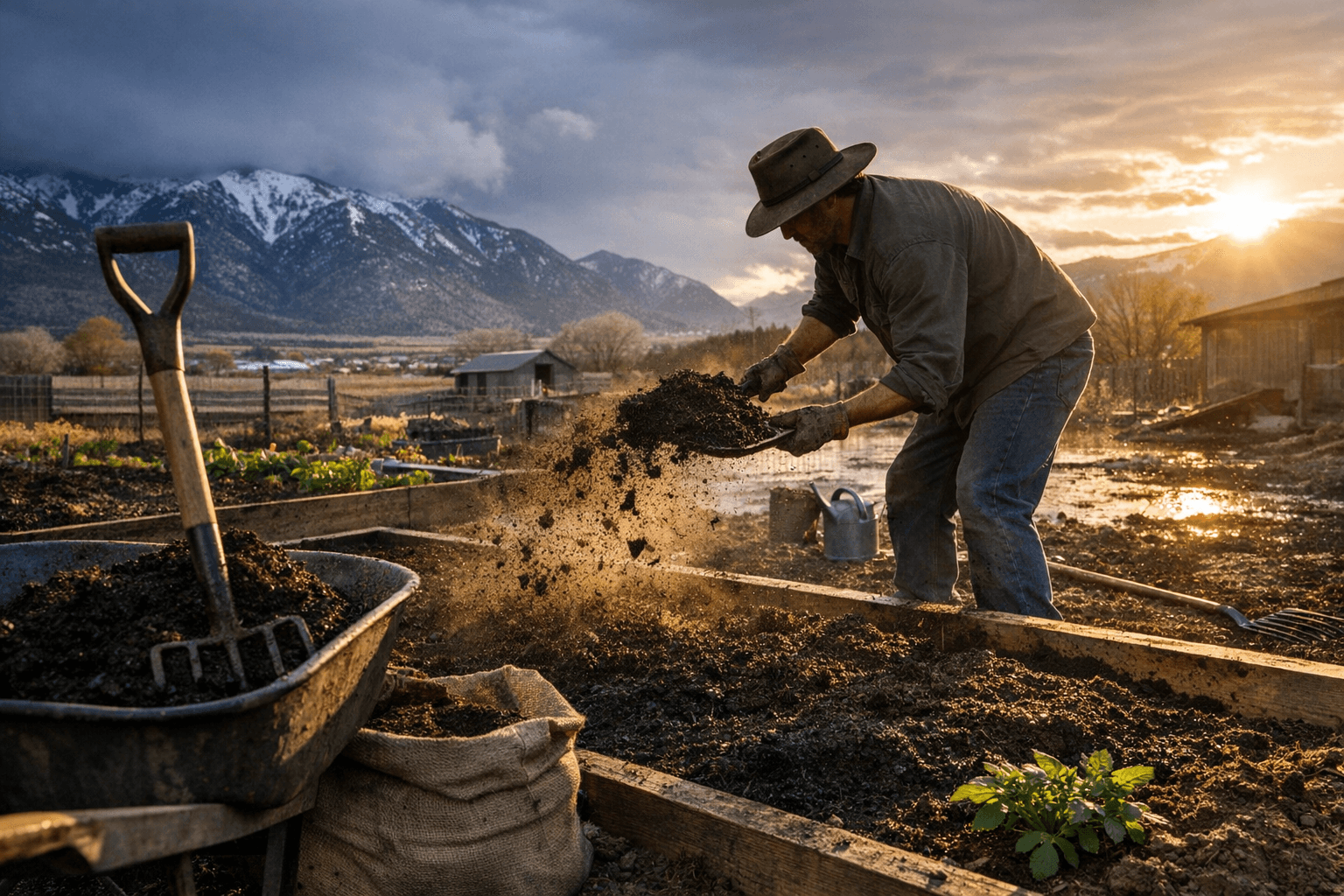
March's back-to-back storms left Iron County's soils saturated, compacted, and leached of the surface organic matter that plants, wells, and septic drainfields all depend on. Fixing that damage now, before you put a single seed in the ground, is the single highest-return action you can take this spring. Healthier soil absorbs rainfall rather than shedding it, which means less water running off toward roadside ditches, drainfields, and shallow wells, and far less time with a hose in July.
What March's Storms Actually Did to Your Ground
The sequence of events matters here. Heavy, wet snow followed by freeze-thaw cycles is one of the most effective ways to compress topsoil and drive surface organic matter downward, where plant roots can't easily reach it. When that snowpack melts fast, which happened across Iron County this spring, the runoff has nowhere to go in already-saturated soil. It sheets across the surface, pulling fine particles and nutrients with it into roadside ditches, low spots, and any permeable zone near a wellhead or septic system.
The result underground is a double problem: compaction reduces the large pore spaces that let roots breathe and that hold water between rain events, while lost organic matter means the soil's capacity to buffer moisture swings shrinks sharply. According to MSU Extension research, healthy soils carry organic matter levels between 5 and 15 percent. Soils that drop below the 5 percent threshold become noticeably less productive and, critically, lose their ability to hold water and nutrients effectively. For a county where the growing season is already short and late-season frosts are a real threat, that loss compounds quickly.
The Sandy-Clay Divide in Iron County
Iron County's soils are not uniform. Gardeners in and around Crystal Falls often encounter pockets of sandy loam over loamy substrates, while lower-lying areas and former lake beds near Iron River can hold heavy, poorly draining clay. These two types fail in opposite directions, and each requires a targeted approach.
Sandy soils have pore spaces that are simply too large. Water and dissolved nutrients drain through before roots can capture them, which is why sandy-bed gardens need frequent watering and still struggle with yellowing foliage. Clay soils, by contrast, drain so slowly that spring saturation lingers for weeks, cutting off oxygen to roots and creating exactly the kind of waterlogged compaction that invites erosion at the soil surface. In both cases, the fix is the same: organic matter. Added to sandy soil, it acts as a sponge, slowing drainage and holding nutrients in the root zone. Added to clay, it opens structure, improves aeration, and makes the soil workable weeks earlier in spring.
Why This Is Also a Water Quality and Property Issue
It is easy to think of soil improvement as a gardening concern, but in Iron County, where a large share of households rely on private wells and septic systems, degraded surface soils carry real infrastructure risk. Runoff that carries fine soil particles and excess fertilizer from unimproved beds can migrate toward wellheads, especially after heavy rain on saturated ground. The same runoff that silts roadside ditches after a March storm is chemically loaded from whatever it picks up along the way.
A well-structured soil profile, one with adequate organic matter and good aggregate stability, absorbs the first inch or two of a rain event before any surface flow begins. That buffering action protects not just your plants but the drainage infrastructure around your property. Improving your soil this spring is, in practical terms, a low-cost form of watershed management at the property scale.
Your Step-by-Step Checklist for This Week
The sequencing of spring soil work matters as much as the work itself. Doing things in the wrong order, particularly tilling or amending when soils are still saturated, can turn a minor compaction problem into a severe one that lasts for years. Here is the right order:
1. Test your soil before you do anything else. MSU Extension can process a basic pH and nutrient test through its local office serving Iron County.
The test tells you whether you need lime to raise pH, sulfur to lower it, or specific nutrients like phosphorus and potassium. Applying amendments blind, without a test, risks nutrient imbalances that stunt plants even in otherwise good soil.
2. Wait until your soil passes the squeeze test. Grab a handful and squeeze it.
If it crumbles apart when you open your hand, it is dry enough to work. If it holds a sticky ball, wait. Working wet soil, especially wet clay, destroys its structure and creates dense compacted layers that persist all season. Patience here pays off in every row you plant.
3. Add two to three inches of compost and work it in shallowly. Well-aged manure, leaf mold, or finished compost all supply organic matter that rebuilds both sandy and clay soils.
In Iron River, GFL collects curbside yard waste through the city's contracted service; that material eventually cycles back as compost feedstock. The Waste Management Transfer Station in Crystal Falls Township also accepts dropped-off residential yard waste. Residents who have been bagging leaves since fall are sitting on a resource they can now put directly to work.
4. Mulch everything you are not actively planting. A two-to-three-inch layer of wood chips, straw, or shredded leaves on unplanted beds does three things at once: it slows surface evaporation, moderates soil temperature against late frosts, and prevents the bare-soil erosion that sends fine particles toward your ditch and drainfield after the next rain event.
5. Plan a cover crop for any bed that will sit idle past late May. Buckwheat, crimson clover, and winter rye are all available through farm supply dealers and can be broadcast-seeded at low cost per square foot.
Their roots break up shallow compaction, their residue feeds soil microbes, and their canopy prevents erosion. Deep-rooted varieties are particularly effective at breaking up the kind of clay hardpan that forms under repeatedly saturated Iron County lowland soils.
Biochar for Beds That Never Hold Water
Sandy beds that dry out within two days of rain, no matter how much organic matter you add, are good candidates for biochar. This charred wood product, available through regional farm and garden suppliers, locks into soil pore spaces permanently rather than breaking down like compost. It improves both moisture retention and the soil's capacity to hold nutrients against leaching. It is more expensive than compost as an upfront input, but because it does not decompose, a single application continues to function for years. The caution here applies to all amendments: more is not better. Overapplication of any soil conditioner can tip nutrient balances in the wrong direction, so start conservatively and retest.
Getting Help Locally
The MSU Extension office serving Iron County can provide soil test kits, help interpret results, and offer planting calendars calibrated to the northern Michigan growing season. Iron County garden clubs are another practical resource for sourcing locally adapted seed varieties and connecting with neighbors who have already figured out what works in local clay or sand. For residents who want a more detailed amendment program, the Extension office can connect you with agronomists who understand the specific moisture and pH conditions that characterize Iron County's varied soil types.
The storms that hammered this county in March were a reminder of how much force moves through the landscape when soils cannot absorb what falls on them. Getting that absorption capacity back, bed by bed and lawn by lawn, is the most durable investment you can make before the growing season begins.
This article was produced by Prism’s automated news system from verified source data, official records, and press releases, then run through automated quality and moderation checks before publishing. The system is built and supervised by the people who set the standards it runs under. Read our full AI policy.
Did this article answer your question?