Iron County column spots goldfinches, redpolls as spring arrives
Goldfinches and redpolls are sharing Iron County feeders now, and the easiest clue is in the birds themselves: one is changing into summer yellow, the other is an Arctic visitor.
Two finches tell the story of spring
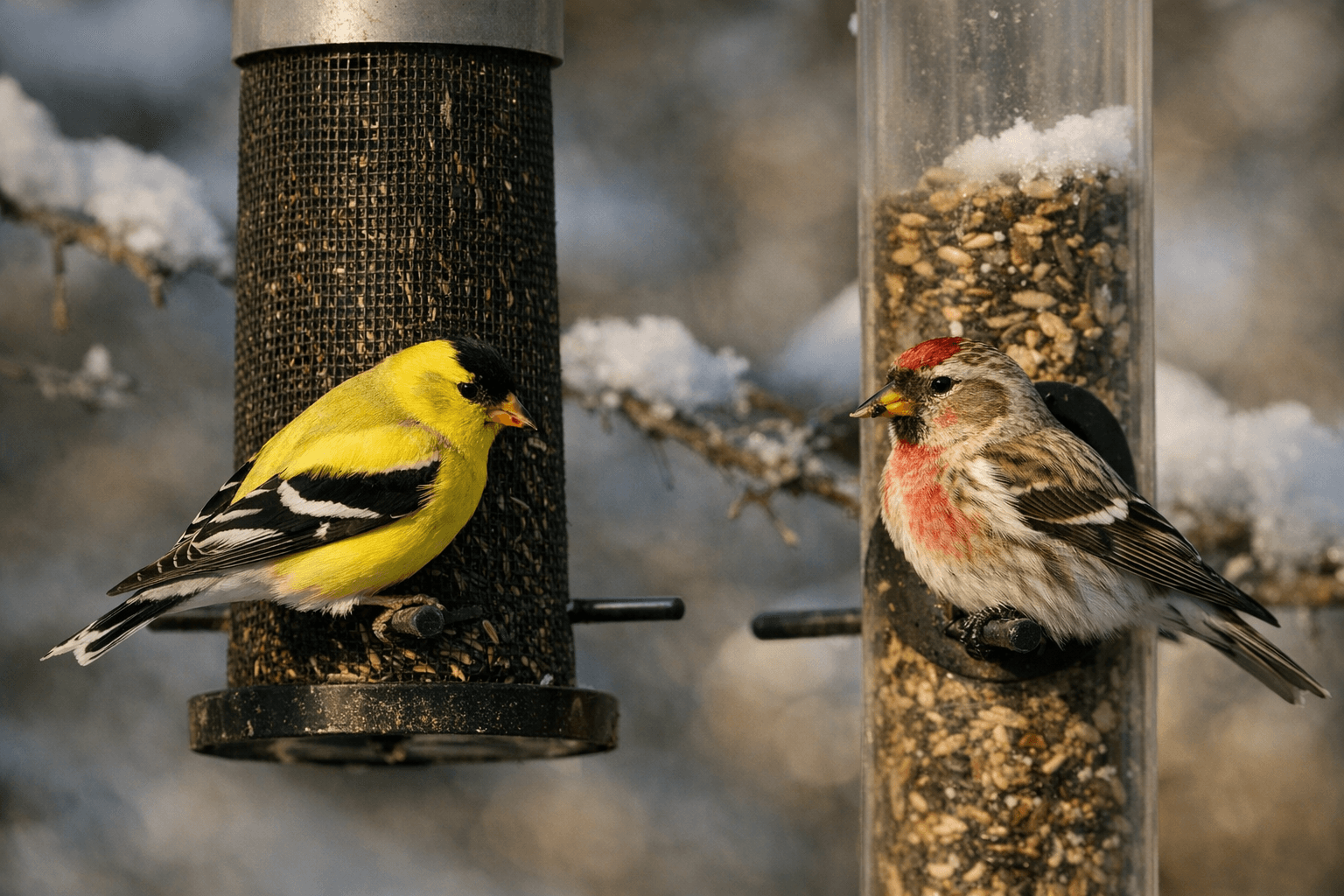
The feeders are giving up one of the clearest signs that winter is loosening its grip on Iron County: American Goldfinches and Common Redpolls are showing up together, each with a different reason for being here. One is a local bird slipping into its brighter spring look. The other is a wanderer from the Arctic, dropping south when food runs thin. Put side by side, they turn an ordinary backyard window into a live seasonal field guide.
How to tell them apart at an Iron River feeder
The American Goldfinch is the brighter, more familiar face, often called Iron River’s Wild Canary for good reason. In summer, the male flashes a clear yellow body with black wings and cap, and even now, as the season shifts, some birds can look patchy yellow and olive while their plumage changes. That uneven look is not a problem bird, it is a goldfinch in mid-molt, and goldfinches are unusual among songbirds because they molt twice a year.
Listen before you look too hard. The goldfinch’s call is a sharp, rolling po-ta-to-chip, and its flight is easy to recognize once you know it. Cornell Lab of Ornithology describes goldfinches as among the strictest vegetarians in the bird world, which helps explain why they are so tied to feeders and seed plants rather than insect hunting. Audubon notes that the species is a classic warm-weather meadow bird, built for bright fields and open edges.
The Common Redpoll is the smaller, tougher-looking visitor that often arrives with a flocky, nervous energy. It has a red forehead patch, a streaky brown body, and a tiny throat pouch for storing seeds. Where the goldfinch catches the eye with color, the redpoll catches it with motion, hopping quickly from perch to perch and dropping to seed trays with a no-nonsense urgency that feels distinctly winter-bird.
Why they are here now
The goldfinch’s spring arrival at feeders is not really an arrival at all. It is part of a local rhythm that begins with seeds, not insects. Holden Forests & Gardens says goldfinches often wait until late July or early August to nest, when milkweed and thistle have produced fibrous seeds, and Audubon calls them late nesters in mid- to late summer. That timing makes sense in Iron County yards, where thistle, milkweed, and other seed plants help support a bird that lives almost entirely on plant food.
That seed-heavy diet also explains one of the most surprising goldfinch facts in the bird world: they are so committed to seeds that even Brown-headed Cowbird chicks almost never make it in their nests. Cornell Lab says a cowbird chick in an American Goldfinch nest seldom survives longer than three days because goldfinch parents do not feed their young insects the way many other birds do. The goldfinch’s nest itself is built with care in shrubs or saplings, usually 4 to 10 feet above the ground, and lined with plant fibers, spider webs, grasses, and downy material such as thistle fluff.
That is why the goldfinch feels so tied to the change of seasons. The bird is not just becoming brighter, it is following the calendar of the plants around it. When thistle and milkweed begin to produce those fibrous seeds, the goldfinch’s whole life strategy comes into focus: feed on seed, nest late, and use the summer landscape on its own terms.
The redpoll means winter is still speaking
The Common Redpoll tells a different story. Cornell Lab describes these birds as small finches of the Arctic tundra and boreal forest that migrate erratically, and Audubon places them among the winter finches that sometimes invade southern Canada and the northern states. In irruption years, Cornell Lab says, redpolls can appear in large numbers as far south as the central United States, which is why Iron County yards can suddenly feel as if a piece of far northern winter has dropped in.
Redpolls are built for cold in a way few backyard birds are. Cornell Lab notes that they can withstand temperatures as low as -65 degrees by fluffing their feathers and even burrowing into snow. That is a remarkable adaptation for a bird that may now be picking through feeders in a thawing Northwoods yard. When they show up, they often gather in groups, especially around thistle or nyjer seed, which makes a feeder look busy in a way that is easy to notice even from across the yard.
The redpoll’s presence is a reminder that spring does not arrive all at once in Iron County. The snow may be shrinking and the roads clearer, but the bird world still carries traces of the cold season. In that sense, redpolls are not just winter leftovers. They are proof that the northern migration map still reaches into local yards, even after the first signs of thaw.
What to watch for in your own yard
A feeder in Iron River can hold both birds at once, and that is what makes this stretch of the season so interesting. Goldfinches are beginning to slide toward their brighter summer look, while redpolls are still hanging on to the cold-weather pattern that brought them south. If you are watching from a kitchen window or brushing snow off the porch, the easiest clue is the contrast: goldfinches look cleaner, yellower, and more open in shape, while redpolls look streaked, compact, and restless.
- Goldfinches often show yellow, black, and olive tones, especially as their plumage changes.
- Redpolls have a red forehead patch and a more streaked, winter-dressed look.
- Goldfinches give the po-ta-to-chip call.
- Redpolls tend to cluster at feeders, especially for thistle or nyjer seed.
A few quick field marks make the identification easier:
The bigger story is not just which bird is at the feeder, but what their presence says about Iron County right now. Goldfinches point toward late-summer seed cycles already building in the landscape. Redpolls point back to the Arctic, where cold still rules the bird calendar. Together, they make spring in the Northwoods look less like a clean break and more like a handoff, with winter birds lingering even as the first true signs of the warmer season settle into the yards around Iron County.
This article was produced by Prism’s automated news system from verified source data, official records, and press releases, then run through automated quality and moderation checks before publishing. The system is built and supervised by the people who set the standards it runs under. Read our full AI policy.
Did this article answer your question?