Wild Rivers Invasive Species Coalition to Formalize as Nonprofit with $70K Grant
A $70K state grant will turn the Wild Rivers Invasive Species Coalition into the Roots & Rivers Collaborative by June 5, as Eurasian watermilfoil closes in on Iron County lakes.
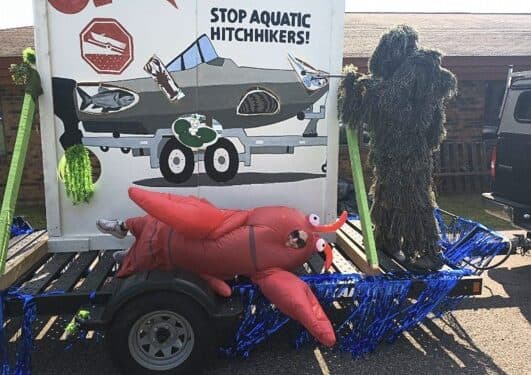
The coalition that has guarded Upper Peninsula waterways against aquatic invaders since 2009 is getting a new legal identity, a new name, and, its coordinator says, a far more competitive shot at the grant dollars that keep the work funded.
The Wild Rivers Invasive Species Coalition secured a $70,000 award from the Michigan Invasive Species Grant Program to convert to 501(c)(3) nonprofit status and relaunch as the Roots & Rivers Collaborative. The hard launch is set for June 5 at the organization's annual meeting in Crandon, Wisconsin, a concrete deadline that gives the public its first benchmark for judging whether the state's investment delivers.
Lindsay Peterson, WRISC coordinator since 2017, is expected to become executive director of the new nonprofit. Peterson called the transition "just under a new name and a little bit of a refresh," but the practical stakes are larger than the phrasing suggests. "It's something the organization has talked about for several years," she said, explaining that nonprofit status will make seeking grant funding easier and better position the coalition for growth. That matters because WRISC operates entirely on grants, having secured roughly $650,000 over the past several years to fund invasive-species projects and support local jobs. Most multi-year foundation grants and many state programs require 501(c)(3) status from applicants, meaning the $70,000 transition investment is essentially a key that opens far larger funding doors.
The award is part of $2.4 million the Michigan Invasive Species Grant Program distributed to 27 projects statewide targeting aquatic and terrestrial invasive species. The program, jointly administered by the Michigan departments of Agriculture and Rural Development; Environment, Great Lakes, and Energy; and Natural Resources, has directed more than $42 million to 328 projects since its founding.
Iron County's own waterways are addressed through a parallel grant. The Iron Baraga Conservation District, which oversees Iron, Gogebic and Ontonagon counties, received its own $70,000 MISGP award to develop early-detection and rapid-response strategies, with Eurasian watermilfoil named as the primary aquatic threat. The district's work will also focus on building regional partnerships, engaging volunteers and diversifying funding.
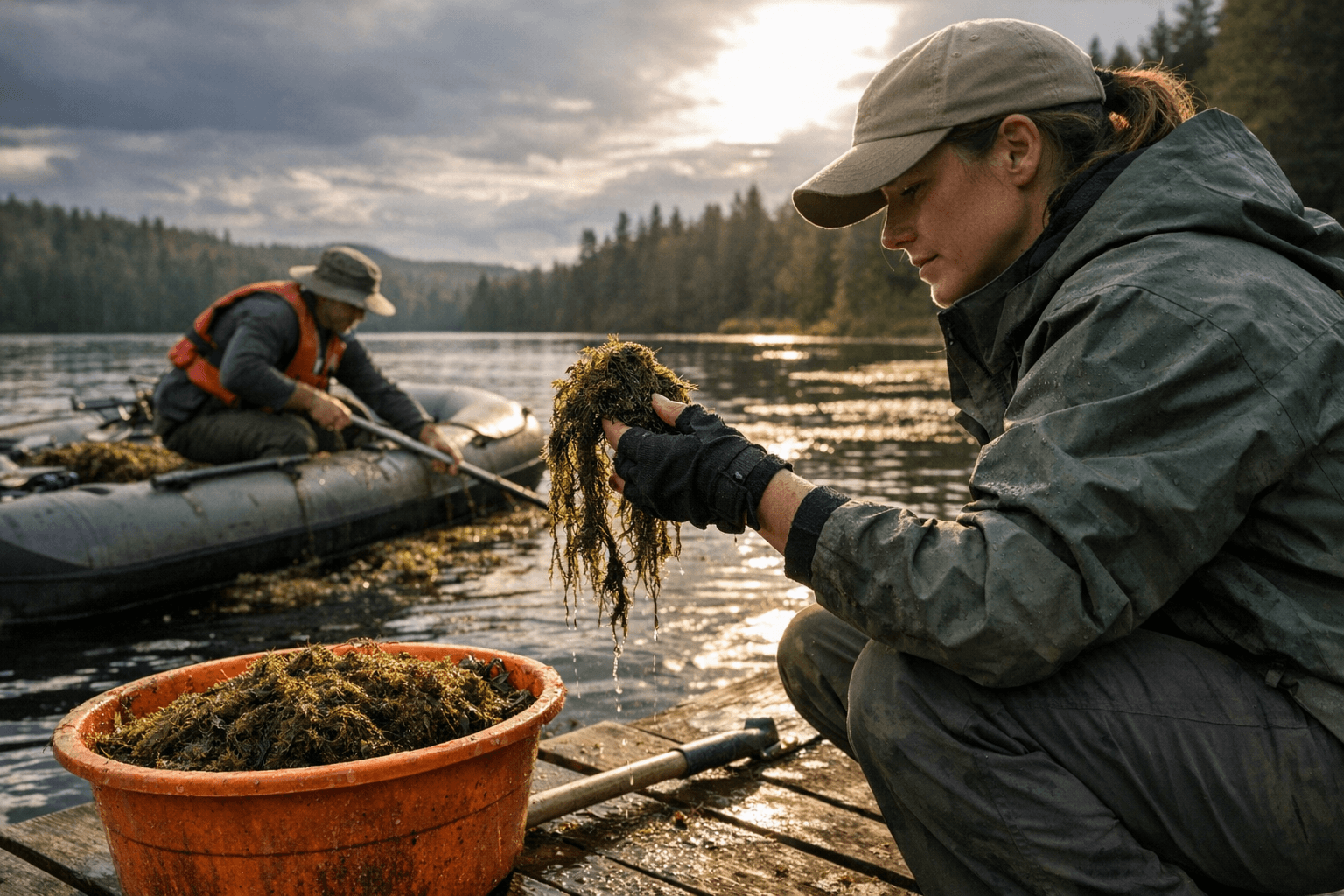
Eurasian watermilfoil is not a slow-moving problem. The aquatic plant forms dense surface mats that block sunlight, choke native vegetation, degrade fish habitat and tangle boat propellers. Once a lake is colonized, eradication is rarely possible. Zebra and quagga mussels carry the same permanence: a single boat trailer moved from an infested water body to a clean one can introduce colonies that reorganize an ecosystem within a season.
With boat-launch season underway across Iron County, anyone trailering a watercraft onto local lakes should drain all water from the boat, motor, livewells and bilge before leaving any ramp, remove visible plant material from hulls and trailers, and allow equipment to dry for at least five days before entering a different water body. Suspected aquatic invasive sightings can be reported to the Michigan DNR to trigger rapid-response action before a population establishes.
WRISC has not yet announced volunteer-recruitment timelines under the new structure, but Peterson's June 5 target sets the clock. With $70,000 committed to the organizational conversion and $650,000 in prior grants demonstrating the coalition's capacity to deliver, local governments and lakefront property owners have a reasonable basis to ask, come this summer, whether the Roots & Rivers Collaborative has expanded boat-inspection coverage, launched formal volunteer training and filed its first multi-year grant applications as a registered nonprofit.
This article was produced by Prism’s automated news system from verified source data, official records, and press releases, then run through automated quality and moderation checks before publishing. The system is built and supervised by the people who set the standards it runs under. Read our full AI policy.
Did this article answer your question?