Bayview Corner blends century-old history with South Whidbey commerce
Bayview Corner is South Whidbey’s working crossroads, where historic buildings, local shops and community space shape daily life between Langley and Freeland.
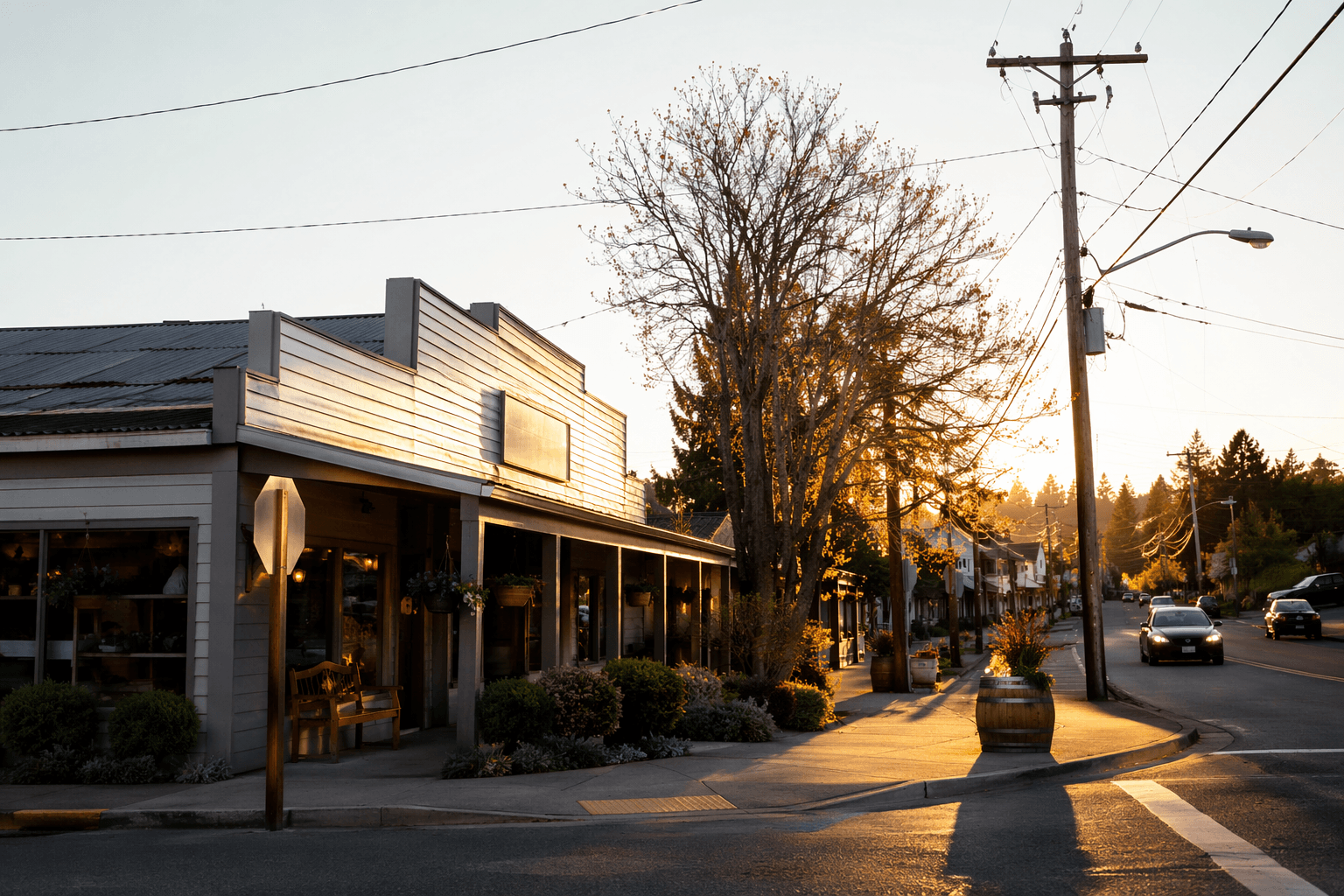
Bayview Corner is more than the turnoff from Highway 525 that many drivers pass without stopping. It is the practical middle of South Whidbey life between Langley and Freeland, a compact business district where people run errands, meet friends, shop locally and linger long enough to notice how much history is packed into a few buildings.
What gives the place its weight is the combination of commerce and continuity. Goosefoot describes Bayview Corner as the crossroads of South Whidbey’s social, economic and educational life since the 1850s, and the district still works that way today. The old structures are not museum pieces set apart from daily use. They remain part of a live local economy, with retail tenants, gathering spaces and preservation work all operating side by side.
A crossroads with deep roots
Bayview’s story begins before the current village feel took shape. Goosefoot says European settlement of Bayview began in 1860, when early pioneers arrived at the head of Useless Bay to log and settle. That early pattern, a place shaped by movement and access, still defines the corner today.
The Bayview Cash Store became the clearest symbol of that role. Goosefoot says the first store was built about 1908 by Adolph Meier, serving a growing community that needed a general store close at hand. When it burned in 1916, the area went without a general store for eight years, a gap that underscores how important a single building could be in a rural business district. In 1924, William Burk rebuilt the store at its current location, and Goosefoot says he placed it so travelers between Clinton and Langley had to pass through the crossroads.
That decision still shapes the economics of the area. Bayview Corner is not a place that depends only on destination traffic. It sits in the path of regular movement, which means its businesses benefit from the routine flow of island life as much as from visitors looking for a slower, more local stop.
How Goosefoot saved the center of the corner
The modern Bayview Corner district owes much of its current form to Goosefoot, the nonprofit that stewards much of the property. The organization began in 1999 with a parking-lot conversation between longtime South Whidbey resident and philanthropist Nancy Nordhoff and her friend Linda Moore, when the Cash Store was deteriorating and at risk of being sold. That moment turned concern into action, and it remains central to understanding why Bayview still feels like a community hub instead of a generic commercial strip.
Goosefoot bought the Cash Store and surrounding property in 2000 and spent five years renovating the building before reopening it in 2005. The organization says it did not become self-sufficient until 2014, which shows that preservation here was not a short project but a long investment. Nordhoff, who died in January 2026, is identified by Goosefoot as a co-founder, and her role is still embedded in the way the corner is discussed and managed.
That stewardship matters well beyond one historic storefront. Bayview Corner is one of those places where preserving the building also preserves the relationships around it: tenants, artists, meeting groups and the steady stream of people who rely on the district as part of everyday South Whidbey life.
The historic buildings that define the district
Four historic structures give Bayview Corner its layered character: the Bayview Cash Store from 1924, the Bayview School from 1909, a Sears kit house from 1914 and the Bayview Community Hall from 1928. Together, they make the corner feel less like a single intersection and more like a small civic district with its own timeline.
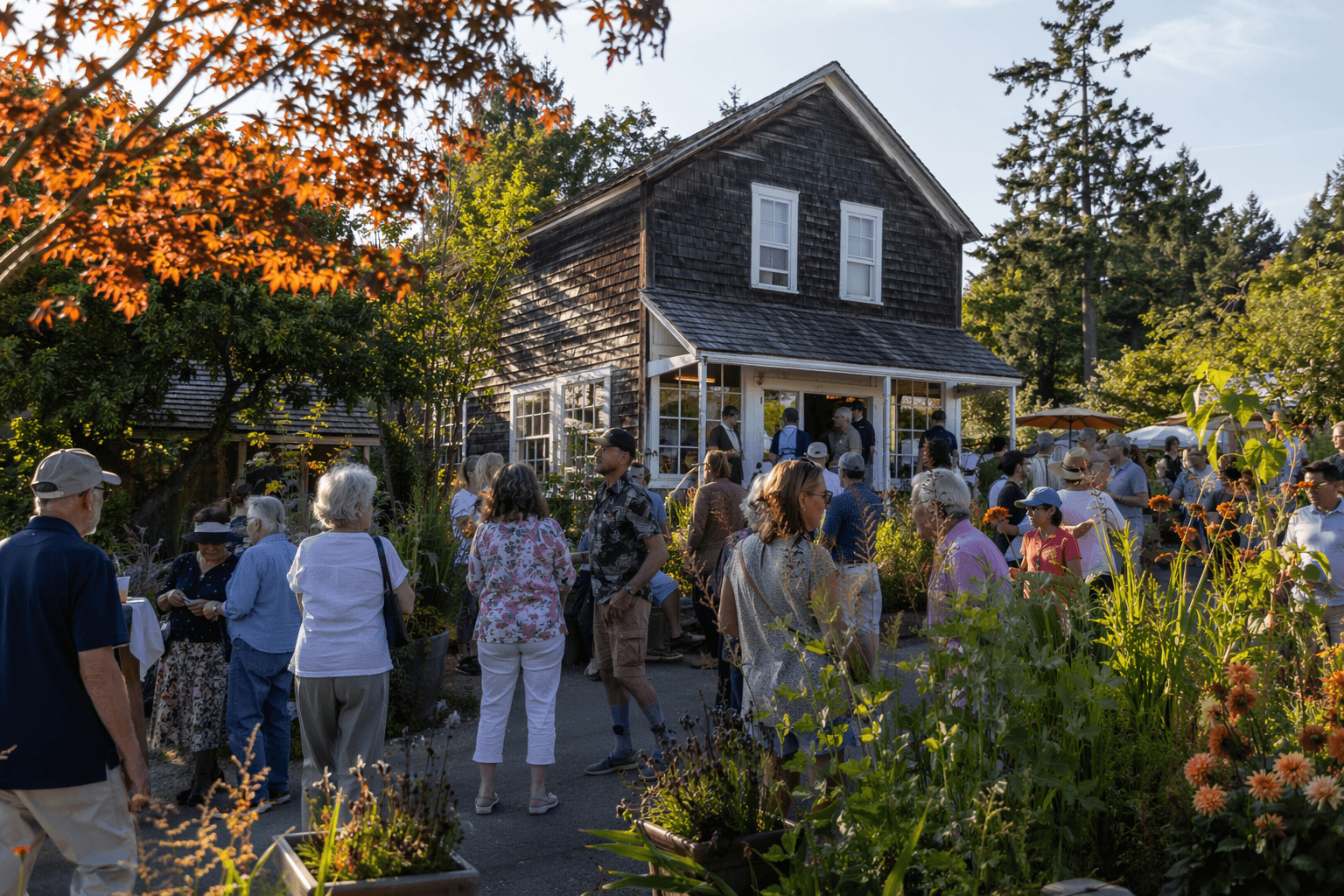
The Bayview Community Hall is especially revealing. Goosefoot says it was organized in 1927 by the Whidby Community Hall Association and financed in 1928 through 240 twenty-five-dollar bonds at 2 percent per annum. Sno-Isle Libraries adds that the hall was built in 1927 on donated land with volunteer help. Those details point to a community that repeatedly chose to build shared spaces rather than leave everything to private commerce.
That history still resonates because the hall and surrounding buildings continue to serve public life. Bayview is not only where people buy things. It is also where they gather, organize and maintain the social fabric that makes a small island economy function.
A commercial district with real local use
The Bayview Cash Store remains the retail anchor of the district. Goosefoot describes it as Bayview Corner’s retail hub and one of its main anchors, and it currently leases to Bayview Appliance & Mattress Center, Casey’s Crafts, Satin & Spur and Whidbey Island Kayaking. That tenant mix says a lot about the corner’s role in South Whidbey commerce: practical household needs, local crafts, western wear and outdoor recreation all fit under the same historic roofline.
Goosefoot also says the Bayview properties are used for more than retail. The organization curates art shows in Bayview and provides meeting space in historic buildings, reinforcing the corner’s identity as a place people actually use rather than simply admire. The Taproom@Bayview Corner adds another layer as a community-oriented gathering place in the Cash Store, giving the district a spot for conversation and social time as well as shopping.
This combination is what makes Bayview matter economically. South Whidbey depends on places that can serve residents first while still appealing to visitors looking for authenticity. Bayview Corner does both. It supports everyday errands and local commerce, but it also gives the island a recognizable place where history, retail and community life overlap in a way that cannot be replicated by a strip mall or a roadside stop.
Why Bayview still matters now
Bayview Corner’s value is not only in its age. It is in the way that age continues to shape present-day use. The district links Langley and Freeland, but it also links past and present: pioneer settlement, a rebuilt general store, volunteer-built civic space, nonprofit stewardship and active tenants all coexist in a footprint small enough to pass in seconds and rich enough to hold for hours.
That is why any change in traffic, tenancy or development at Bayview would matter far beyond the intersection itself. This is a place where the island’s economic habits and its sense of identity meet. Bayview Corner has survived because generations kept treating it as essential, and that same practical loyalty is what gives the crossroads its enduring place in South Whidbey life.
This article was produced by Prism’s automated news system from verified source data, official records, and press releases, then run through automated quality and moderation checks before publishing. The system is built and supervised by the people who set the standards it runs under. Read our full AI policy.
Know something we missed? Have a correction or additional information?
Submit a Tip