Whidbey Audubon Expands Christmas Bird Count, South Whidbey Joins
Whidbey Audubon completed its North Whidbey Christmas Bird Count on December 17 with 60 volunteers documenting 20,116 birds across 148 species, and for the first time the organization conducted a South Whidbey count centered at Goss Lake. The tallies offer a detailed snapshot of winter bird populations, informing local conservation priorities and showing strong community participation in citizen science.
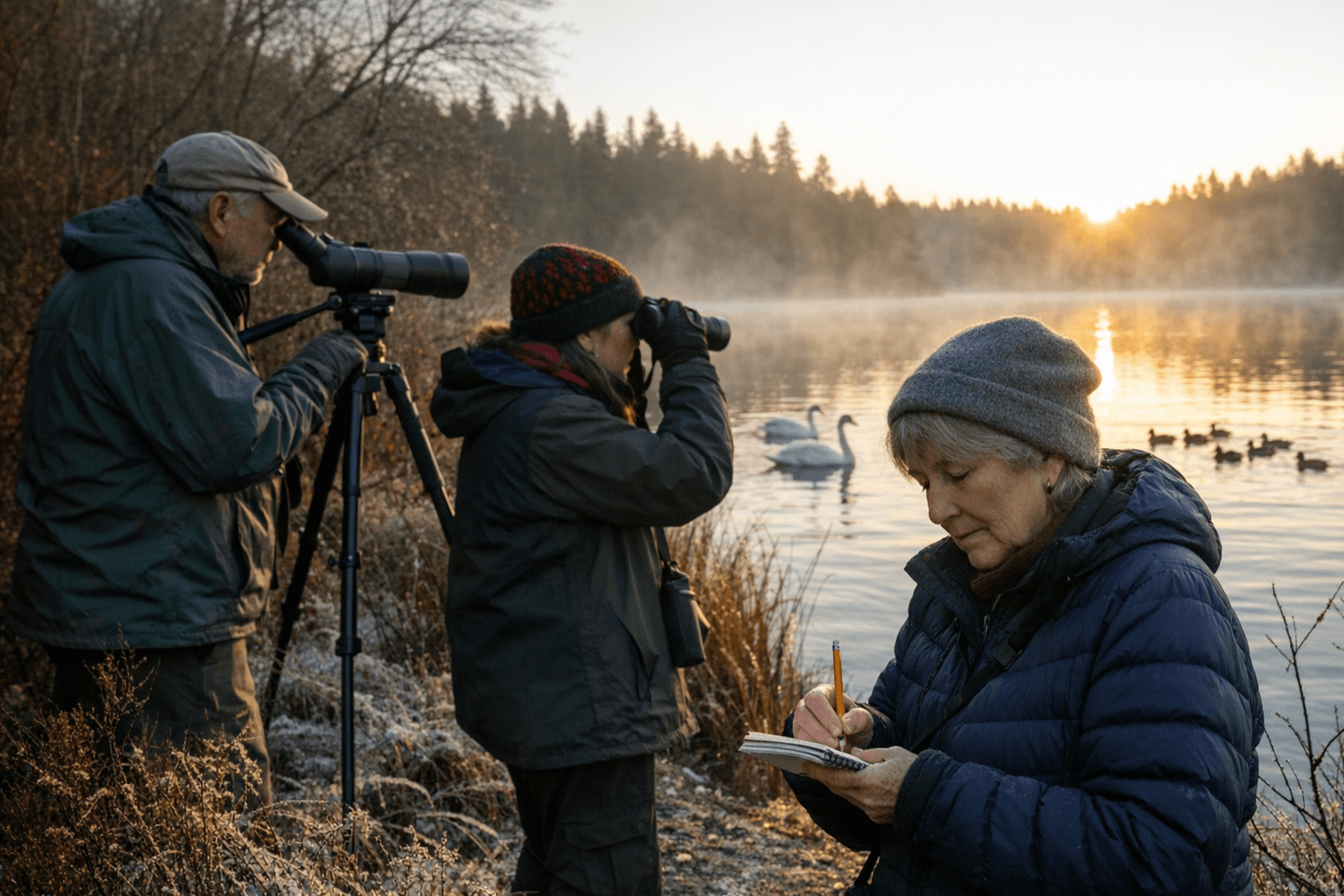
Volunteers fanned out across Whidbey Island this December to take inventory of wintering birds, producing one of the most extensive sets of local data available for land managers and residents. On December 17, 60 volunteers on North Whidbey recorded 20,116 individual birds and 148 species. For the first time, a dedicated South Whidbey circle was run on December 30, with 70 volunteers documenting more than 100 species and raising $240 in donations to support Audubon activities.
The new South Whidbey counting area is a 15 mile diameter circle centered at Goss Lake, and it includes Greenbank Farm at the northern edge and reaches down to the Clinton ferry dock at the southern border. That geography captures a mix of farmland, wetlands and shoreline habitat, helping volunteers register both inland and marine dependent species.
Counts included several notable species for Island County. Observers documented a northern shrike, western meadowlarks, and both orange crowned and yellow rumped warblers. Concentrations at Deer Lagoon were especially large, with more than 750 western grebes and 2,650 American wigeons counted at that single site. Across the island, American robins still outnumber European starlings, and the ratio of American crows to common ravens is roughly 20 to 1.
Those figures matter locally because they provide statistical evidence of habitat use and species trends during the non breeding season. High waterfowl counts at Deer Lagoon underscore the importance of estuarine and nearshore habitats for wintering birds, which has implications for shoreline management and habitat protection efforts. The continued dominance of native species like the American robin over introduced starlings is a useful indicator for conservationists tracking long term shifts in the local bird community.
The volunteer turnout and modest fundraising highlight strong community engagement in citizen science, and the expanded South Whidbey circle will improve spatial coverage for future trend analysis. For an area by area breakdown of counts visit the Whidbey Audubon website, and for species information consult the National Audubon website.
Know something we missed? Have a correction or additional information?
Submit a Tip

