Young exhibitors show months of work at Whidbey Island Fair
The fair's brightest ring sits on months of chores, training and family labor. On South Whidbey, the Kline siblings, ages 9 to 18, make that work visible.
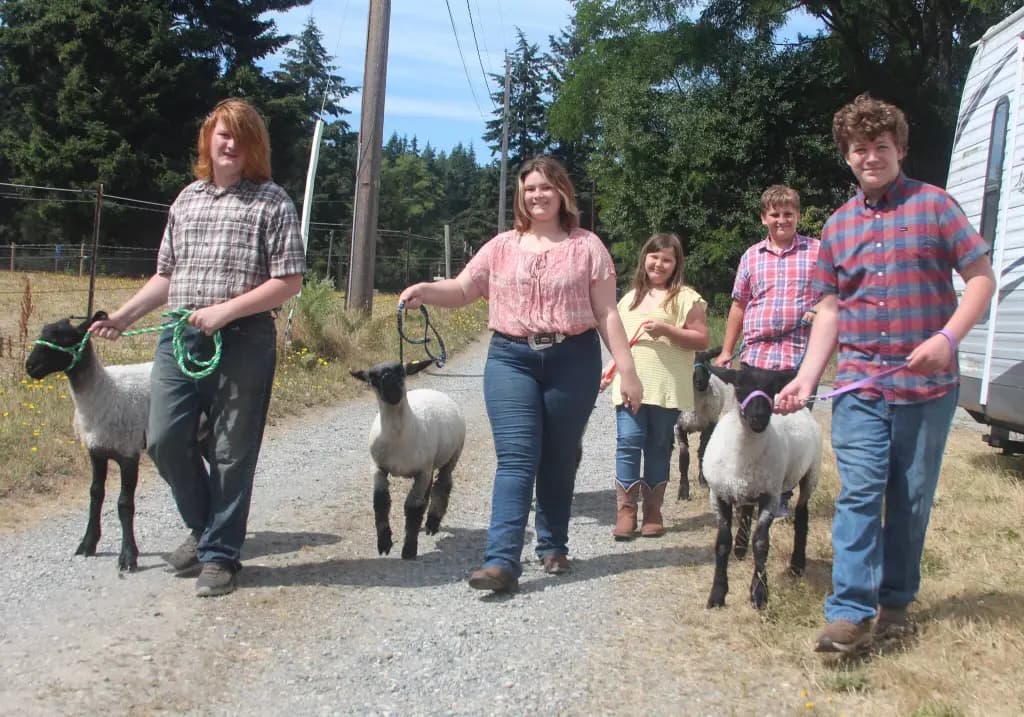
At the Whidbey Island Fair, the lambs in the ring are only the final stop in a season of early mornings, daily chores and patient training. The Kline siblings, ages 9 to 18, walking their lambs on South Whidbey, show how deeply the fair is tied to family labor, youth development and the island’s agricultural identity.
A fair built long before opening day
The Whidbey Island Fair is easy to read as a summer outing, but the work behind it starts months earlier. Young exhibitors spend that time feeding animals, cleaning pens, practicing handling and learning how to present livestock with calm control in front of neighbors and judges. The result is a public event that looks festive on the surface and disciplined underneath.
That long lead time matters on South Whidbey because the fair has already proven it is more than a one-off attraction. The fair returned for its 100th summer in 2025, a marker that places today’s youth exhibitors inside a much longer local tradition. The next Whidbey Island Fair is listed for July 23-26, 2026, keeping that cycle of work, display and community recognition moving forward.
What the young exhibitors are really learning
The most important lesson at the fair is not just how to lead an animal into a show ring. Young people involved in 4-H and similar programs are learning responsibility in a way that is immediate and measurable: animals need care every day, not just when spectators arrive. They also learn livestock handling, public speaking, sportsmanship and perseverance, skills that carry into school, work and civic life.
That is why the image of the Kline siblings with their lambs matters. It shows children and teens doing steady, unglamorous work over time, then stepping into a public setting where they must stay composed and confident. In a rural and semi-rural community like South Whidbey, that blend of skill-building and accountability is part of the fair’s value.
Why 4-H still anchors the fair culture
The Whidbey Island Fair’s youth-show structure makes that development visible. A 2023 fair premium guide included a section labeled “4-H’er of the Year,” underscoring that the fair is not just a place to compete but a place to recognize commitment and growth. In that guide, Abby Ruddell, who was 17, was named the 4-H’er of the Year.
That kind of recognition tells you how the fair sees its young people: not as extras in the entertainment lineup, but as the center of a working system that depends on mentors, parents, siblings and volunteers. Families spend time and money on feed, gear, transportation and the routines that keep animals healthy and prepared. The fair gives that investment a public stage, and the award structure shows how seriously the community takes it.
A community event with real stakes
For Island County, the fair’s youth projects are part of a wider pipeline that supports local culture. Agriculture is not only about production; it is also about teaching the next generation how to care for living things, cooperate with adults outside their household and stand in front of a crowd with poise. Those lessons help explain why fairs still draw support in places like South Whidbey, where community ties are often built through schools, barns, volunteer groups and family traditions.
The social value here is easy to miss if the fair is treated as just a weekend of rides and snacks. Young exhibitors practice discipline that many adults struggle to teach in a classroom alone. They also gain a form of belonging that comes from being counted on, and from seeing their work matter to people they know by name.
What to watch for at the 2026 fair
When the Whidbey Island Fair returns July 23-26, 2026, the livestock exhibits will carry more meaning than a quick glance suggests. Look for the signs of the months behind the scenes: animals that have been handled patiently, exhibitors who move with growing confidence and families who have spent the season making sure a child is ready for the ring.
The fair’s strongest tradition is not the spectacle itself. It is the steady, intergenerational effort that makes a young exhibitor, a lamb and a crowd of neighbors part of the same South Whidbey story.
This article was produced by Prism’s automated news system from verified source data, official records, and press releases, then run through automated quality and moderation checks before publishing. The system is built and supervised by the people who set the standards it runs under. Read our full AI policy.
Did this article answer your question?