Ben Bolt cemetery marks Jim Wells County's early ranching history
Las Calaveras Cemetery links Ben Bolt to the Valadez family, a 1864 land purchase, and Jim Wells County's early ranching economy. Its graves preserve who built the community.
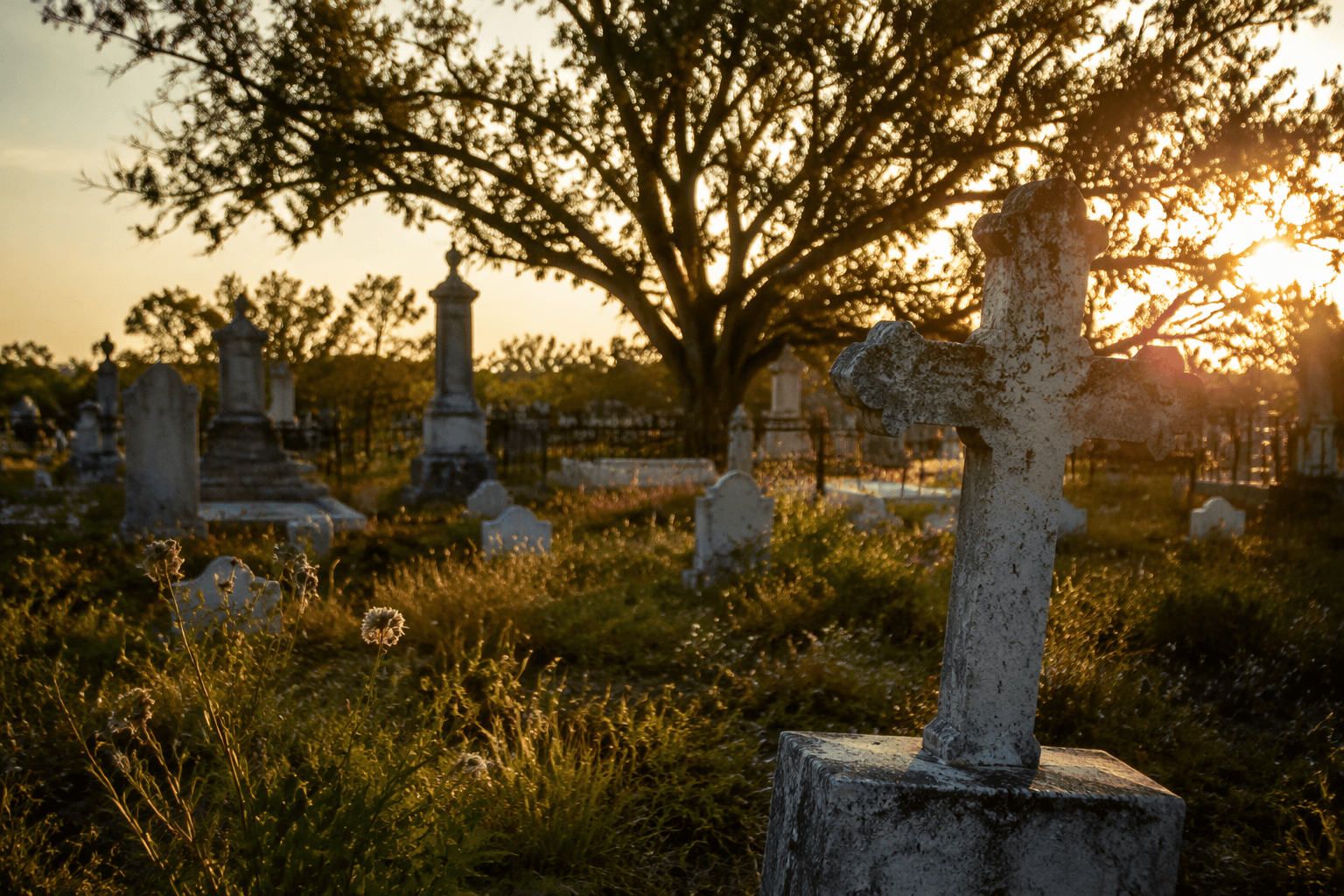
Las Calaveras Cemetery in Ben Bolt is more than a quiet burial ground. It is a surviving record of how Jim Wells County took shape, from a Tamaulipas-born landowner’s ranching operation to the families who kept using the site across generations. In a county where historic places can be scattered across ranch roads and easy to overlook, preserving a cemetery like this determines which names, migrations, and settlement patterns remain part of the public memory.
A documented historic site on FM 2508
The Texas Historical Commission Atlas places Las Calaveras Cemetery at FM 2508 in Ben Bolt, in Jim Wells County, and lists it as Marker Number 12966 with Atlas Number 5249012966. The atlas also records the site in UTM Zone 14 at Easting 595842 and Northing 3059122, details that anchor the cemetery in the county’s officially documented historic landscape rather than in local lore alone.
That matters because the site sits inside a larger story of Ben Bolt itself. Ben Bolt is on Farm Road 2508 off U.S. Highway 281, about seven miles south of Alice, and the town’s later layout does not erase the earlier ranching world that came before it. Las Calaveras remains one of the clearest physical links to that earlier period, when family landholdings and burial places often formed the backbone of local identity.
The Valadez family built a ranching footprint here
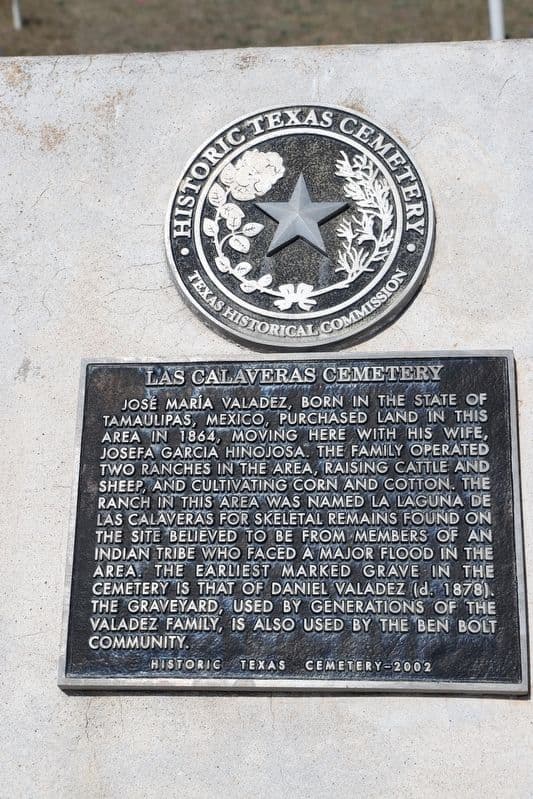
The cemetery’s history is tied closely to José María Valadez, who was born in Tamaulipas, Mexico, and purchased land in the area in 1864. He and his wife, Josefa Garcia Hinojosa, settled into a part of South Texas where land acquisition, cattle work, and small-scale farming were still defining permanence on the brush country frontier. Their story places Mexican and Tejano migration at the center of Jim Wells County’s early development, not on its margins.
The Valadez family operated two ranches in the region, raising cattle and sheep and cultivating corn and cotton. Those details show the economic base that supported early settlement here: livestock for the range, crops for subsistence and trade, and land ownership as a marker of stability. Las Calaveras Cemetery survives as a reference point for that economy, because the people buried there were tied to the very ranching system that made Ben Bolt possible.
Why the name La Laguna de las Calaveras still matters
The ranch name, La Laguna de las Calaveras, adds another layer to the site. The name refers to skeletal remains found there, believed to be from members of an Indigenous tribe affected by a major flood. That tradition ties the cemetery to environmental memory and to the longer human history of the region, long before county roads, post offices, or town plats gave the area its present shape.
That older layer is part of what makes Las Calaveras valuable to Jim Wells County. It preserves traces of Indigenous presence, flood history, Mexican settlement, and ranching all in one place. The cemetery is not just about one family’s graveyard. It is a record of how land, disaster, migration, and labor all shaped the county’s early decades.
Graves that mark a family and a community
The earliest marked grave in the cemetery is Daniel Valadez, who died in 1878. That marker gives the site a hard chronological anchor and shows how long the Valadez family’s connection to the land has endured. The cemetery was used by generations of the Valadez family and by the Ben Bolt community, which means it functioned both as a family burial ground and as a shared local cemetery.
That dual use explains why the site still carries meaning beyond the original landowning family. A place that held generations of one ranching family’s dead also served neighbors in the surrounding community, turning the cemetery into a shared archive of the area’s earliest residents. A separate Jim Wells County cemetery inventory also identifies an unnamed cemetery near Ben Bolt on the west side of U.S. 281, roughly 0.73 miles north of FM 2508, a reminder that this part of the county holds a dense and layered burial landscape.
Ben Bolt grew up around the same ground
Ben Bolt itself helps frame what Las Calaveras represents. Before the railroad, Mexican herders lived in the ranching area, which places livestock work and Hispanic settlement ahead of the town’s formal development. The community was laid out in 1904 by L. B. Collins, and a post office was established there in 1906, but those dates came after the ranching patterns already in motion.
That sequence is what gives the cemetery its importance today. The graves at Las Calaveras show the county before its town boundaries hardened, before the post office, and before Ben Bolt became the place people recognize on modern maps. For Jim Wells County, the site stands as a compact but enduring record of the families, herders, and early landowners who turned open country into a settled community.
This article was produced by Prism’s automated news system from verified source data, official records, and press releases, then run through automated quality and moderation checks before publishing. The system is built and supervised by the people who set the standards it runs under. Read our full AI policy.
Did this article answer your question?