Orange Grove history reveals roots as a Jim Wells County crossroads community
Orange Grove was branded as citrus country, but its real story is rail land, German settlement, and a barter economy that still shapes its identity today.
A town built on a practical bargain
Orange Grove’s earliest story starts with a deal that still feels familiar to any farming community: L. W. Mumme’s first store opened in 1909 and took produce as payment on accounts. That detail captures the town’s DNA as plainly as any monument can. Orange Grove was not simply platted and left to grow on its own, it was imagined, marketed, and then shaped by the realities of land, rail access, agriculture, and family enterprise.
How the name was meant to work
The name Orange Grove was chosen for a reason. According to local historical accounts, Fennell Dibrell and Max Starcke platted the streets and named them for friends after they were hired in 1908 to subdivide and sell 2,500 acres from the Ventana Ranch and Miller’s Ranch. The town’s name was meant to evoke the profitable citrus industry of the Lower Rio Grande Valley, a signal to settlers that this was a place with agricultural promise and a future tied to the land.
That mattered because naming was never just branding. It was an economic message, one designed to attract people looking for opportunity in a rail-connected ranch subdivision. The citrus reference also carried a larger regional meaning: Valley citrus had already become a symbol of growth and risk, and later freezes in 1949 and 1951 showed how quickly agricultural optimism could be tested by nature. Orange Grove’s name still reflects that mix of ambition and uncertainty.
Rail, ranch land and the first institutions
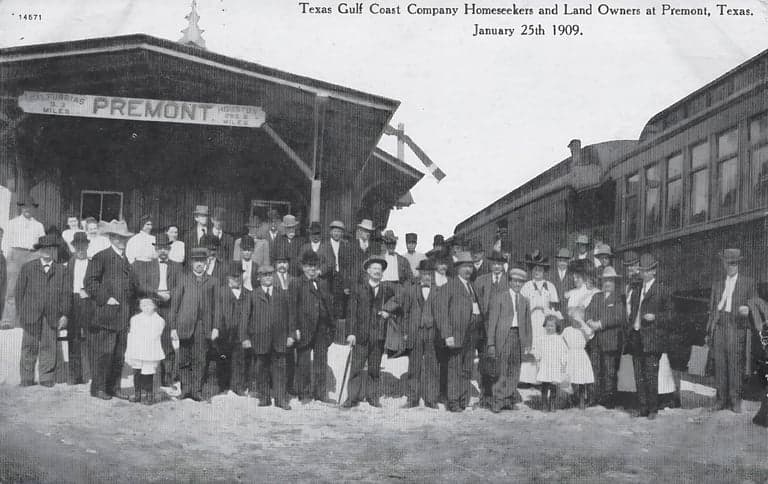
Orange Grove began in 1889, when the San Antonio and Aransas Pass Railway reached the area and George Reynolds and Hannah Compton Reynolds donated 51 acres to secure a rail stop on their Ventana Ranch. That early rail connection explains why the town never felt like an isolated settlement. It was built to sit on a path of movement, between ranch land and commerce, between farm output and the markets that needed it.
The town’s civic structure appeared quickly after that. The Orange Grove post office opened in 1909, the same year the first store began serving residents, and the Orange Grove Rifle Club organized in 1911 before getting its own hall by 1912. By 1914, the railroad’s promised line and station were finally built at Orange Grove, which helped lock the community into the transportation network it had been waiting for. In the same year, Orange Grove had an estimated population of 200, along with a bank, a cotton gin, four general stores, and a weekly newspaper, the Orange Grove Record.
That combination says a lot about what kind of place Orange Grove was becoming. A bank meant capital. A cotton gin meant farm output had become large enough to process locally. A weekly newspaper meant the town had enough shared life to sustain its own public conversation. Together, those institutions turned a rail stop into a working community.
German-Texan roots still sit underneath the town
The settlement pattern also helps explain the cultural texture of Orange Grove. Historical accounts note that the developers sold much of the land to German settlers from other Texas towns, and the predominant language in Orange Grove reportedly remained German well into the 20th century. That history still matters because it helps explain the community’s blend of family land ownership, small-scale business, and strong local memory.

Names such as Heinrich, or Henry, Duevel Sr. remain part of that local story, and the Orange Grove Museum helps keep it visible. The museum preserves artifacts, photographs, records, and memorabilia that document Orange Grove and surrounding parts of Jim Wells County, giving residents a place to connect family histories with the town’s larger development. In a place like Orange Grove, memory is not just nostalgia. It is part of how people understand who stayed, who settled, and how land passed from one generation to the next.
A small town that kept growing, then settled into itself
Orange Grove’s population history shows steady change without losing its small-town scale. The town was estimated at about 300 in 1925 and about 1,000 by 1931. It was estimated at 750 in 1939 and 906 in the early 1940s, then about 1,100 in the early 1960s, 1,000 in the mid-1970s, 1,175 in 1990, and 1,288 in 2000. The 2020 census counted 1,165 residents, while ACS-based 2024 estimates put the population at 1,089.
Those numbers show a community that has remained established even as its population has shifted. Orange Grove has never become a large city, but it has never disappeared into the map either. That stability is part of why the town still feels like a crossroads community, a place where roads, school buses, farm routes, and family errands still intersect in daily life.
Why the school district matters to that identity
Orange Grove Independent School District is one of the clearest signs that the town still functions as a local center. The district serves approximately 1,750 students at five campuses, which means Orange Grove continues to anchor surrounding rural families well beyond the town limits. Schools in a place like this do more than educate children. They help organize the rhythms of the community, from morning traffic to Friday-night gatherings to the long-term decisions families make about where to live.
That school footprint also shows how Orange Grove has adapted from its early rail-and-ranch economy into a service center for the area. The town’s original pitch was agricultural opportunity, and its present-day role still reflects that logic. It is a place built around access, whether to land, education, commerce, or county life.
Orange Grove still feels like Orange Grove
The deepest lesson in Orange Grove’s name is that identity was engineered around usefulness. Dibrell and Starcke’s streets, the Reynolds family’s rail donation, the German settlers who bought land, Mumme’s produce-for-credit store, the rifle club hall, and the newspaper all point to one thing: this was a town that grew from practical choices, not accident. Its name promised orchard-country prosperity, but its character came from the harder work of making a settlement function.
That is why Orange Grove still feels like Orange Grove. It is not just a stop on the way to somewhere else. It is a Jim Wells County community whose history was built from land, labor, and local institutions, and whose present still carries the imprint of those first decisions.
This article was produced by Prism’s automated news system from verified source data, official records, and press releases, then run through automated quality and moderation checks before publishing. The system is built and supervised by the people who set the standards it runs under. Read our full AI policy.
Did this article answer your question?