Kauai Museum preserves island history through exhibits and outreach
Kauai Museum turns a stop in Līhue into a crash course on royal lineages, plantation history, and county geography before you explore the island.

Kauai Museum gives you a working map of the island before you ever leave Līhue. Its galleries and archives connect place names, family histories, mission-era change, and plantation labor to the streets, shorelines, and communities you will see across Kauai County, Niihau, Lehua, and Kaula.
A first stop that explains the island
A visit here is useful because Kauai is not a one-note destination. The County of Kauai stretches across four islands, and the museum helps sort out why names like Wilcox, Rice, Kaumualii, Kamakahelei, and Kūhiō keep appearing in schools, roads, buildings, and public memory. The result is a visit that works as orientation, not just sightseeing.
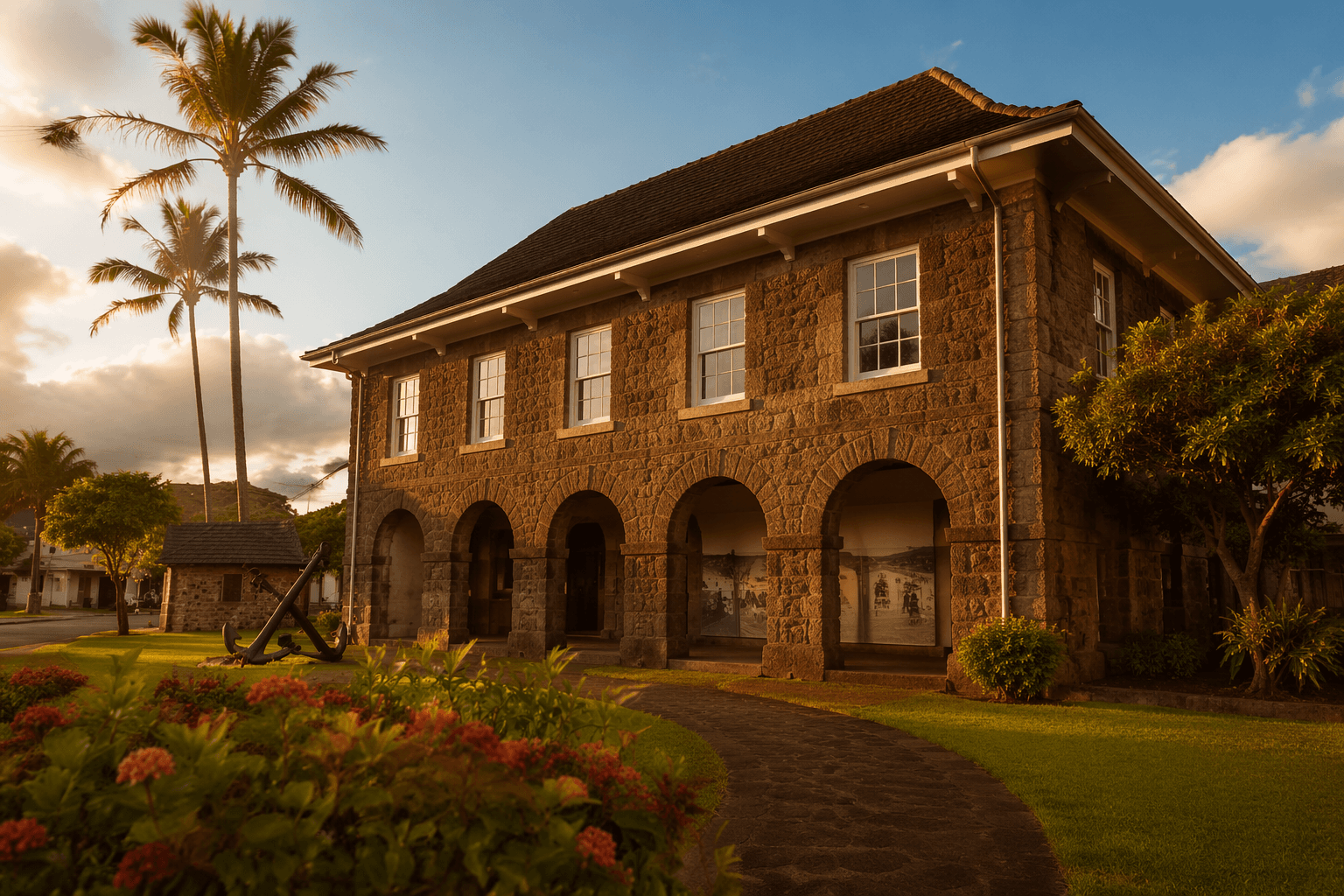
The museum also carries the story of its own making in a way that mirrors the island’s civic history. A committee formed in April 1954, with Juliet Rice Wichman as chairperson and Dora Jane Isenberg Cole as a member, raised funds for a new building next to Wilcox Library. Kenneth Roerig was selected as the architect, and the museum officially opened to the public on December 3, 1960.
Where the county’s history is organized into clear chapters
The museum’s strength is that it breaks Kauai history into practical, readable themes. Its collections and gallery pages point visitors toward ancient Kauai and Niihau, royal family heritage, missionary family history, and sugar plantation stories, giving structure to a history that is often scattered across families, sites, and oral memory. That makes it easier to understand why one neighborhood, one plantation camp, or one alii name can carry so much meaning in the county.
- Heritage Gallery
- Royal Family Heritage
- Rice Building
- Wilcox Building
- Missionary Gallery
- Plantation Village Gallery
Specific gallery names help turn that broad history into a route through the building:
Those labels matter because they point directly to the island’s main historical turns. A visitor can move from alii-era stories into missionary influence and then into plantation-era labor and migration without losing the thread.
The exhibits that give context most visitors miss
The museum’s article archive and exhibit themes are especially valuable if you want to understand the people behind the places. Topics include Prince Kūhiō, Chiefess Kamakahelei, Liholiho, and the kidnapping of King Kaumualii, which means the museum is already built around the political and family history that shaped modern Kauai. For new residents, that background helps explain why island identity is still tied to monarchy-era names and responsibilities.
The Cultural Exhibit adds a rotating layer of hands-on learning. Seasonal exhibits have included The Art of Kapa, From Kapa to Quilt, the Pupu O Niihau Learning Center, Extended Reality (XR) Beyond Kauai, and the L.E.A.P. Student Art Festival. Together, those exhibits show how the museum balances traditional craft, language, and learning with contemporary forms of education.
Digital interpretation and hands-on learning
One of the museum’s most practical strengths is that it does not treat history as sealed off from the present. In the XR project, the museum created six virtual kūpuna, a collection of virtual artifacts, three augmented-reality exhibits, and two short video animations. That mix gives visitors a way to see ancestral knowledge and material culture in formats that are easier for students and younger families to engage with.
The museum’s class listings reinforce that it is still an active teaching space. Current programming has included lei-making classes and an Ulana Ohana weaving schedule in May and June 2026, which shows that the museum is not only preserving finished objects but also passing on process, skill, and practice. For families and school groups, that matters as much as the exhibits themselves.
Why this belongs on a countywide itinerary
Kauai Museum also fits into a larger network of local history work. The Kauai Historical Society, established in 1914, says its mission is to preserve and disseminate the oral, written, and pictorial history of Kauai County. Together, the two institutions help anchor county memory in Līhue, where both residents and visitors can trace the island’s past through objects, documents, and named stories.
That broader context helps explain why a museum stop should come early in any Kauai itinerary. A gallery on royal history, a panel on plantation life, or a class in traditional weaving does more than fill an afternoon. It gives you the context to read the island more accurately when you leave the museum and head toward the coast, a town center, or a neighborhood with a name that once felt unfamiliar.
What to know before you go
The museum is at 4428 Rice St., Līhue, HI 96766, which places it in easy reach for anyone already moving through town. Current admission listings show $15 for general admission, $10 for kamaāina, $12 for seniors, $10 for students ages 8 to 17, free for children under 7, and free for active military.
One travel guide lists hours as Monday through Friday from 9 a.m. to 4 p.m. and Saturday from 9 a.m. to 2 p.m. Membership adds another layer of access, including free admission for the year, notifications about special exhibits and events, reduced fees for classes, workshops, and lectures, discounted guest admission, newsletters, and private access to exhibitions outside public hours for higher tiers.
For anyone trying to understand Kauai beyond a postcard view, the museum offers a clear place to start. Its exhibits, archives, and outreach show how the county’s royal heritage, plantation legacy, missionary history, and place-based identity are still being interpreted in Līhue and carried outward across the island.
This article was produced by Prism’s automated news system from verified source data, official records, and press releases, then run through automated quality and moderation checks before publishing. The system is built and supervised by the people who set the standards it runs under. Read our full AI policy.
Did this article answer your question?